Los Angeles sprawls across 500 square miles, and most first-time visitors waste half their trip stuck in traffic trying to figure out what’s actually worth their time. You’ve got a limited number of days and a city that stretches from the beach to the hills to downtown, so a real los angeles bucket list matters more here than almost anywhere else in the country.
This guide gives you the 30 experiences that separate a forgettable trip from one you’ll talk about for years, from the obvious icons to the hidden gems locals actually visit. We built it around what makes LA different: celebrity history, beach culture, film industry access, and neighborhoods that each feel like their own city.
You’ll find everything from Griffith Observatory sunsets to Venice Beach boardwalk stops, plus honest notes on when a guided experience saves you hours of parking and guesswork. As a local tour operator that’s run over a million tours through these exact spots, we know which stops deserve a full afternoon and which ones you can check off in fifteen minutes.
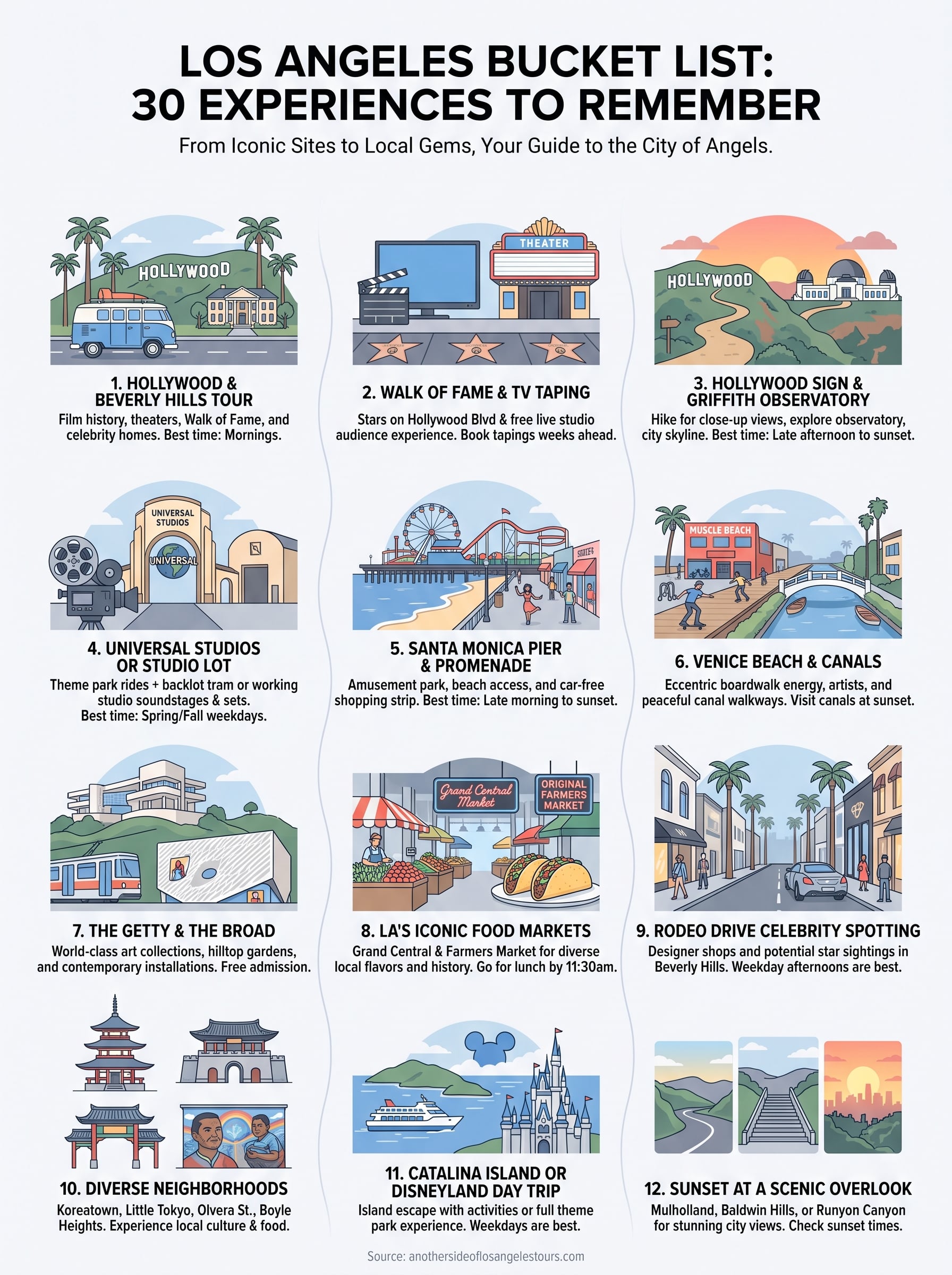
1. Take a guided tour of Hollywood and Beverly Hills
Hollywood and Beverly Hills sit right next to each other on a map, but they tell two completely different stories about Los Angeles. Hollywood gives you the film industry’s history, the theaters, and the Walk of Fame, while Beverly Hills shows you where that industry’s money actually lives. Doing both in one guided outing is the single most efficient way to knock out a huge chunk of your los angeles bucket list without burning a full day figuring out parking and routes on your own.
What it involves
A good tour threads together landmarks like the TCL Chinese Theatre, the Sunset Strip, and the mansion-lined streets of Beverly Hills, with a guide filling in the context you’d otherwise miss entirely. This is where celebrity history comes alive: which house belonged to which star, what scandal happened where, and why a particular building matters to film history. Private and small-group formats both work well here, and some operators run these as Segway tours or e-bike routes if you want to cover more ground without walking it all.
A guide turns a drive-by of mansions into an actual story about the people who built this city.
Best time to visit
Morning departures beat afternoon ones almost every time. Traffic on Sunset and through Beverly Hills gets noticeably worse after 11am, and the light for photos is better before the midday sun flattens everything out. Weekdays also move faster than weekends, when both locals and other visitors clog the same streets you’re trying to see.
Getting there
Most guided tours include pickup from your hotel or a central meeting point, which removes the biggest headache of this whole itinerary item: parking in Beverly Hills. Street parking near Rodeo Drive is scarce and metered aggressively, and rideshare drop-offs can get backed up during peak hours. If you’re driving yourself, plan to use a paid lot and expect to walk a few blocks regardless.
Estimated cost
Prices vary by group size and vehicle type, but expect a wide range depending on what you book.
| Tour Type | Typical Group Size | Approximate Price |
|---|---|---|
| Shared small-group van tour | 6-15 people | $75-$120 per person |
| Private vehicle tour | 1-6 people | $400-$900 total |
| Limousine tour | Up to 8 people | $1,000-$1,996 total |
Groups of three or more often unlock discounted per-person rates, which makes the private option more reasonable than it first looks.
2. See the Hollywood Walk of Fame and a TV taping
Every los angeles bucket list needs a stop at the Walk of Fame, if only to see how different it looks in person compared to the postcards. Over 2,700 brass stars stretch along Hollywood Boulevard and Vine Street, and pairing that walk with a free TV taping turns a quick photo op into a half-day experience you actually remember.
What it involves
Walking the boulevard takes maybe 30 minutes if you’re just spotting names, longer if you stop at the TCL Chinese Theatre’s handprints or the Dolby Theatre next door. Getting into a live taping means requesting free tickets through a show’s official audience site weeks ahead, then showing up early since seating runs first-come, first-served even with a confirmed ticket.
The stars on the sidewalk are free, but the real Hollywood story happens once you’re inside a studio audience.
Best time to visit
Early morning keeps the boulevard walkable before tour buses and street performers fill every block. Tapings mostly happen on weekday afternoons or evenings during filming seasons, roughly September through April, so check a show’s schedule before you plan your trip dates around it.
Getting there
Hollywood Boulevard sits along the Metro Red Line, and the Hollywood/Highland station drops you right at the busiest stretch of stars, which beats hunting for parking in this congested area. Studios hosting tapings, like those near Sunset-Gower or CBS Television City, usually list shuttle or parking info on the ticket confirmation.
Estimated cost
Walking the stars costs nothing, and studio tapings are free too. Budget $10-$20 if you want a paid attraction like Madame Tussauds along the same stretch.
3. Hike to the Hollywood Sign and Griffith Observatory
Nothing on a los angeles bucket list photographs better than the Hollywood Sign framed behind Griffith Observatory’s white domes. The two sit in the same park, so a single trip up into the hills covers both a genuine hike and one of the city’s best free views, without needing a car once you’re on the trail.
What it involves
Most visitors take the Griffith Park trails, like the Hollywood Sign Trail from Mt. Lee Drive, for a close-up view of the sign’s letters, then walk or drive over to the observatory for telescopes, exhibits, and the skyline view featured in countless films. Plan two to three hours if you want both the hike and time to actually explore the observatory grounds rather than rushing through.
Griffith Park gives you the sign, the skyline, and a real workout, all without spending a dollar.
Best time to visit
Late afternoon into sunset delivers the payoff here: golden light on the hills, then the city lighting up below as evening settles in. Summer weekends pack the parking lots by 10am, so weekday mornings or off-season visits make the trails far less crowded.
Getting there
Griffith Park has limited parking near the observatory, and it fills fast on weekends, so many visitors take the DASH Observatory shuttle from Vermont/Sunset instead. Trailheads for the sign sit a short drive or rideshare away from the observatory’s main lot.
Estimated cost
Hiking and observatory admission are free. Telescope viewing after dark and the planetarium show run about $10-$15 per person.
4. Tour Universal Studios or a working studio lot
Film production is the reason Los Angeles exists as a tourist destination at all, and a studio visit is where that industry stops being an abstraction. Universal Studios Hollywood gives you rides built around movie franchises plus a genuine backlot tram tour, while a working studio lot like Warner Bros. or Sony Pictures shows you soundstages and sets still in active use. Either choice belongs on a serious los angeles bucket list, especially if you want more than a photo of a studio gate.
What it involves
Universal mixes theme park attractions with a 45-minute tram ride past sets from films and shows you actually recognize. A working lot tour skips the rides entirely and instead walks you through soundstages, prop warehouses, and the New York backlot street doubled for countless productions. Some studio lot tours combine with a Hollywood sightseeing route, which saves you a separate trip across town.
A studio tour turns "they filmed that here" into something you can actually walk through.
Best time to visit
Universal gets brutal in summer, with lines stretching well past an hour for popular rides, so spring and fall weekdays run smoother. Working studio tours depend on production schedules, meaning weekday mornings often mean more active soundstages to see, though a strike or hiatus period can mean quieter, less exciting sets.
Getting there
Universal Studios sits right off the 101 freeway and has its own Metro Red Line stop, Universal City, with a free shuttle to the entrance. Warner Bros. and Sony require advance reservations and sit in Burbank and Culver City respectively, both a manageable rideshare from central Hollywood.
Estimated cost
Universal general admission runs $109-$179 per person depending on season and date. Working studio lot tours typically cost $60-$70 per person for a two-hour walking experience.
5. Spend a day at Santa Monica Pier and the promenade
Santa Monica marks the western edge of Route 66, and its pier has been pulling in visitors since 1909. This stop belongs near the top of any los angeles bucket list because it packs a beach, an amusement park, and a walkable shopping strip into one compact area, no driving required once you’ve parked.
What it involves
The Santa Monica Pier itself holds Pacific Park, a small amusement park with a solar-powered Ferris wheel that gives you ocean views from the top. Below the pier, the beach stretches wide and flat, good for a swim or just watching surfers past the pilings. A few blocks inland, the Third Street Promenade offers three car-free blocks of shops, street performers, and restaurants, easy to fill an afternoon without a strict plan.
One pier, one beach, and one pedestrian strip cover a full day without ever needing your car.
Best time to visit
Late morning through sunset works best, since the marine layer often burns off by 10am and the pier lights up nicely as the sun drops into the ocean. Weekends bring bigger crowds and street performers, while weekday visits feel noticeably calmer, especially outside summer.
Getting there
Metro’s Expo Line ends at Downtown Santa Monica station, a short walk from both the pier and the promenade, which beats fighting for beachside parking. Drivers should expect $10-$20 for nearby lots, more during summer weekends.
Estimated cost
Walking the pier and promenade costs nothing. Pacific Park rides run about $4-$8 each, or $28-$35 for an unlimited ride wristband.
6. Stroll Venice Beach boardwalk and the canals
Venice Beach delivers the eccentric, anything-goes energy that Santa Monica’s polished pier doesn’t. Muscle Beach, street performers, and vendors selling everything from tarot readings to skateboards line the Venice Boardwalk, while a few blocks inland, the quiet Venice Canals feel like a different city entirely. Both belong on any los angeles bucket list that wants more than postcard beaches.
What it involves
Walking the boardwalk itself takes an hour or so, longer if you stop to watch the outdoor gym crowd at Muscle Beach or browse the art stalls. The Venice Canals, built in 1905 to mimic their Italian namesake, sit a short walk south and offer a completely different pace: small footbridges, duck-filled water, and bungalows with actual gondolas parked out front.
Ten minutes off the boardwalk and you trade street performers for silent canals and rowboats.
Best time to visit
Morning keeps the boardwalk manageable before the afternoon crowds and street parking fills up. Sunset works well for the canals instead, when the light hits the water and most tourists have already headed elsewhere.
Getting there
Rideshare drop-off near the Venice Beach sign on Windward Avenue puts you right in the middle of the action. Metro’s Rapid 733 bus runs along Lincoln Boulevard a few blocks inland, and paid lots along Pacific Avenue fill early on weekends.
Estimated cost
Walking both the boardwalk and canals costs nothing. Renting a beach cruiser or e-bike to cover more ground runs about $15-$25 per hour.
7. Admire world-class art at the Getty and the Broad
Los Angeles has a serious art scene that gets overshadowed by its beaches and studios, and the Getty Center and The Broad prove it. Both museums offer free admission, which is rare for institutions holding this level of collection, and together they cover everything from European masterpieces to contemporary pop art. Any los angeles bucket list focused only on beaches and Hollywood is missing half the city.
What it involves
The Getty sits on a hilltop in Brentwood, and you ride a driverless tram up from the parking garage to reach galleries filled with paintings, sculpture, and gardens with sweeping views over the westside. The Broad, downtown, houses a contemporary collection built around artists like Jeff Koons and Yayoi Kusama, including her mirrored Infinity Rooms, which usually require a separate timed reservation once you’re inside.
Two free museums, one hilltop and one downtown, cover centuries of art without costing you a dime to get in.
Best time to visit
Weekday mornings work best at both museums, since weekend afternoons bring long lines, especially for the Broad’s Infinity Room. The Getty’s gardens look their best in spring when everything blooms, while the Broad’s indoor galleries make a solid rainy-day plan any time of year.
Getting there
The Getty has its own exit off the 405 freeway with a dedicated parking structure and tram connection. The Broad sits downtown near Grand Park, walkable from the Metro Red Line’s Civic Center station, with paid lots nearby for drivers.
Estimated cost
Admission to both museums is free. Getty parking runs $25 per car, while The Broad only charges extra for special ticketed exhibitions, typically $15-$25.
8. Taste local flavors at LA’s iconic food markets
Grand Central Market and the Original Farmers Market anchor two very different eras of Los Angeles food culture, and both belong on any los angeles bucket list built around eating well. Grand Central Market opened downtown in 1917 and now packs dozens of vendors selling everything from Sonoratown tortillas to fresh oysters under one historic roof. The Original Farmers Market, near The Grove since 1934, feels more like a small town square, with produce stalls sitting next to decades-old lunch counters.
What it involves
Walking either market means grazing rather than sitting down for one meal. Grab a taco here, a bowl of gumbo there, and finish with something sweet from a bakery stall, all within the same building. Both markets mix old-school LA institutions with newer vendors, so you get local flavors spanning decades of the city’s immigrant food history in a single visit.
A market crawl gets you more of LA’s food history in one lunch than any single restaurant reservation could.
Best time to visit
Lunch hours get crowded fast, so arrive by 11:30am to beat the rush at both markets. Weekday visits move quicker than weekends, when lines for popular stalls can stretch outside the building entirely.
Getting there
Grand Central Market sits downtown, walkable from the Metro Red Line’s Pershing Square station. The Original Farmers Market has its own parking lot next to The Grove, though it fills quickly on weekends, so arriving early or using rideshare helps.
Estimated cost
Budget $10-$20 per person for a satisfying grazing lunch at either market, more if you’re sampling from multiple vendors.
9. Spot celebrities and shop on Rodeo Drive
Beverly Hills built its reputation on Rodeo Drive, three blocks of designer storefronts that draw window-shoppers and serious buyers in equal numbers. Nowhere else on a los angeles bucket list blends luxury retail with genuine celebrity spotting odds quite like this stretch, since the same restaurants and boutiques that attract tourists also attract the people who live in the hills above them.
What it involves
Walking Rodeo Drive itself takes maybe 20 minutes, but the real experience is lingering at spots like the Beverly Wilshire, the two-tiered Via Rodeo, or a sidewalk table at a café where you can watch who comes and goes. Nearby streets, like Little Santa Monica and Brighton Way, hold quieter boutiques and salons that see just as much star traffic without the crowds.
The best celebrity sightings happen off the main drag, at the quiet cafés locals actually use.
Best time to visit
Weekday afternoons offer better odds for both shopping and sightings, since weekends bring heavier tourist traffic and fewer locals running errands. Late morning also gives you softer light for photos in front of the famous storefronts.
Getting there
Rideshare drop-off works best here, since street parking is scarce and the nearby public garages fill fast. The Metro Rapid 720 bus also runs along Wilshire Boulevard a few blocks south, a workable option if you’re skipping a car entirely.
Estimated cost
Window-shopping and walking cost nothing. Budget $20-$40 for coffee or a light meal at one of the people-watching spots along the way.
10. Wander LA’s diverse neighborhoods and cultures
Los Angeles holds one of the most ethnically diverse populations in the country, and that diversity shows up block by block once you leave the tourist corridors. Koreatown, Little Tokyo, Olvera Street, and Boyle Heights each carry their own food, architecture, and history, and no los angeles bucket list feels complete without at least one afternoon spent in a neighborhood that has nothing to do with Hollywood.
What it involves
Pick two or three neighborhoods rather than trying to see all of them in one day. Olvera Street preserves the city’s founding-era Mexican marketplace, Little Tokyo packs temples and mochi shops into a few dense blocks, and Koreatown runs 24-hour restaurants alongside karaoke rooms. Walking each one, rather than driving through, is what actually reveals the local culture underneath the postcard version of LA.
The real Los Angeles lives in its neighborhoods, not in the ten square miles tourists usually see.
Best time to visit
Early evening works well for Koreatown and Little Tokyo, once dinner crowds arrive and restaurants hit their stride. Olvera Street feels most alive on weekend afternoons, when mariachi music and vendor stalls fill the plaza.
Getting there
Metro’s Red and Purple Lines connect Koreatown, Little Tokyo, and Union Station near Olvera Street directly, making a transit day genuinely practical here. Boyle Heights sits a short Gold Line ride further east.
Estimated cost
Walking any of these neighborhoods costs nothing. Budget $15-$25 per person for a meal at a local restaurant along the way.
11. Take a day trip to Catalina Island or Disneyland
Sometimes the best move on a los angeles bucket list is leaving the city entirely for a day. Catalina Island sits 22 miles offshore and feels like a different country, with golf carts replacing cars and a harbor town built around diving and hiking. Disneyland, meanwhile, sits inland in Anaheim and delivers the polished theme park experience LA itself doesn’t really offer.
What it involves
Catalina means a ferry ride to Avalon, then snorkeling, kayaking, or a glass-bottom boat tour over kelp forests. Disneyland means two full parks, Disneyland and California Adventure, connected by a shared entrance plaza and Downtown Disney. Both work as a single day trip, though Disneyland rewards two days if you want both parks without rushing.
Leaving LA for a day, whether by ferry or freeway, shows you a completely different side of Southern California.
Best time to visit
Weekdays beat weekends at both destinations, and spring or fall avoid Catalina’s summer ferry crowds and Disneyland’s peak-season pricing and lines. Early ferry departures give you the most island time before the last boat back.
Getting there
Catalina Express runs ferries from San Pedro, Long Beach, and Dana Point, roughly an hour each way. Disneyland sits about 35 miles southeast of downtown LA, reachable by car, rideshare, or the Metrolink train to Anaheim.
Estimated cost
| Destination | Transportation | Admission |
|---|---|---|
| Catalina Island | $75-$90 round-trip ferry | Activities extra, $30-$80 |
| Disneyland | Free to drive, $30+ parking | $104-$224 per park ticket |
12. Catch a sunset at a scenic LA overlook
No los angeles bucket list wraps up properly without one more sunset, and this city offers overlooks well beyond the observatory crowds. Mulholland Drive cuts along the ridge separating the Valley from the Westside, with several unmarked pullouts giving you a private view of the whole basin turning orange. Baldwin Hills Scenic Overlook, south of downtown, climbs a steep staircase to a 360-degree view most tourists never find, while Runyon Canyon combines a short hike with skyline views stretching to the ocean on clear days.
What it involves
Each spot works the same way: get there roughly 30 minutes before sunset, claim a bit of space, and let the sky do the work. Baldwin Hills demands a real climb, about 160 steps, so hiking shoes help more than sandals. Mulholland requires nothing but a pullout and patience for the light to shift.
A ten-minute drive up Mulholland gets you a sunset view most visitors never know exists.
Best time to visit
Check sunset times the morning of, since they shift by nearly two hours between summer and winter. Clear winter days often deliver sharper views than hazy summer evenings, when marine layer can blur the horizon.
Getting there
Mulholland Drive requires a car, since no public transit reaches most pullouts. Baldwin Hills Scenic Overlook has a parking lot off La Cienega Boulevard, and Runyon Canyon sits walkable from rideshare drop-off near Fuller Avenue in Hollywood.
Estimated cost
All three overlooks are free. Bring your own snacks or a drink, since none of these spots have vendors nearby.
Start planning your LA adventure
Thirty stops is a lot to juggle, and trying to string them together on your own usually means losing hours to parking, traffic, and figuring out which freeway exit actually gets you there. That’s the real value of this los angeles bucket list: it shows you what’s worth your limited time, but turning it into an actual itinerary still takes planning.
Pick a handful of these that match what you actually care about, whether that’s celebrity history, beach days, or food crawls through Koreatown and Little Tokyo, and build your days around those instead of trying to force all thirty into one trip. Group nearby stops together, and let a guide handle the ones that eat up whole afternoons if you drive yourself.
If you’d rather skip the guesswork entirely, book a private Los Angeles tour and let a local guide connect the dots for you.