Los Angeles stretches across 500 square miles of coastline, canyons, and urban sprawl, and scattered throughout are famous Los Angeles landmarks that draw millions of visitors every year. From the Hollywood Sign perched above the hills to the Santa Monica Pier jutting out over the Pacific, these spots define the city’s identity. But knowing which landmarks are actually worth your time? That’s where a little local guidance goes a long way.
We’ve spent years leading tours through every corner of LA at Another Side Tours, and our guides know these landmarks inside and out, the history behind them, the best times to visit, and the details most people walk right past. This list pulls from that firsthand experience to give you 14 stops that genuinely deliver, whether you’re planning a first trip or finally getting around to exploring beyond your hotel block. Each one earns its spot not just for being recognizable, but for being worth the visit.
1. Another Side Of Los Angeles Tours
Before diving into individual stops, it’s worth knowing you don’t have to navigate the city on your own. Another Side Tours offers guided experiences across LA, so you spend more time actually seeing the city and less time wrestling with parking, traffic, and missed context at every stop.
Why this is the easiest way to cover landmarks
Los Angeles is not a walkable city by design, and getting between famous Los Angeles landmarks on your own eats up a significant chunk of your day. Another Side Tours handles the logistics and routing for you, pairing stops that make geographic sense and delivering local context at each one that no audio guide or travel blog can replicate.
A knowledgeable guide turns a quick photo stop into something you’ll actually remember long after the trip.
Best ways to experience it
The company offers multiple tour formats to match different travel styles. Options include private vehicle tours, Segway tours, e-bike rides, and limousine service. If you want flexibility, a private tour lets you ask questions, spend extra time at spots you love, and move on quickly from ones that don’t grab you.
Time and cost basics
Tours run anywhere from 90 minutes to 7 hours, depending on the itinerary. Pricing starts at $75 per person for shorter experiences and scales up to around $1,996 for premium options like limousine tours. Groups of three or more qualify for discounts, which makes this a practical pick for families or travel parties looking to split costs.
What to pair it with nearby
Most itineraries already bundle multiple neighborhoods into a single outing, so you don’t need to plan pairings manually. A single tour commonly covers Hollywood, Beverly Hills, Santa Monica, and Venice Beach, giving you solid geographic coverage without backtracking across the city.
Tips to get the most value
Book in advance, especially during summer and spring break when spots fill fast. Wear comfortable shoes even on vehicle-based tours since some stops involve walking. Ask your guide upfront about off-the-beaten-path details at each landmark; the most useful local knowledge tends to surface when you ask direct questions.
2. Hollywood Sign
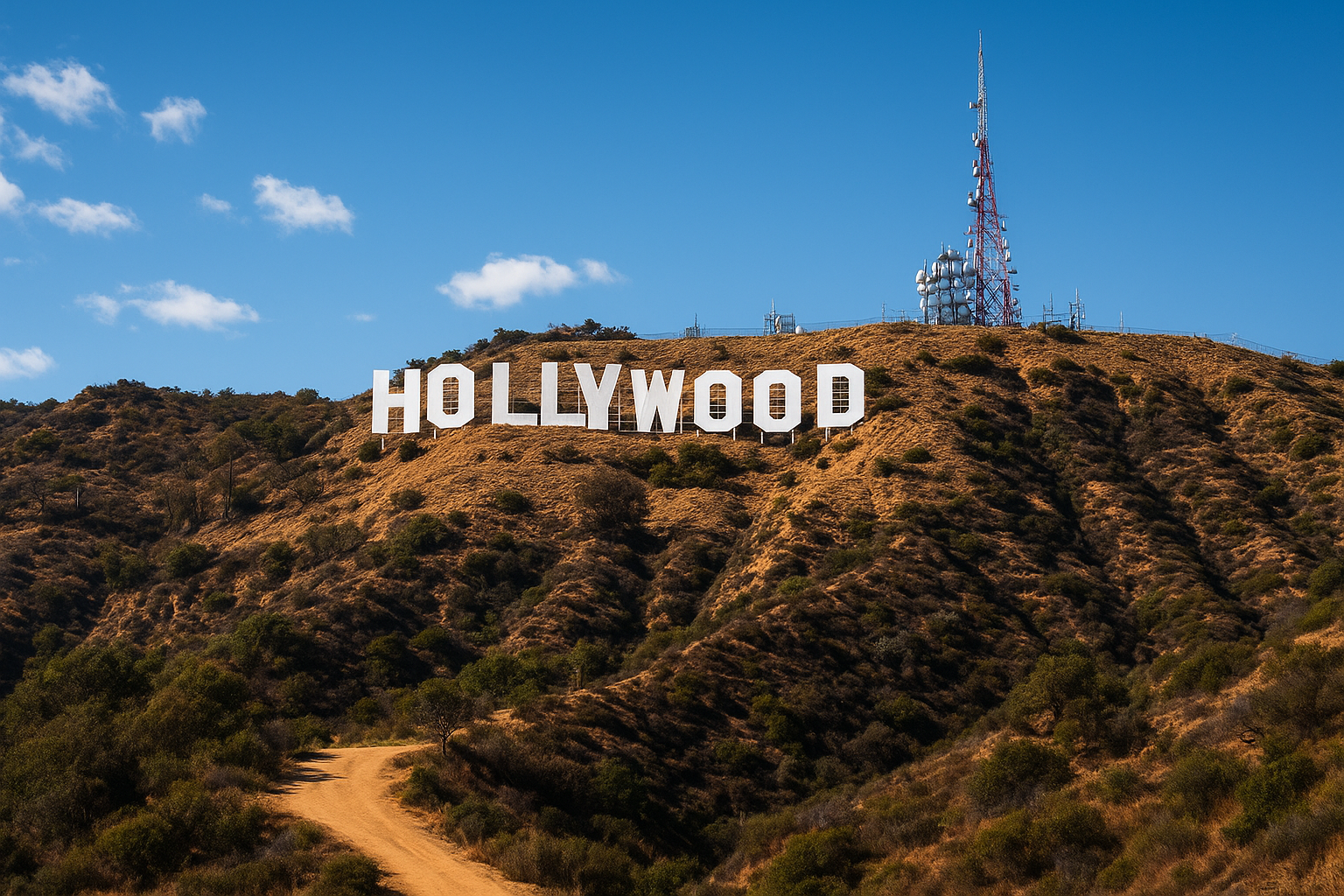
The Hollywood Sign stands as one of the most recognized symbols in the world, visible from multiple vantage points scattered across the city. No list of famous Los Angeles landmarks is complete without it making an appearance.
Why it’s famous
Originally erected in 1923 as a real estate advertisement for a development called "Hollywoodland," the sign eventually became a permanent fixture of the LA skyline. Today it represents the global entertainment industry that built this city and draws millions of visitors every year.
Few images capture the idea of Los Angeles more instantly than those nine white letters on the hillside.
Best ways to experience it
You can see the sign from several public viewpoints, with Lake Hollywood Park and the area near Griffith Observatory offering the clearest sightlines. For a closer look, trails like the Brush Canyon Trail and Mount Lee Drive lead you directly to the fence behind the sign.
Time and cost basics
Viewing the sign from a distance costs nothing. Parking near popular trailheads runs $5 to $10 depending on the lot, and some free street parking is available on weekdays if you arrive early enough.
What to pair it with nearby
Griffith Observatory sits just a few miles away and makes a natural companion stop. Runyon Canyon and Lake Hollywood Park both work well for visitors who want additional time outdoors in the hills after spotting the sign.
Tips for photos and crowds
Arrive early on weekday mornings for the fewest people and the best natural light on the letters. The Lake Hollywood Park overlook gives you a wide enough angle to fit the full sign in frame without a strenuous hike.
3. Griffith Observatory
Griffith Observatory sits on the south slope of Mount Hollywood in Griffith Park and ranks as one of the most visited famous Los Angeles landmarks year after year. The views from the terrace alone justify the trip, but the building delivers far more than a scenic overlook.
Why it’s famous
Built in 1935, the observatory has appeared in dozens of films and television shows, most notably "Rebel Without a Cause." Beyond its cinematic history, it offers free public access to interactive astronomy exhibits that make the visit genuinely educational, not just photogenic.
Best ways to experience it
Drive up to the parking area or take the DASH Observatory shuttle from Los Feliz Boulevard. Inside, planetarium shows run throughout the day for a small fee, and the rooftop telescopes open to the public on clear nights at no charge.
Time and cost basics
General admission to the building is free. Planetarium shows run $7 to $10 per person depending on the program. Budget at least 90 minutes to walk the exhibits, catch a show, and spend time on the terrace.
What to pair it with nearby
The observatory sits inside Griffith Park, so a short drive or hike connects you to Hollywood Sign viewpoints. Nearby Los Feliz Village has solid coffee shops and restaurants that work well for a meal before or after your visit.
Tips for photos and crowds
The west-facing terrace at sunset gives you the city skyline and fading hillside light in a single frame.
Arrive on a weekday afternoon to avoid the weekend crowds. Street parking fills fast, so treat the DASH shuttle as your first-choice option rather than a backup.
4. Santa Monica Pier
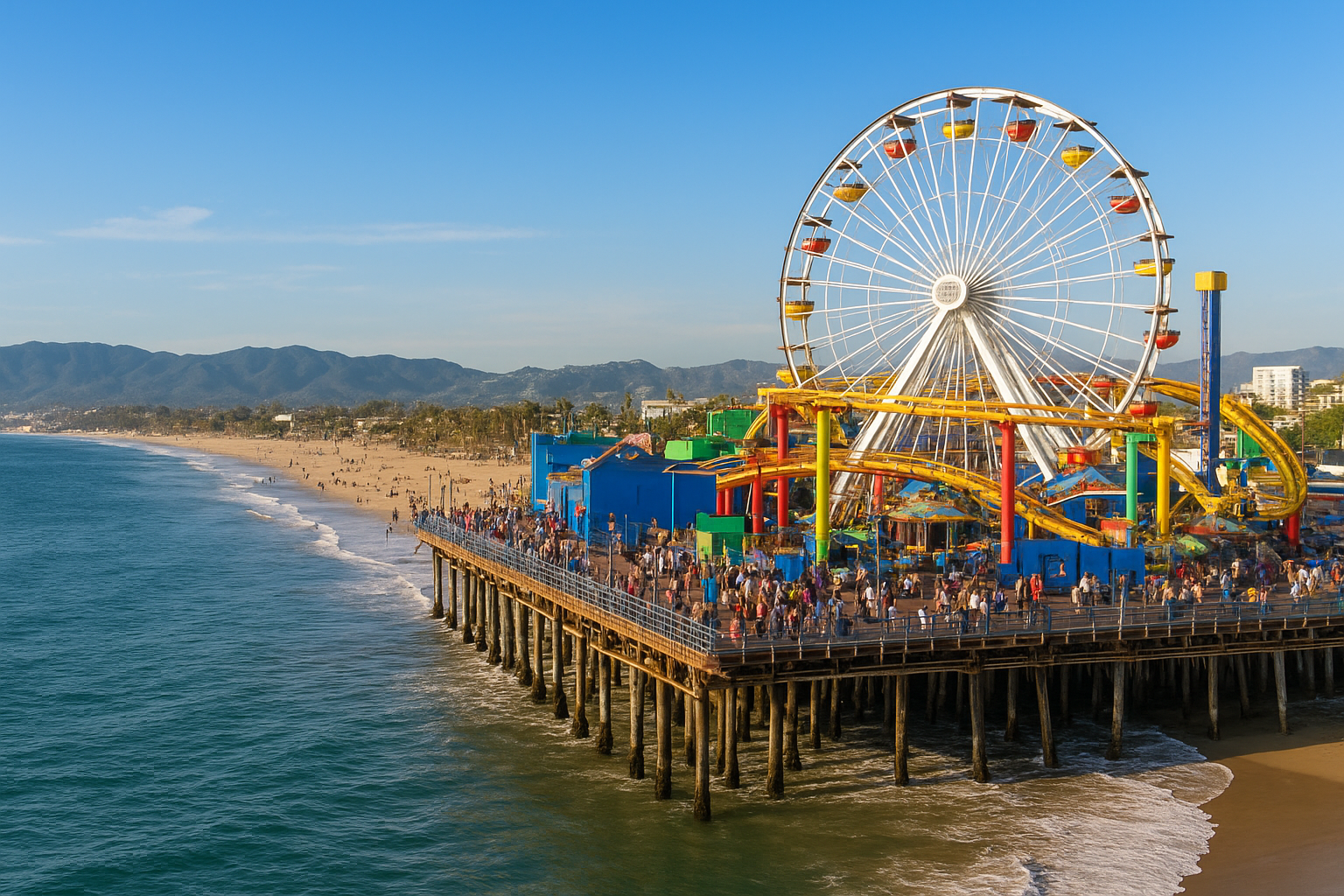
The Santa Monica Pier sits at the western edge of Santa Monica Boulevard and marks the end of one of America’s most iconic road trips, Route 66. As one of the most recognized famous Los Angeles landmarks, it draws over 10 million visitors each year and delivers a full afternoon’s worth of activity with no admission required to walk on.
Why it’s famous
Built in 1909, the pier is one of the oldest pleasure piers on the West Coast. It gained widespread recognition through films, music videos, and decades of pop culture appearances. The Ferris wheel, carousel, and Pacific Park amusement rides give it an energy that’s hard to match at any other LA landmark.
Standing at the end of the pier looking back at the Santa Monica Mountains gives you one of the most complete views of the LA coastline you’ll find anywhere.
Best ways to experience it
Walk the full length of the pier, then spend time at Pacific Park for rides or grab food at one of the seafood stands. Renting a bike along the Santa Monica Beach path before or after extends the experience without adding much cost.
Time and cost basics
Pier access is free. Pacific Park ride tickets start around $5 each, and an unlimited ride wristband runs roughly $35 for adults. Budget two to three hours to cover the pier and the surrounding beach area comfortably.
What to pair it with nearby
The Venice Beach Boardwalk sits about two miles south and connects directly via the beach bike path. Third Street Promenade, just three blocks east, offers shopping and dining if you want to extend the outing into the evening.
Tips for photos and crowds
Arrive before 11 a.m. on weekdays to beat the midday crowds. The best photo angle of the Ferris wheel against the Pacific comes from the beach below the pier looking north, especially in the late afternoon light.
5. Venice Beach Boardwalk
Venice Beach Boardwalk runs for nearly two miles along the Pacific and stands out as one of the most lively and unpredictable famous Los Angeles landmarks you’ll encounter in the city. Street performers, murals, skaters, and vendors line the path from morning until well past sunset, creating a scene that feels entirely unlike anywhere else in LA.
Why it’s famous
The boardwalk earned its reputation as LA’s open-air stage, where the city’s most unconventional personalities show up to perform, sell art, or simply be seen. The Muscle Beach Outdoor Gym, where bodybuilders train in public view, became a defining image of Southern California culture starting in the 1950s and still draws a crowd today.
Best ways to experience it
Walking the full length gives you the most complete picture, but renting roller skates or a bike from nearby vendors keeps the pace moving and covers more ground. The skate park at the north end draws serious riders and makes for a natural stopping point before you double back.
Time and cost basics
Access to the boardwalk is entirely free. Bike or skate rentals typically run $15 to $25 per hour depending on the vendor. Budget at least 90 minutes to move through the full stretch without feeling rushed.
What to pair it with nearby
Santa Monica Pier sits two miles north and connects easily via the beach path. Abbot Kinney Boulevard, just a few blocks inland, offers independent shops and restaurants worth folding into your afternoon.
The stretch between Muscle Beach and the skate park gives you the highest concentration of activity in a single pass.
Tips for photos and crowds
Weekend afternoons bring peak crowds and peak energy, so visit then if you want the full spectacle. For quieter conditions and better light, arrive on a weekday morning when the path opens up and the boardwalk murals catch the eastern sun before foot traffic builds.
6. Venice Canals
Just a few blocks from the boardwalk, the Venice Canals offer a completely different version of the neighborhood. This network of waterways feels more like a quiet European village than a major American city, which is exactly what makes it one of the more surprising famous Los Angeles landmarks on this list.
Why it’s famous
Abbot Kinney developed the canals in 1905 with the explicit goal of recreating the look and feel of Venice, Italy in Southern California. Most of the original network was paved over in the 1920s, but six canals were preserved and restored in the 1990s, and the neighborhood around them has become one of the most desirable residential areas in Los Angeles.
Walking through the canal district feels like stepping into a different city entirely, which is part of why it draws visitors who thought they already knew Venice Beach.
Best ways to experience it
A slow walking loop through the residential bridges and paths gives you the full picture. The canals run parallel to each other, so you can cross back and forth at the footbridges and cover the entire area in a single relaxed pass.
Time and cost basics
Access is completely free, and the full loop takes roughly 30 to 45 minutes at a comfortable pace.
What to pair it with nearby
Abbot Kinney Boulevard sits less than a five-minute walk away and makes a natural follow-up with its shops, cafes, and galleries.
Tips for photos and crowds
Visit weekday mornings for the calmest conditions and the best reflection light on the water.
7. Getty Center
The Getty Center sits high above Brentwood on a hilltop off the 405 freeway and delivers one of the most striking arrivals of any famous Los Angeles landmarks on this list. The architecture alone, designed by Richard Meier and opened in 1997, makes the visit worth it before you even step inside the galleries.
Why it’s famous
The Getty holds one of the most significant art collections in the United States, spanning European paintings, sculptures, decorative arts, and photographs across multiple buildings and outdoor spaces. Beyond the collection, its panoramic views of the LA Basin and Pacific Ocean give it a scale and setting no other museum in the city can match.
Few places in Los Angeles reward a slow, unhurried visit the way the Getty does.
Best ways to experience it
Take the complimentary tram from the parking structure at the base of the hill up to the main campus. Once there, move through the galleries at your own pace and spend time in the central garden, which changes with the seasons and draws as much attention as the art inside.
Time and cost basics
Admission is free, though parking costs $25 per vehicle. Budget at least two to three hours to cover the main pavilions and the outdoor spaces without feeling rushed.
What to pair it with nearby
Brentwood Village sits just a few minutes away by car and offers solid dining options for a post-visit meal.
Tips for photos and crowds
Visit on a weekday morning when foot traffic stays low and the light hits the travertine buildings cleanly before midday haze sets in.
8. LACMA and Urban Light
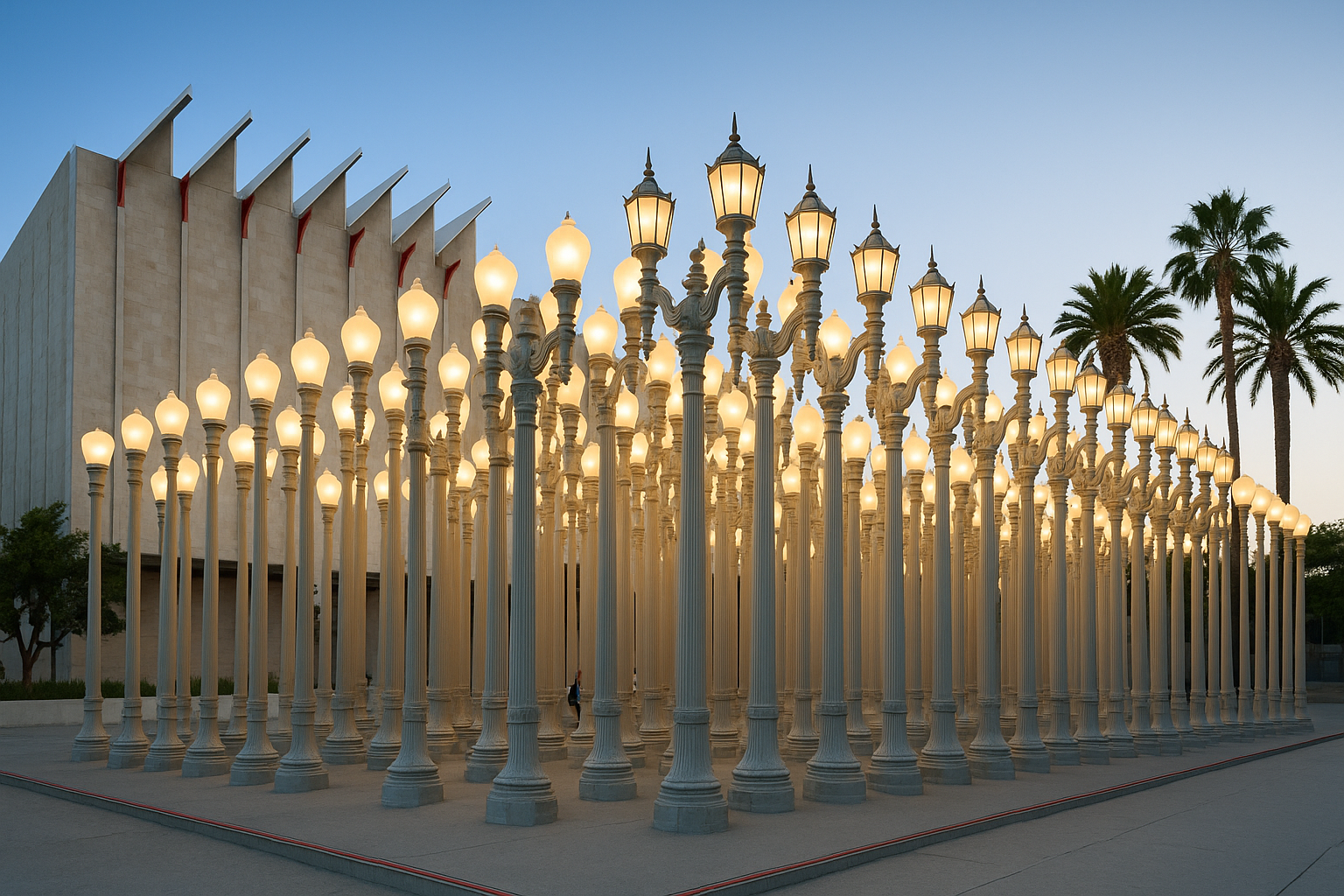
The Los Angeles County Museum of Art, known as LACMA, sits on Wilshire Boulevard in the Mid-Wilshire district and draws visitors as much for what stands outside as what hangs on the walls inside. Its Urban Light installation, a grid of 202 restored antique street lamps arranged in front of the entrance, has become one of the most photographed famous Los Angeles landmarks in the city.
Why it’s famous
LACMA holds the largest art collection in the western United States, covering more than 150,000 objects across ancient, modern, and contemporary work. Urban Light, created by artist Chris Burden and installed in 2008, turned the museum’s exterior into a public landmark in its own right that draws visitors day and night regardless of whether they step inside.
The lamp installation works just as well at dusk as it does in full daylight, giving you two distinct visual experiences from the same spot.
Best ways to experience it
Walk through the Urban Light installation at street level before heading inside. The museum’s main campus spans several buildings, so pick two or three specific collections to focus on rather than trying to cover everything in one visit.
Time and cost basics
General admission runs $25 for adults, with discounts for students and seniors. Budget at least two hours to move through a meaningful portion of the collection without rushing.
What to pair it with nearby
The La Brea Tar Pits sit directly adjacent and add genuine geological history to the visit at no extra cost.
Tips for photos and crowds
Shoot Urban Light on a weekday evening when foot traffic drops and the lamps catch the surrounding light most evenly.
9. Walt Disney Concert Hall
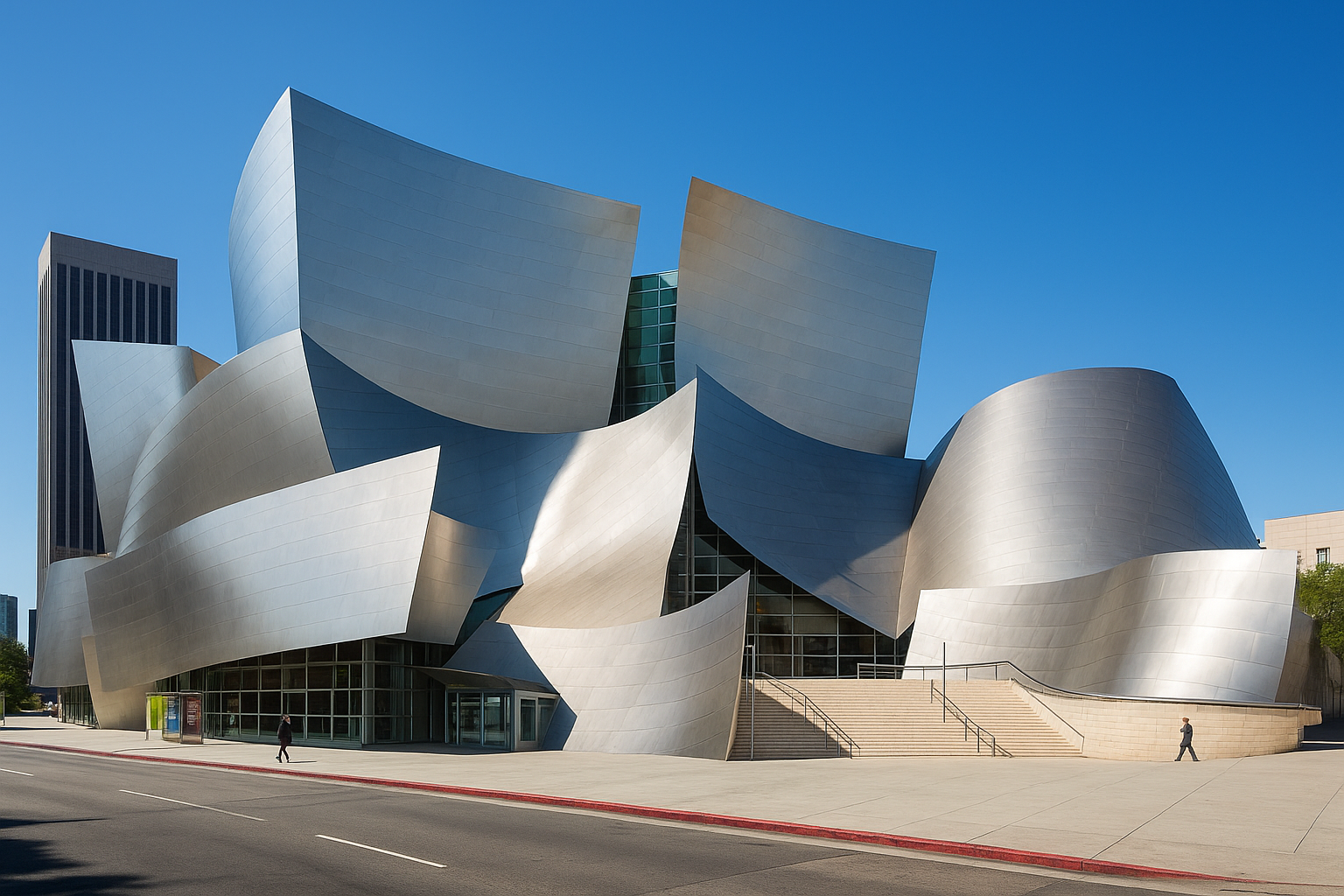
Walt Disney Concert Hall stands in downtown LA’s Bunker Hill neighborhood as one of the most architecturally striking famous Los Angeles landmarks in the city. Designed by Frank Gehry and opened in 2003, its flowing stainless steel exterior curves and folds in ways that make the building look different from every angle you approach it.
Why it’s famous
The hall serves as the permanent home of the Los Angeles Philharmonic, one of the most respected orchestras in the world. Beyond its musical reputation, the building’s deconstructivist design made it an instant architectural landmark and drew international attention the moment it opened.
Gehry’s design is one of those rare cases where the building itself becomes as compelling as what happens inside it.
Best ways to experience it
You can take a free self-guided audio tour of the building’s exterior gardens and public spaces without purchasing any ticket. For the full experience, book a performance ticket through the LA Philharmonic and hear the hall’s exceptional acoustics firsthand.
Time and cost basics
Exploring the exterior and public gardens costs nothing during open hours. Performance tickets range from $20 to over $200 depending on the program and seat location.
What to pair it with nearby
The Broad museum sits directly across the street, and Grand Central Market is just a short walk down the hill, making Bunker Hill a natural half-day combination without any backtracking.
Tips for photos and crowds
Visit on a clear weekday morning when the stainless steel panels catch the sun most sharply and foot traffic stays low around the exterior.
10. The Broad
The Broad opened in 2015 directly across from Walt Disney Concert Hall in downtown LA’s Bunker Hill district and quickly became one of the most talked-about famous Los Angeles landmarks in the city. Its exterior, covered in a textured white "veil and vault" facade, stands out immediately on Grand Avenue and signals that the experience inside will be equally distinctive.
Why it’s famous
The museum holds the personal art collection of philanthropists Eli and Edythe Broad, featuring over 2,000 works from the 1950s to the present. Artists like Jeff Koons, Cindy Sherman, and Jean-Michel Basquiat fill the galleries, and the rotating exhibitions keep the experience fresh even for repeat visitors.
The Infinity Mirrored Room by Yayoi Kusama draws longer lines than almost any other single artwork in Los Angeles.
Best ways to experience it
Free general admission makes the Broad accessible without planning around a ticket budget. Reserve your timed entry online in advance since walk-up availability runs out fast on weekends. Arriving at opening time on a weekday gives you the best shot at the Kusama room without a long wait.
Time and cost basics
Admission is free, though the Infinity Room requires a separate same-day reservation. Budget 90 minutes to two hours for a full visit.
What to pair it with nearby
Walt Disney Concert Hall sits directly across the street, and Grand Central Market is just a short walk down the hill.
Tips for photos and crowds
Book your free timed entry online at least a few days ahead to avoid arriving and finding no slots available.
11. Grand Central Market
Grand Central Market has operated continuously on South Broadway in downtown Los Angeles since 1917, making it one of the oldest and most historically grounded famous Los Angeles landmarks in the city. The market spans nearly 30,000 square feet of stalls, counters, and vendors that reflect the full cultural range of the people who have called LA home across more than a century.
Why it’s famous
The market built its reputation as a gathering place for the entire city, drawing working-class shoppers, downtown office workers, and curious visitors under one roof. Over the past decade, a wave of new vendors alongside longstanding stalls transformed it into one of the most compelling food destinations in LA without erasing its original character.
Few places in the city let you eat your way through this many food traditions in a single visit.
Best ways to experience it
Arrive hungry and without a fixed plan. Walk the full length of the market first, take in the options, then return to what caught your attention. The egg and chorizo at Eggslut and the pupusas at Sarita’s draw long lines for good reason, so factor wait times into your pace.
Time and cost basics
Entry is completely free. Budget $10 to $25 per person for food depending on how much you order. Ninety minutes covers a full walk-through plus a meal at one counter.
What to pair it with nearby
Walt Disney Concert Hall and The Broad sit just a short uphill walk away on Bunker Hill, making this a natural lunch stop between cultural destinations.
Tips for photos and crowds
Weekday mid-morning visits keep crowds manageable and give you clear sightlines for shooting the market’s historic neon signage and original tile work.
12. TCL Chinese Theatre
TCL Chinese Theatre on Hollywood Boulevard has anchored the entertainment district since 1927, making it one of the most historically layered famous Los Angeles landmarks still operating in its original form. The ornate pagoda-style architecture and the forecourt filled with celebrity handprints and footprints draw millions of visitors every year.
Why it’s famous
The theatre opened with the premiere of Cecil B. DeMille’s "The King of Kings" and has hosted major Hollywood premieres continuously ever since. The celebrity cement blocks in the forecourt, featuring signatures, handprints, and footprints from icons like Marilyn Monroe and Humphrey Bogart, turned the entrance plaza into an outdoor museum that visitors return to repeatedly.
Few spots in Hollywood connect you to the industry’s actual history as directly as crouching down next to a legend’s handprint.
Best ways to experience it
Walk the forecourt at your own pace to find specific celebrities before catching a film inside. The theatre still operates as a working cinema, so buying a movie ticket lets you experience the original interior, which remains largely intact.
Time and cost basics
Forecourt access is free and open daily. Movie tickets run $20 to $30 depending on the format. Budget 30 to 45 minutes for the forecourt alone.
What to pair it with nearby
The Hollywood Walk of Fame runs directly in front of the theatre, and Hollywood & Highland shopping center sits immediately adjacent.
Tips for photos and crowds
Arrive before 10 a.m. to shoot the forecourt without crowds blocking the cement blocks.
13. Hollywood Walk of Fame
The Hollywood Walk of Fame stretches for more than 18 blocks along Hollywood Boulevard and Vine Street, embedding over 2,700 terrazzo and brass stars into the sidewalk to honor entertainers across film, television, music, radio, and live performance. It ranks among the most visited famous Los Angeles landmarks in the country.
Why it’s famous
Launched in 1958 to celebrate the entertainment industry and revitalize the Hollywood district, the Walk of Fame has grown into a globally recognized tribute. Each star carries the honoree’s name and a category emblem, and new induction ceremonies happen throughout the year, drawing fans and press from around the world.
A star ceremony on Hollywood Boulevard draws crowds that rival any red carpet event in the city.
Best ways to experience it
Focus your walk on the Hollywood and Highland intersection, where the highest concentration of well-known names sits within a short stretch. Checking the Walk of Fame’s official map online before you arrive lets you pinpoint specific stars without wandering the full route aimlessly.
Time and cost basics
Exploring the entire route costs nothing. Budget 30 minutes to two hours depending on how many stars you stop to photograph and how many specific names you want to track down.
What to pair it with nearby
TCL Chinese Theatre sits directly on the boulevard, and Dolby Theatre, home of the Academy Awards, stands just steps away at Hollywood and Highland. Both add depth to a single Hollywood-stretch visit without requiring any extra transit.
Tips for photos and crowds
Arrive before 10 a.m. on weekdays before tour groups and street performers fill the sidewalks. Ground-level shots of individual stars give you cleaner frames than trying to capture the full crowded street from a standing position.
14. Rodeo Drive
Rodeo Drive in Beverly Hills runs just three blocks but carries enough global name recognition to place it firmly among the most referenced famous Los Angeles landmarks in popular culture. The street built its reputation on luxury retail, and that reputation holds today.
Why it’s famous
Rodeo Drive became the address for high-end fashion in North America during the 1970s and 1980s, attracting flagship stores from Gucci, Chanel, Louis Vuitton, and Cartier along its short stretch. Films like "Pretty Woman" cemented its image in the broader public imagination and drew visitors who had never set foot in Beverly Hills.
Best ways to experience it
Walk the full three-block stretch from Wilshire Boulevard north to Santa Monica Boulevard and take your time looking at both sides. You don’t need to spend anything to absorb the architecture, storefronts, and manicured landscaping that give the street its distinctive look.
The open-air Via Rodeo, just off the main strip, gives you a quieter version of the same atmosphere with slightly fewer crowds.
Time and cost basics
Window shopping costs nothing, and a full walk takes about 30 minutes. Budget more time if you plan to browse inside any of the flagship stores.
What to pair it with nearby
Beverly Gardens Park runs along Santa Monica Boulevard and adds a relaxed green stretch to the visit. A few nearby spots extend the outing without requiring extra transit:
- Greystone Mansion for historic architecture a short drive north
- Beverly Hills City Hall for an architectural detour on foot
Tips for photos and crowds
Visit on a weekday morning before midday foot traffic builds. Shooting from the Wilshire Boulevard end looking north gives you the full street perspective with the cleanest available light.
Plan your LA landmark game plan
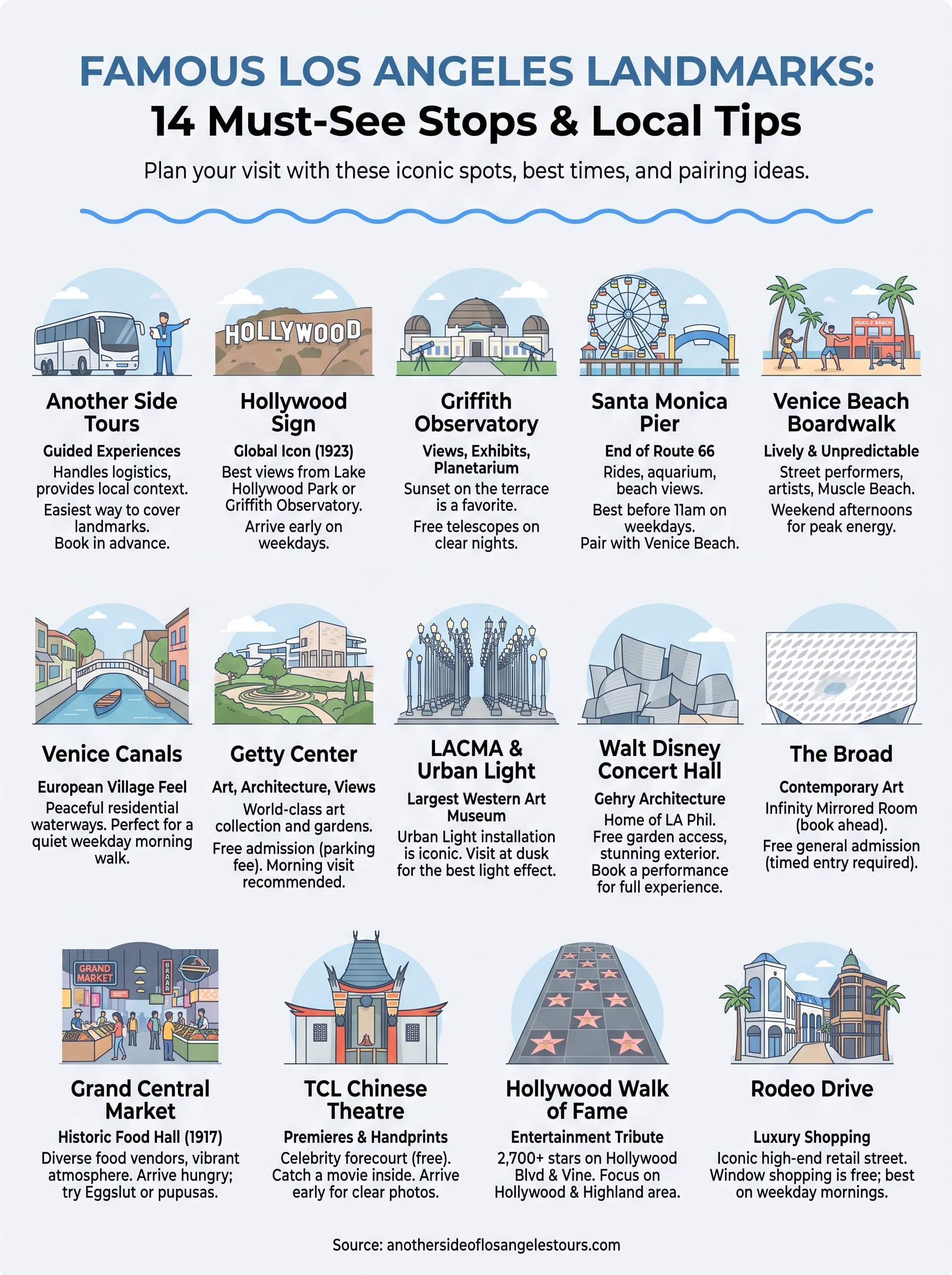
Fourteen famous Los Angeles landmarks sounds manageable until you factor in the city’s size, traffic patterns, and the time it takes to actually absorb each stop rather than just photograph it. The key is grouping by geography: pair the Hollywood Sign with Griffith Observatory, bundle Grand Central Market with The Broad and Walt Disney Concert Hall, and connect Santa Monica Pier with Venice Beach and the canals in a single coastal afternoon.
You don’t need to rush through all fourteen stops in one trip. Picking six to eight stops across two or three days gives you enough time at each location to move at a pace that makes the visit stick. If you want someone else to handle the routing, logistics, and local context so you can focus on the experience itself, book a guided Los Angeles tour and let a local expert handle the rest.