Los Angeles sprawls across 500 square miles, and trying to see it all on your first visit is a recipe for frustration. The good news: you don’t need to see everything. You need to see the right things. This guide covers 14 iconic Los Angeles landmarks that give first-time visitors a real sense of what makes this city unlike anywhere else, from world-famous monuments to spots that most tourist itineraries overlook entirely. If you’ve been searching for Los Angeles landmarks worth your limited time, or the famous LA landmarks everyone talks about, this list covers both.
At Another Side Tours, our local guides have spent years helping visitors cut through the noise and experience LA with context, not just a checklist. We’ve used that firsthand knowledge to put together a list that balances the must-sees with places that actually surprise people. Whether you’re planning a self-guided day or considering a private tour with our team, these 14 landmarks will give your trip shape and purpose.
Below, you’ll find each landmark with practical details, what makes it worth your time, when to go, and what to look for once you’re there. No filler, no fluff, just the spots that earn their reputation.
1. Another Side Of Los Angeles Tours
Before diving into individual landmarks, it’s worth knowing that Another Side Of Los Angeles Tours gives you the fastest way to make sense of this city. Navigating LA alone means dealing with traffic, parking, and zero context for what you’re actually looking at. A guided tour solves all three problems at once.
What it is
Another Side Tours is a licensed, professional tour operator based in Los Angeles that has completed over one million tours. The company offers private, semi-private, and small group sightseeing tours of Los Angeles across the city’s most famous neighborhoods and attractions. Transportation options include private vehicles, Segways, e-bikes, and limousines, depending on which experience you book.
Why it’s a smart first stop for first-timers
Los Angeles doesn’t hand you its best moments. You have to know where to look, when to arrive, and what the story is behind what you’re seeing. Another Side Tours guides are local experts who give you that context in real time, covering iconic los angeles landmarks alongside hidden spots most visitors never find.
Booking a guided tour on day one of your trip reorients your entire visit. You leave with a mental map and a shortlist of places worth returning to on your own.
Best way to do it
Book a private or semi-private tour rather than a large group option. Smaller tours allow your guide to adjust the route based on your interests and pace. The company offers everything from 90-minute neighborhood walks to full-day custom experiences that cover multiple parts of the city.
How much time to budget
Tours range from 90 minutes to 7 hours, depending on the itinerary you choose. For a first visit, a half-day tour (3 to 4 hours) covers enough ground to orient you without exhausting you before the rest of your trip.
What it costs
Prices start at $75 per person for basic tours and go up to $1,996 for premium limousine experiences. Group discounts apply for parties of three or more, which makes this a cost-effective option if you’re traveling with family or friends.
Tips for first-time visitors
Book in advance, especially if you’re visiting between May and September when tour slots fill up quickly. Wear comfortable shoes regardless of which tour type you choose, and bring water and sunscreen since most tours spend significant time outdoors.
2. Hollywood Sign
The Hollywood Sign is one of the most recognized iconic Los Angeles landmarks on the planet, and it deserves a spot near the top of your itinerary.
What it is
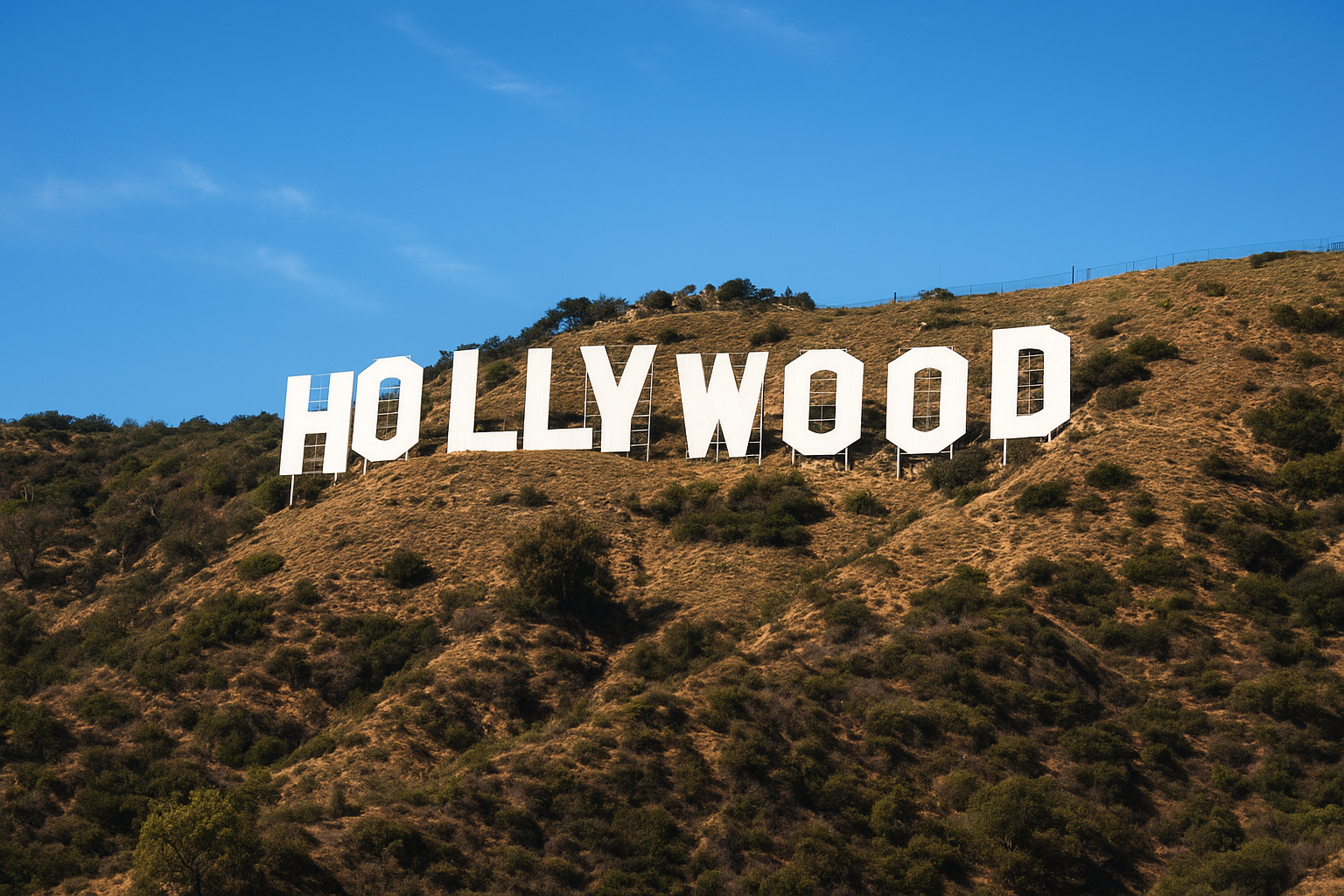
Perched on Mount Lee in Griffith Park, the sign stands 45 feet tall across nine letters. It was originally built in 1923 to advertise a real estate development called Hollywoodland, with the last four letters eventually removed over the following decades, one of many things to know about the Hollywood Sign.
Why it’s iconic
Few structures appear in more films, TV shows, and photographs than this one. Seeing it in person gives you a sense of scale and history that no photo fully captures.
Standing beneath these hills and looking up at those letters puts into perspective how much of modern culture traces back to this stretch of Southern California.
Best way to visit
Your best views come from Griffith Observatory or the Mulholland Drive overlook rather than hiking to the sign’s base, where you can’t read the letters clearly. Lake Hollywood Park also offers a strong straight-on angle with easier parking.
How much time to budget
Budget 30 to 60 minutes for a viewpoint visit. Add an extra hour if you plan to hike one of the trails that brings you close to the letters.
Costs, tickets, and reservations
Viewing the sign is completely free from all public overlooks. Parking at Lake Hollywood Park fills up fast on weekends, so plan to arrive early.
Tips for first-time visitors
Arrive before 10 a.m. for the best light and smaller crowds. Bring water and sunscreen if you plan to hike any of the surrounding trails.
3. Griffith Observatory
Sitting on the southern slope of Mount Hollywood, Griffith Observatory is one of those iconic Los Angeles landmarks that rewards you from the moment you arrive. The views alone justify the trip.
What it is
The observatory is a public facility run by the City of Los Angeles, opened in 1935. It houses planetarium shows, telescopes, and exhibits on astronomy and space science. The building is a striking Art Deco structure that has appeared in dozens of films, most famously Rebel Without a Cause.
Why it’s iconic
The views from the observatory deck give you one of the best panoramic views of Los Angeles, from downtown to the Pacific Ocean. The building also sits at a prime angle to the Hollywood Sign, making it the best single viewpoint in the city.
No other spot in LA gives you the Hollywood Sign, the city skyline, and the ocean in a single glance.
Best way to visit
Take the DASH Observatory shuttle from Los Feliz rather than driving up, especially on weekends when parking fills fast. Walking trails from Griffith Park also bring you directly to the building if you prefer arriving on foot.
How much time to budget
Budget two to three hours to explore the exhibits, walk the grounds, and catch a planetarium show. Add extra time if you plan to hike up from the park below.
Costs, tickets, and reservations
Building entry is completely free. Planetarium show times and ticket prices run about $10 per adult, and you can book tickets in advance through the observatory’s official website.
Tips for first-time visitors
Arrive on a weekday morning for the smallest crowds and clearest views. The observatory is closed on Mondays, so plan around that. Evening visits offer spectacular city lights, but parking becomes extremely limited after dark.
4. Santa Monica Pier
The Santa Monica Pier stretches out over the Pacific Ocean at the western end of Route 66, and it delivers one of the most satisfying views you’ll find among all the iconic Los Angeles landmarks on this list.
What it is
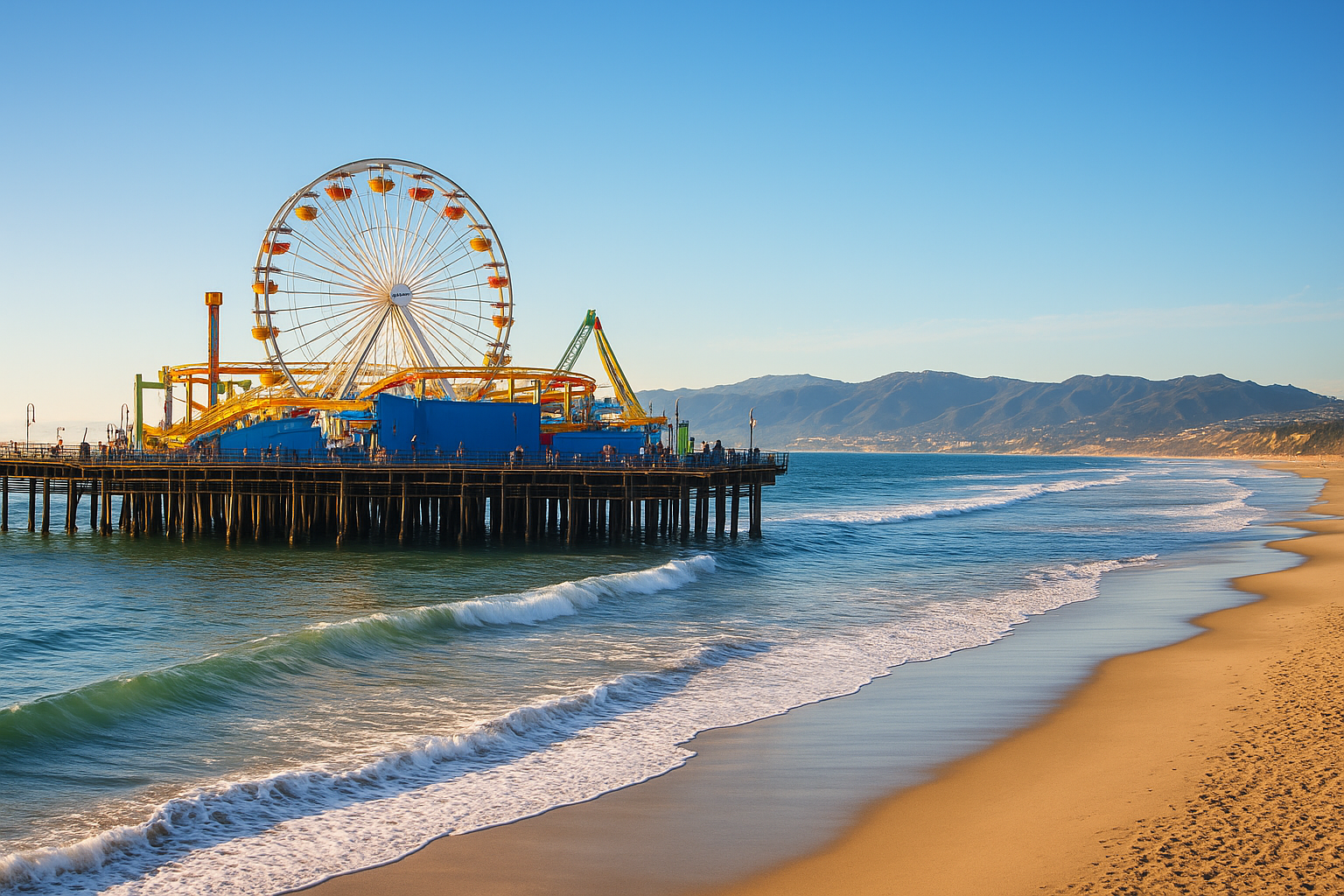
Built in 1909, the pier is a public landmark at the foot of Colorado Avenue in Santa Monica. It holds a small amusement park called Pacific Park, an aquarium, restaurants, and a solar-powered Ferris wheel that illuminates the coastline at night, along with plenty of other rides, food, and views on the pier.
Why it’s iconic
The pier marks the official western terminus of Historic Route 66, which alone makes it worth a stop. That title carries extra weight in 2026, the centennial year of Route 66. It also appears in dozens of films and TV shows, and the view back toward the Santa Monica Mountains from the end of the pier is one of the best in the city.
Standing at the end of the pier and looking back at the coastline shows you how dramatically LA shifts from dense urban sprawl to open beach in just a few miles.
Best way to visit
Walk from Santa Monica State Beach along the waterfront path and approach the pier from the sand. This gives you the full visual impact of the structure before you step onto it.
How much time to budget
Plan for one to two hours at the pier itself. Add another hour if you want to continue along Ocean Front Walk toward Venice Beach.
Costs, tickets, and reservations
The pier is free to enter. Rides at Pacific Park are priced individually, with most running $5 to $10 per ride.
Tips for first-time visitors
Visit on a weekday afternoon to sidestep peak weekend crowds, and check when the pier is least crowded by season before you go. Parking along Ocean Avenue fills fast, so the public parking structure on 2nd Street is your best option.
5. Venice Beach and the Boardwalk
Venice Beach sits just south of Santa Monica and delivers a completely different energy from anything else on this list of iconic Los Angeles landmarks. It’s loud, colorful, and entirely its own thing.
What it is
Venice Beach is a 1.5-mile oceanfront neighborhood built around a boardwalk known as Ocean Front Walk. The area was developed in 1905 as a resort town modeled after Venice, Italy, complete with canals. Today, it draws street performers, artists, bodybuilders at Muscle Beach, skaters, and vendors selling everything from art to incense.
Why it’s iconic
Venice captures a side of LA that no other neighborhood replicates. The open-air art walls, skate park, and Muscle Beach gym have appeared in films and TV for decades, and the boardwalk itself functions like a street fair that never ends.
If you want to understand why people move to Los Angeles from all over the world, spend an afternoon walking this boardwalk.
Best way to visit
Park at the beach lot on Venice Boulevard and walk north along the boardwalk. This route takes you past the skate park, the art walls, and the vendor stalls before connecting to the Santa Monica Pier path, with plenty of other Venice Beach stops worth making along the way.
How much time to budget
Plan for one to two hours on the boardwalk. Add extra time if you want to walk the Venice Canals, a quiet residential neighborhood just a few blocks inland that most visitors miss entirely.
Costs, tickets, and reservations
Venice Beach is completely free to visit. Beach parking lots charge $3 to $15 depending on the time of day and season.
Tips for first-time visitors
Come on a weekend afternoon when vendors and the boardwalk’s most legendary street performers are at full capacity. Keep a close eye on your belongings, and leave valuables locked in your car rather than carrying them onto the boardwalk.
6. Getty Center
The Getty Center sits high above Brentwood on a ridgeline that gives it views stretching from downtown Los Angeles to the Pacific, and the building itself is as impressive as anything inside. This is one of those iconic Los Angeles landmarks that surprises first-time visitors who expect a standard museum experience.
What it is
The Getty Center is a world-class art museum and cultural campus designed by architect Richard Meier and opened in 1997. It holds an extensive collection of European paintings, sculptures, decorative arts, and photographs, along with rotating exhibitions throughout the year.
Why it’s iconic
Few of the top museums in Los Angeles combine architecture, landscape design, and fine art at this level. The travertine buildings, the central garden designed by Robert Irwin, and the panoramic city views create an experience that goes well beyond looking at paintings on walls.
The Getty is free to visit, which makes it one of the most accessible cultural institutions of its scale in the entire country.
Best way to visit
Park at the base of the hill and ride the complimentary tram up to the museum entrance. This approach gives you a gradual reveal of the campus that adds to the overall impact.
How much time to budget
Plan for two to three hours to cover the main galleries and the gardens without rushing. Add extra time if you want to explore the rotating special exhibitions.
Costs, tickets, and reservations
Museum admission is completely free. Parking costs $25 per vehicle, though it drops to $15 after 3 p.m.
Tips for first-time visitors
Book your parking reservation in advance through the Getty’s official site, especially on weekends. Arrive early to secure a spot and beat the midday crowds.
7. LACMA and Urban Light
The Los Angeles County Museum of Art, better known as LACMA, sits on Wilshire Boulevard in the Miracle Mile district and pulls double duty as one of the most visited iconic Los Angeles landmarks in the city. The outdoor installation alone makes it worth a detour.
What it is
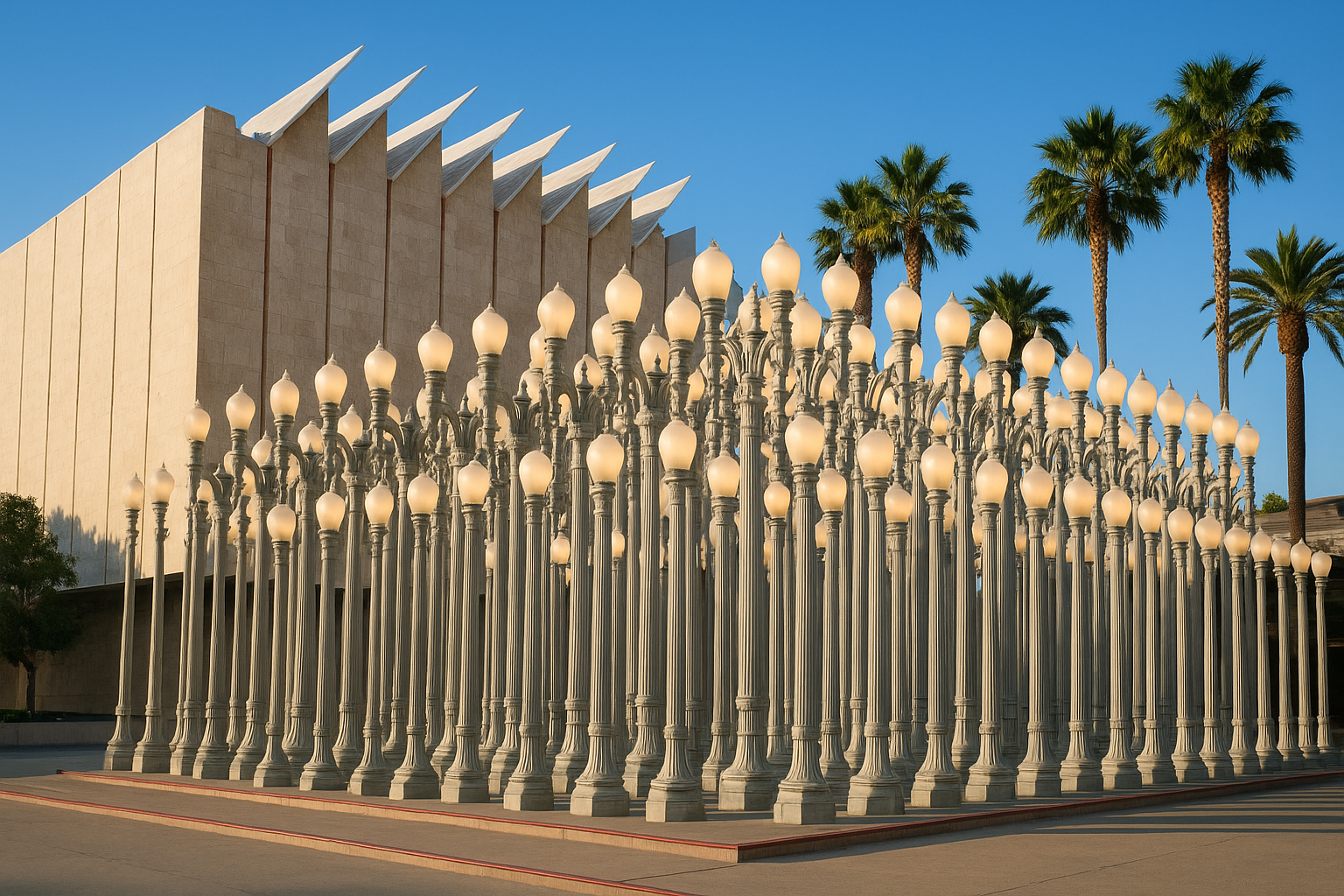
LACMA is the largest art museum in the western United States, with a permanent collection spanning over 150,000 works across ancient artifacts, modern paintings, film, and fashion. Out front, artist Chris Burden’s Urban Light installation features 202 restored antique street lamps arranged in a grid that glows brilliantly after dark.
Why it’s iconic
Urban Light has become one of the most photographed spots in all of Los Angeles. The lamps come from different LA neighborhoods, giving the piece an unexpected connection to the city’s history. Inside, the collection covers enough ground that you could spend multiple visits without repeating yourself.
Most visitors come for Urban Light and stay for the galleries, which is exactly the experience LACMA is designed to create.
Best way to visit
Walk the Wilshire Boulevard sidewalk to approach Urban Light from the front for the strongest visual impact. From there, move directly into the main museum buildings through the central plaza.
How much time to budget
Plan for two to three hours to cover the highlights without rushing through the galleries.
Costs, tickets, and reservations
Adult admission runs $30 per person. Residents of Los Angeles County receive discounted pricing with valid ID.
Tips for first-time visitors
Visit on a weekday evening to photograph Urban Light fully lit with minimal crowds blocking your shot, and time it with the museum’s Friday night jazz series on the plaza.
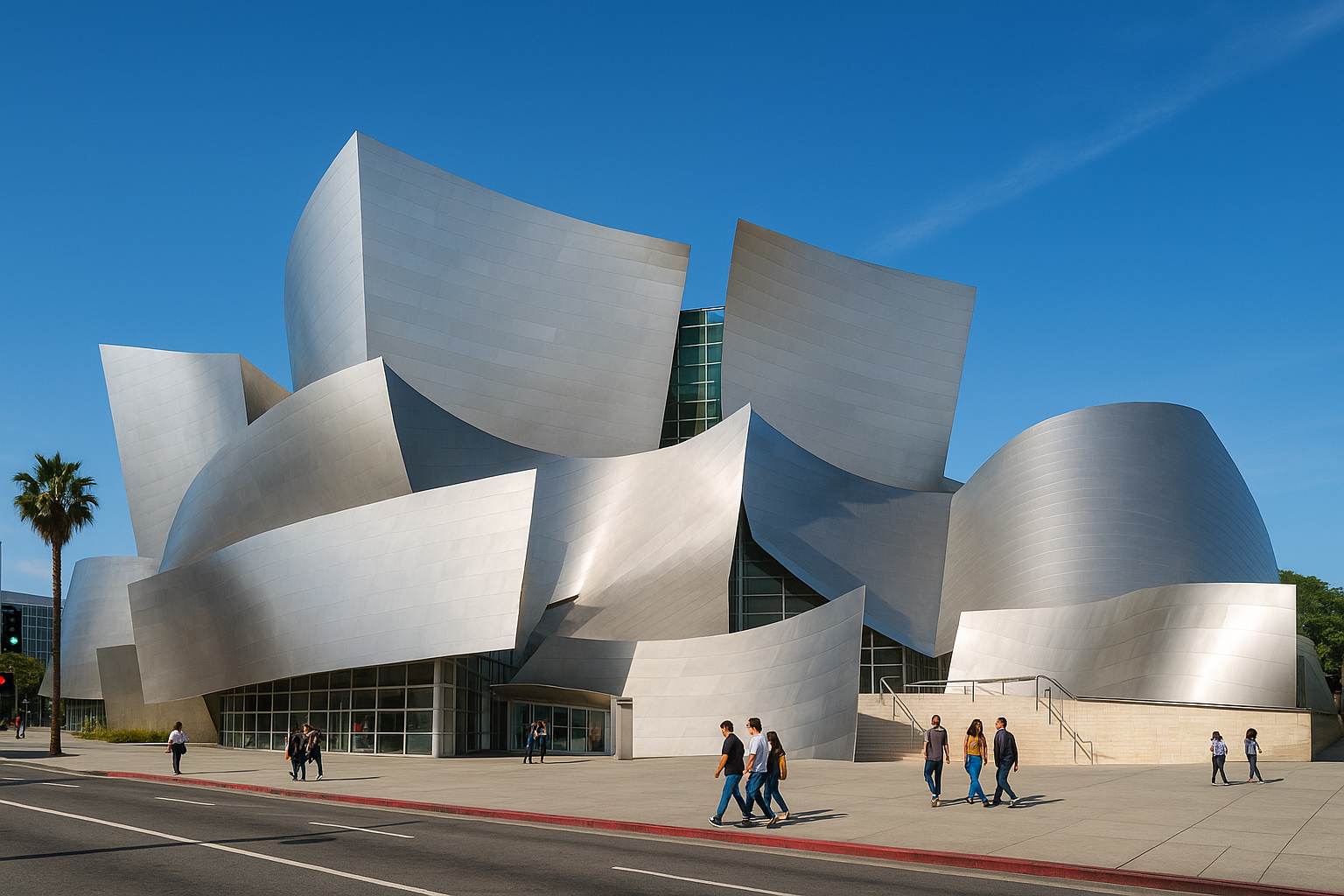
8. Walt Disney Concert Hall
The Walt Disney Concert Hall anchors the southern end of Grand Avenue in downtown Los Angeles and stands as one of the most visually striking iconic Los Angeles landmarks in the entire city.
What it is
The concert hall is the home of the Los Angeles Philharmonic, designed by architect Frank Gehry and completed in 2003. Its exterior features curved panels of stainless steel that catch and reflect sunlight in constantly shifting patterns throughout the day.
Why it’s iconic
Gehry’s design made the building an instant architectural landmark the moment it opened. The swooping steel exterior is unlike anything else among LA’s cultural landmarks worth visiting, and the interior acoustic design is considered among the finest concert hall environments in the world.
Even if you never step inside, the building transforms the surrounding streetscape in a way that makes it impossible to walk past without stopping.
Best way to visit
Walk Grand Avenue from the north and approach on foot for the strongest first impression of the facade. Free self-guided audio tours of the interior are available on most weekday mornings.
How much time to budget
Budget 30 to 45 minutes to walk the exterior and explore the public interior spaces. Add more time if you plan to attend a performance by the LA Philharmonic.
Costs, tickets, and reservations
Exterior access and self-guided interior tours are free. Concert tickets vary widely based on seat location and performance, starting around $25 per person.
Tips for first-time visitors
Check the LA Philharmonic’s official schedule before your visit to see if a performance lines up with your trip. Even a weeknight show turns a quick exterior stop into a genuinely memorable evening.
9. The Broad
The Broad sits directly across Grand Avenue from Walt Disney Concert Hall and rounds out one of the most concentrated stretches of iconic Los Angeles landmarks in the entire city. The building’s distinctive honeycomb exterior makes it instantly recognizable before you even step through the door.
What it is
Founded in 2015 by philanthropists Eli and Edythe Broad, this contemporary art museum houses their personal collection of roughly 2,000 works focused on postwar and contemporary art. Artists represented include Jeff Koons, Cindy Sherman, and Jean-Michel Basquiat across multiple gallery floors.
Why it’s iconic
Yayoi Kusama’s "Infinity Mirrored Room" has become one of the most sought-after art experiences in Los Angeles. Beyond that single installation, the collection covers six decades of contemporary art at a depth that few museums outside New York can match.
Getting a timed ticket for the Infinity Mirrored Room in advance is the single most important step before visiting The Broad.
Best way to visit
Walk Grand Avenue from either direction and enter through the main lobby level. Pick up your timed entry pass for the Kusama installation the moment you arrive if you didn’t reserve one in advance online.
How much time to budget
Plan for 90 minutes to two hours to move through the permanent collection and any rotating exhibitions currently on view without feeling rushed.
Costs, tickets, and reservations
General admission is free, like at several other Los Angeles museums that charge nothing to enter, but the Infinity Mirrored Room requires a separate timed reservation through the museum’s official website.
Tips for first-time visitors
Book your Infinity Mirrored Room reservation several weeks ahead during busy travel months. Slots fill fast, and walk-in availability is extremely limited on weekends.
10. Grand Central Market
Grand Central Market sits at the heart of downtown Los Angeles and has been feeding the city since 1917, making it one of the most historically grounded iconic Los Angeles landmarks on this entire list. Unlike most food halls that feel designed for Instagram, this one functions as a genuine neighborhood institution where locals and visitors share the same narrow aisles and counter stools.
What it is
Grand Central Market is a century-old public food market spanning a full city block on South Broadway in downtown LA. The space holds over 40 vendors serving everything from traditional Mexican food and Thai cuisine to craft coffee and fresh produce. The building itself is open-air and high-ceilinged, giving it an energy that no modern food hall replicates.
Why it’s iconic
The market connects decades of Los Angeles food history to the present day in a single space. Longtime vendors who have operated stalls for generations work alongside newer stalls, which creates an unusually layered dining environment you won’t find anywhere else downtown.
Few places in LA show you the full range of the city’s food culture in one building quite like this one.
Best way to visit
Walk in from the Broadway entrance and loop the full perimeter before committing to a vendor. This gives you a complete picture of your options before the midday rush fills every seat, and the market makes a natural starting point for a walking tour of downtown LA.
How much time to budget
Budget one to two hours to eat, browse, and soak in the atmosphere without feeling rushed.
Costs, tickets, and reservations
Entry is completely free. Individual meals typically run $10 to $20 per person depending on the vendor and portion size.
Tips for first-time visitors
Arrive before noon on weekdays to avoid peak lunch crowds. Most vendors are cash-friendly, but all major cards are accepted throughout the market.
11. Rodeo Drive
Rodeo Drive in Beverly Hills runs for three blocks and carries more name recognition than almost any other street in the world. It sits firmly among the iconic Los Angeles landmarks that every first-time visitor puts on their list, and the real-life version holds up to its reputation.
What it is
Rodeo Drive is a three-block luxury shopping street in Beverly Hills running between Wilshire Boulevard and Santa Monica Boulevard. The street holds flagship stores for Chanel, Gucci, Prada, Louis Vuitton, and dozens of other high-end brands, all within easy walking distance of each other.
Why it’s iconic
Rodeo Drive appeared in Pretty Woman and countless other films, cementing its status as global shorthand for wealth and West Coast glamour. Walking the street gives you an immediate sense of the scale and character of Beverly Hills in a way that photographs never fully capture.
You don’t need to spend money here to get full value from the visit. The architecture, the storefronts, and the energy of the street are the attraction.
Best way to visit
Walk the full three-block stretch from Wilshire to Santa Monica Boulevard and back, following a route built for shopping Rodeo Drive. The Two Rodeo cobblestone promenade at the south end adds an architectural detail worth seeing up close before you leave.
How much time to budget
Budget 45 minutes to one hour to walk the street comfortably and explore the surrounding blocks of Beverly Hills.
Costs, tickets, and reservations
Rodeo Drive is free to walk at any time. Street parking is metered, but several public parking structures nearby offer more affordable hourly rates.
Tips for first-time visitors
Arrive on a weekday morning before tour groups fill the sidewalks. Comfortable shoes matter here since the surrounding streets hold other Beverly Hills landmarks worth visiting well beyond the main three-block strip.
12. TCL Chinese Theatre
TCL Chinese Theatre sits on Hollywood Boulevard and ranks among the most visited iconic Los Angeles landmarks in the entire city. The hand and footprints cemented in the forecourt draw millions of visitors every year, and the building behind them is worth just as much attention.
What it is
TCL Chinese Theatre is a historic movie palace that opened in 1927 on Hollywood Boulevard. The building features pagoda-style architecture, ornate details, and a forecourt containing the hand and footprint impressions of over 200 Hollywood celebrities pressed into concrete during premieres and special events across nearly a century of film history.
Why it’s iconic
This theatre hosted Hollywood premieres for decades and remains one of the most architecturally distinctive of the movie landmarks you can actually walk into on the boulevard. The celebrity concrete impressions give it a physical connection to film history that no other single location in Hollywood replicates.
Matching your hands to a celebrity’s imprint in that forecourt is one of those small moments that actually stays with you long after the trip.
Best way to visit
Walk the forecourt first before heading inside for a film or tour. The hand and footprint blocks are organized loosely by era, so reading the names as you move through the space doubles as a compressed history of Hollywood.
How much time to budget
Budget 30 to 45 minutes for the forecourt and exterior. Add another two hours if you plan to catch a screening inside.
Costs, tickets, and reservations
The forecourt is free to enter. Movie tickets run approximately $18 to $25 per person depending on the format and showtime.
Tips for first-time visitors
Visit on a weekday morning before tour groups arrive. The IMAX screen inside is one of the largest in Los Angeles, making any blockbuster screening here genuinely worthwhile.
13. Hollywood Walk of Fame
The Hollywood Walk of Fame stretches more than 1.3 miles along Hollywood Boulevard and Vine Street, and it remains one of the most walked stretches of pavement among all the iconic Los Angeles landmarks in the city. Most visitors underestimate how much ground it actually covers.
What it is
The Walk of Fame is a public sidewalk monument featuring more than 2,800 five-pointed terrazzo stars embedded in the pavement. Each star honors a celebrity from film, television, music, radio, or live theater, and new honorees are added every year through a formal selection process.
Why it’s iconic
The Walk of Fame launched in 1960 and quickly became the definitive symbol of Hollywood’s entertainment legacy. Spotting the star of a favorite actor or musician creates a direct, physical connection to decades of cultural history that few other public monuments can match.
Searching for a specific star turns an ordinary sidewalk into something that actually holds your attention.
Best way to visit
Walk the full length of Hollywood Boulevard from Highland Avenue east toward Vine Street. This route puts you within walking distance of TCL Chinese Theatre, the Dolby Theatre, and several other sights a short stroll from the stars worth combining into a single outing.
How much time to budget
Budget 45 minutes to one hour to walk a significant portion of the star-lined sidewalk without feeling rushed.
Costs, tickets, and reservations
The Walk of Fame is completely free to visit at any hour of the day.
Tips for first-time visitors
Use the official Walk of Fame website or this guide to where each star sits on the sidewalk to locate a specific star before your visit. Arriving before 10 a.m. gives you clear sidewalks and better light for photographs.
14. La Brea Tar Pits
The La Brea Tar Pits sit in the middle of Hancock Park on Wilshire Boulevard, just steps from LACMA, and they represent one of the most unusual iconic Los Angeles landmarks in the city. Where most LA attractions celebrate entertainment or architecture, this one offers something genuinely unexpected: an active prehistoric excavation site in the middle of a major urban park.
What it is
La Brea Tar Pits is a natural asphalt seep that has been trapping and preserving animals since the last Ice Age. The site contains one of the world’s richest deposits of Pleistocene-era fossils, including mammoths, saber-toothed cats, and dire wolves. An on-site museum displays thousands of recovered specimens alongside ongoing excavation work you can watch from designated viewing areas.
Why it’s iconic
Few cities have a functioning paleontological dig embedded in a public park. The bubbling tar pits visible across the grounds are the same natural phenomenon that trapped Ice Age animals tens of thousands of years ago, which gives the site a visceral immediacy that no replica could replicate.
Standing next to a tar pool that has stayed active for over 50,000 years puts the entire timeline of Los Angeles into a very different perspective.
Best way to visit
Walk the grounds first to see the outdoor tar pits and lake before entering the museum. Combining this stop with a visit to nearby LACMA makes efficient use of your time on Wilshire.
How much time to budget
Budget one to two hours to cover the outdoor grounds and the main museum exhibits at a comfortable pace.
Costs, tickets, and reservations
Adult admission runs $20 per person. Children under five enter free, and timed tickets are available through the museum’s official website.
Tips for first-time visitors
Visit on a weekday morning to avoid school groups and weekend crowds. Wear shoes you don’t mind getting dusty since the outdoor path around the tar lake involves unpaved sections.

Wrap Up and Plan Your Route
These 14 iconic Los Angeles landmarks cover the full range of what the city actually offers, from prehistoric tar pits and world-class art museums to sun-bleached boardwalks and glittering Hollywood history. Each one earns its place on the list, and none of them require more than a day or two to experience if you plan your route around geography rather than jumping across the city repeatedly.
Start downtown, work your way through Hollywood and into Beverly Hills, then finish at the coast. That sequence eliminates most of the backtracking that kills a day in LA traffic. If you have extra time after you’ve covered these famous LA landmarks, add the Capitol Records Building near Hollywood and Vine, a short walk from the Walk of Fame, or catch a Dodgers game at Dodger Stadium. Both rank among the Los Angeles landmarks locals point visitors to next. If you’d rather have someone else handle the logistics while you focus on the experience, our guides know exactly how to connect these spots into a route that makes the most of your time. Compare our private Los Angeles tour options and arrive with a plan already in place.