Figuring out how to spend a day in Los Angeles isn’t hard because there’s nothing to do, it’s hard because there’s too much. The city sprawls across 503 square miles, traffic can eat an hour before you’ve seen a single landmark, and every neighborhood feels like its own universe. Without a plan, you’ll spend more time in your car than actually experiencing anything.
We’ve been guiding visitors through LA for over a million tours at Another Side Tours, and we’ve watched plenty of one-day visitors make the same mistakes: trying to hit every attraction on the map, underestimating distances, or spending half the day stuck on the 405. The good news? A single day in LA can be genuinely great, if you’re strategic about it.
This itinerary gives you a realistic, hour-by-hour plan that covers the highlights, Hollywood, Santa Monica, Beverly Hills, Griffith Observatory, without the chaos. We’ve built it around how the city actually works: geography, traffic patterns, and timing. Follow it as-is, or use it as a framework and swap in stops that match your interests. Either way, you’ll leave feeling like you actually saw Los Angeles, not just its parking lots.
Before you go: where to stay and what to skip
Your hotel location in Los Angeles matters more than in almost any other city. Because LA has no real central hub, your starting point dictates how much of the day you actually spend seeing things versus sitting in traffic between them. Before you lock in a plan for how to spend a day in Los Angeles, look at a map and figure out which neighborhood your accommodation sits in. That single detail will shape every decision that follows.
Pick a home base that puts you close to your priorities
If you’re staying in Hollywood or Los Feliz, you’re already walking distance from the Hollywood Walk of Fame and a short drive from Griffith Observatory. That’s a strong base for an early start. Santa Monica and Venice work well if your priority is the beach and the Westside, but expect a longer drive east to Hollywood once midday traffic kicks in. Beverly Hills sits roughly in the middle of many popular stops, which makes it one of the more flexible bases for a single-day visit.
Here’s a quick breakdown of how each area lines up with major stops:
| Staying in | Close to | Best strategy |
|---|---|---|
| Hollywood / Los Feliz | Walk of Fame, Griffith Observatory | Strong AM start, head west midday |
| Santa Monica / Venice | Beach, Third Street Promenade | Start west, work east before traffic peaks |
| Beverly Hills / West Hollywood | Rodeo Drive, Sunset Strip | Central access, good for a split itinerary |
| Downtown LA | Grand Central Market, arts district | Best for food and culture, far from the beach |
Your hotel location is the single biggest factor in how much you actually see in one day. Get this wrong and the traffic will make the decision for you.
What you should skip if you only have one day
Some of LA’s most famous attractions eat entire days on their own, and cramming them into a 24-hour visit rarely works in your favor. Universal Studios requires a minimum of five to six hours to get any real value from the experience. The Getty Center is spectacular, but it sits on the Westside and fills up quickly, making it a poor fit unless you’re already staying in Santa Monica or Brentwood. Disneyland is technically in Anaheim, about 35 miles from Hollywood, which means travel time alone costs you two to three hours round-trip.
Skip the following on a one-day visit unless one of them is your specific and only priority:
- Universal Studios Hollywood (full-day commitment, long lines)
- Disneyland or Disney California Adventure (different city, full-day minimum)
- The Getty Center (only practical if you’re based on the Westside)
- LACMA (large museum that rewards slow visits, not quick stops)
- Six Flags Magic Mountain (90 minutes north, theme park day trip only)
Cutting these from your list is not missing out. It’s the move that keeps the rest of your day from collapsing under the weight of one bad time estimate. Focus on neighborhoods, viewpoints, and food, and you’ll leave with a far stronger sense of what LA actually feels like at street level rather than standing in a queue for three hours wondering where the morning went.
Plan for LA traffic and pick one main zone
LA traffic isn’t just an inconvenience, it’s a schedule-killer that can turn a well-planned day into a frustrating series of delays. The single most important thing you can do when figuring out how to spend a day in Los Angeles is to pick one geographic zone and build your entire itinerary around it. Trying to bounce between the Westside, Hollywood, and Downtown in a single day will cost you two to three hours of driving at minimum, and that’s before anything goes wrong.
Understand how traffic moves in LA
LA traffic follows predictable patterns if you know what to look for. Westbound freeways fill up after 3 PM as people leave work and head toward the beach. The 405, 10, and 101 are the worst offenders during those hours. Mornings before 9 AM are your best window for covering distance, which is why any smart one-day plan starts early and front-loads travel across the city.
Here’s how traffic intensity shifts through the day:
| Time | Freeway traffic | Best move |
|---|---|---|
| Before 9 AM | Light to moderate | Drive and cover distance fast |
| 9 AM – 11 AM | Building | Settle into one zone |
| 11 AM – 3 PM | Moderate | Short drives only |
| 3 PM – 7 PM | Heavy to severe | Walk or stay put |
| After 7 PM | Clearing | Can move between zones again |
Choose your zone based on what matters most to you
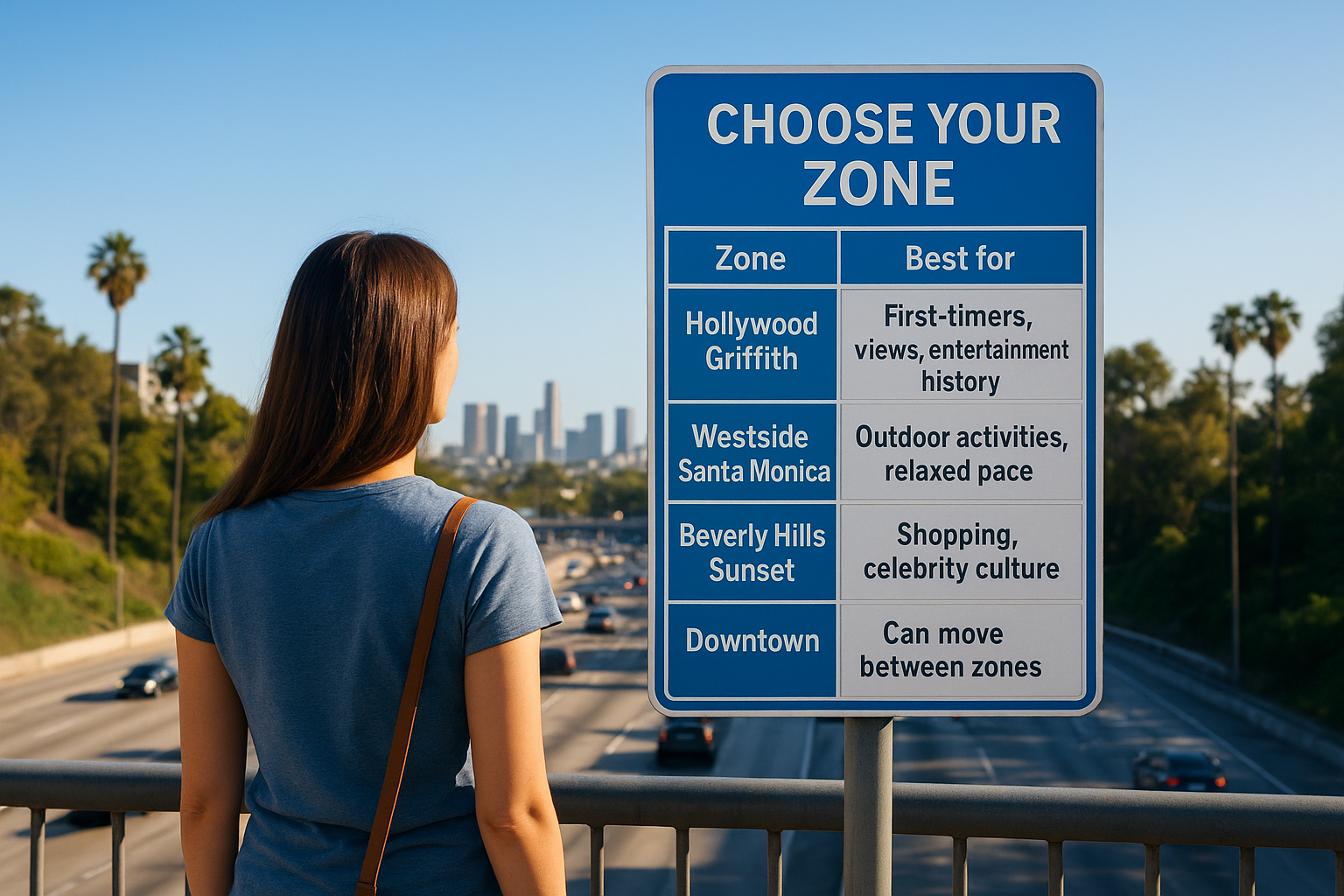
Rather than trying to see everything, pick the one zone that matches your top two or three priorities and commit to it. Each major LA zone has a distinct personality and enough to fill a full day on its own. The table below helps you match your interests to the right area before you finalize any plans.
| Zone | Covers | Best for |
|---|---|---|
| Hollywood / Griffith | Walk of Fame, Observatory, Los Feliz | First-timers, views, entertainment history |
| Westside / Santa Monica | Beach, Venice, Third Street Promenade | Outdoor activities, relaxed pace |
| Beverly Hills / Sunset | Rodeo Drive, Sunset Strip | Shopping, celebrity culture |
| Downtown | Grand Central Market, Arts District | Food, architecture, urban culture |
Picking one zone and staying in it will give you more real experiences in a single day than crossing the city twice ever will.
A realistic one-day LA itinerary by time block
This itinerary is built around one zone: Hollywood, Griffith Park, and the surrounding area. It’s the right choice for first-time visitors figuring out how to spend a day in Los Angeles because it concentrates the city’s most iconic stops within a manageable radius. Adjust start times if your hotel is farther out, but keep the overall sequence intact since it’s designed around how traffic and crowds actually build through the day.
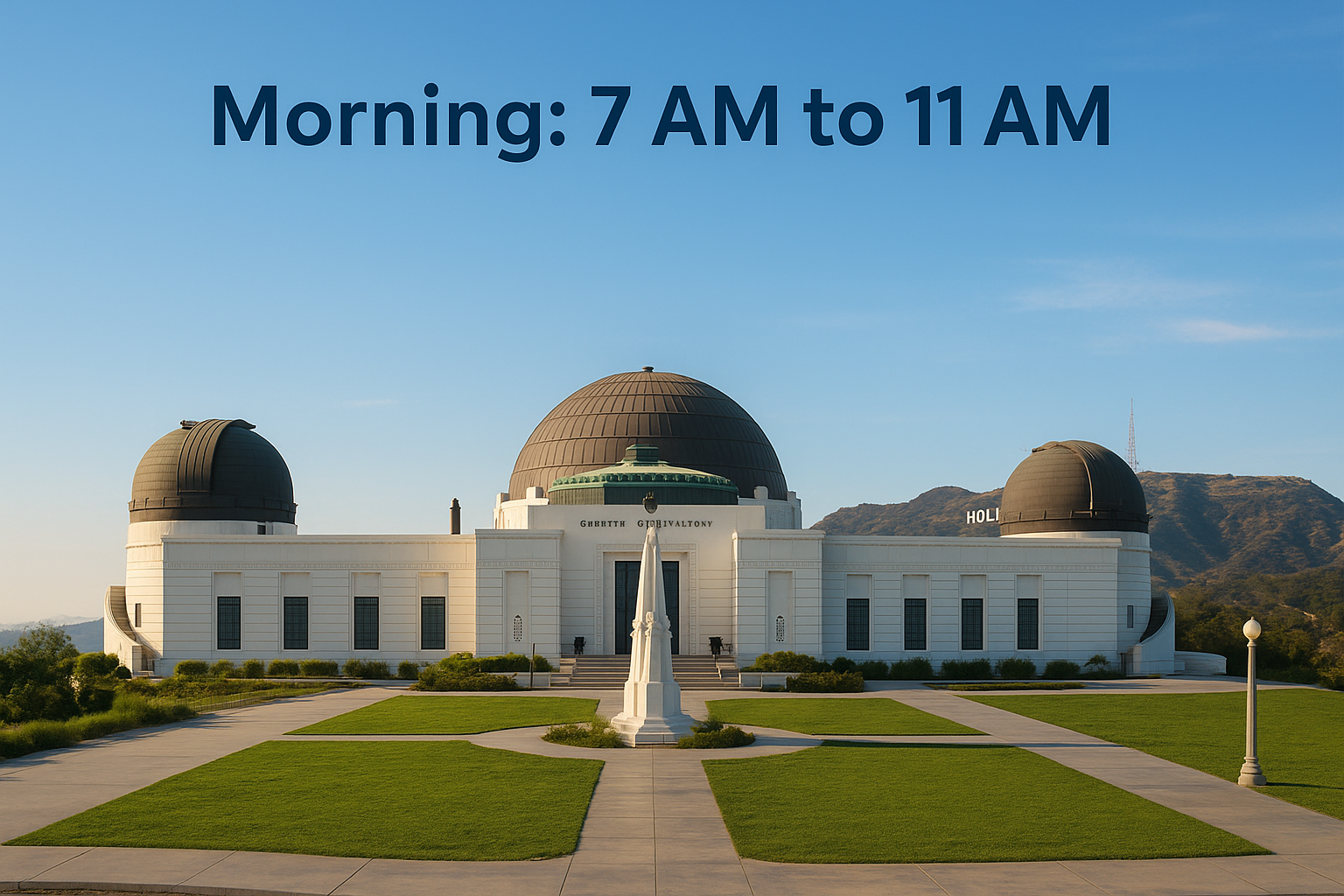
Morning: 7 AM to 11 AM
Start your day early at Griffith Observatory. Arrive by 7:30 AM and you’ll catch the view before the tour buses pull in. The observatory itself opens at noon on weekdays, but the grounds and the panoramic view of the Hollywood Sign are free and accessible all morning. Spend 45 minutes here, then drive down to Los Feliz Boulevard for breakfast at a local cafe before the rush hits.
By 9 AM, head toward the Hollywood Walk of Fame on Hollywood Boulevard. At this hour, the sidewalk is quiet enough to actually stop and look without fighting through a wall of people. Walk east from Highland Avenue toward Vine Street, a stretch that covers the most concentrated section of celebrity stars and landmark storefronts.
Getting to Griffith Park before 8 AM is the single move that separates a relaxed morning from a crowded one.
Midday: 11 AM to 3 PM
By 11 AM, Hollywood Boulevard is getting busy, which is your signal to shift west. Drive or rideshare to Beverly Hills and walk Rodeo Drive. This takes about 25 to 35 minutes depending on traffic. Grab lunch somewhere along Brighton Way or Canon Drive, where you’ll find real restaurants without tourist markup.
After lunch, use the remaining midday hours to explore the residential streets just north of Rodeo Drive. The architecture rewards a slow 20-minute walk and costs nothing. Keep in mind that this is also your window for any reservation-based activity, such as a guided tour, since midday crowds are predictable and manageable.
Afternoon and evening: 3 PM to 8 PM
Avoid getting back in the car between 3 PM and 7 PM if at all possible. Instead, stay within your current zone and explore on foot. Sunset Boulevard through West Hollywood has enough ground-level interest, murals, architecture, and small shops, to fill two hours without a car.
By 7 PM, traffic clears enough to move again for a dinner reservation in Silver Lake, Los Feliz, or West Hollywood, all within reach and all with strong restaurant options that reflect what LA food actually tastes like beyond the tourist corridors.
If you have no car: a workable one-day plan
Not having a car in Los Angeles is a real constraint, but it doesn’t make a strong day impossible. The key to figuring out how to spend a day in Los Angeles without a car is to commit to one compact zone and combine the Metro with rideshare apps strategically. Trying to cross the city on public transit alone will burn your day. Stay focused, and you’ll cover the most iconic ground without needing a rental.
The Metro covers more of the city than most visitors realize, and pairing it with rideshare for short gaps makes the whole system work.
Use the Metro and rideshare together
LA Metro’s B Line (Red Line) runs directly through Hollywood, connecting Union Station downtown to North Hollywood with stops at Hollywood/Highland, Hollywood/Vine, and Hollywood/Western. That single line puts the Walk of Fame, the Hollywood Bowl area, and Los Feliz all within reach without a car. For anywhere the Metro doesn’t reach directly, a rideshare fills the gap for a reasonable flat fare.
Here’s how to combine both modes for maximum efficiency:
| Leg | Mode | Notes |
|---|---|---|
| Hotel to Hollywood/Highland | Metro B Line or rideshare | Depends on your starting location |
| Hollywood Boulevard exploration | On foot | Walk of Fame stretch is walkable |
| Hollywood to Griffith Observatory | Rideshare | Metro doesn’t go there directly |
| Griffith back to Hollywood | Rideshare | 10 to 15 minutes, low cost |
| Hollywood to Santa Monica (optional) | Metro E Line transfer | About 50 minutes total |
A car-free itinerary sequence that works
Start your morning at Hollywood/Highland station by 8:30 AM and walk east along Hollywood Boulevard while the crowds are still thin. Spend an hour covering the Walk of Fame and the TCL Chinese Theatre exterior, then rideshare up to Griffith Observatory for the views. Budget around $12 to $18 each way for rideshare from Hollywood to Griffith, depending on surge pricing.
After Griffith, rideshare back to Los Feliz Boulevard for lunch, which costs less than the Griffith trip and puts you in a walkable neighborhood with strong food options. From Los Feliz, the Metro E Line transfer gives you access to Venice and Santa Monica for the afternoon if you want to end the day at the beach. The full transit fare runs well under $10 for the day using a TAP card, which you load and use on any Metro line.
Make it smooth: reservations, parking, costs, safety
The logistics side of figuring out how to spend a day in Los Angeles doesn’t need to be complicated, but skipping a few key steps will cost you time or money you didn’t plan to lose. Get these details sorted the night before and your actual day runs far smoother.
Book ahead for the spots that fill up fast
Griffith Observatory is free to visit but the parking lot fills by 9 AM on weekends, and timed entry passes for the interior sell out days in advance. Reserve your observatory entry on the official Griffith Observatory site before your trip, or plan to rideshare directly to the entrance and skip the parking situation entirely.
Booking Griffith Observatory entry and any guided tour at least 48 hours ahead removes the two most common reasons first-time visitors get turned away at the door.
If you’re adding a guided tour to your day, book it 24 to 48 hours in advance rather than the morning of. Tour slots, especially for small-group experiences, fill quickly during peak travel months from March through October.
Parking strategy that saves you time and money
Street parking in Hollywood and Beverly Hills is metered and aggressively enforced. The safest approach is to identify a parking structure near your first stop and leave your car there for the morning block rather than moving it repeatedly. The Hollywood & Highland Center has a large paid structure with validation options at the attached shops, which brings costs down to around $3 for the first two hours.
In Santa Monica, the City of Santa Monica operates several public structures near the Third Street Promenade that charge flat evening rates after 6 PM. Download the ParkMobile app before your trip so you can pay and extend your meter remotely without walking back to the car.
Budget what you’ll actually spend
A realistic single day in LA, covering transportation, food, parking, and one or two paid experiences, runs between $120 and $200 per person depending on your choices. Here’s a basic cost breakdown to use as a planning reference:
| Expense | Estimated cost |
|---|---|
| Parking (full day, structure) | $15 to $30 |
| Breakfast and lunch | $30 to $50 |
| Rideshare trips (2 to 3 legs) | $25 to $45 |
| Guided tour | $75 to $150 |
| Dinner | $40 to $70 |
Bringing cash for smaller food stalls and street vendors saves you card minimums and speeds up transactions in busier spots.
Wrap-up and next steps
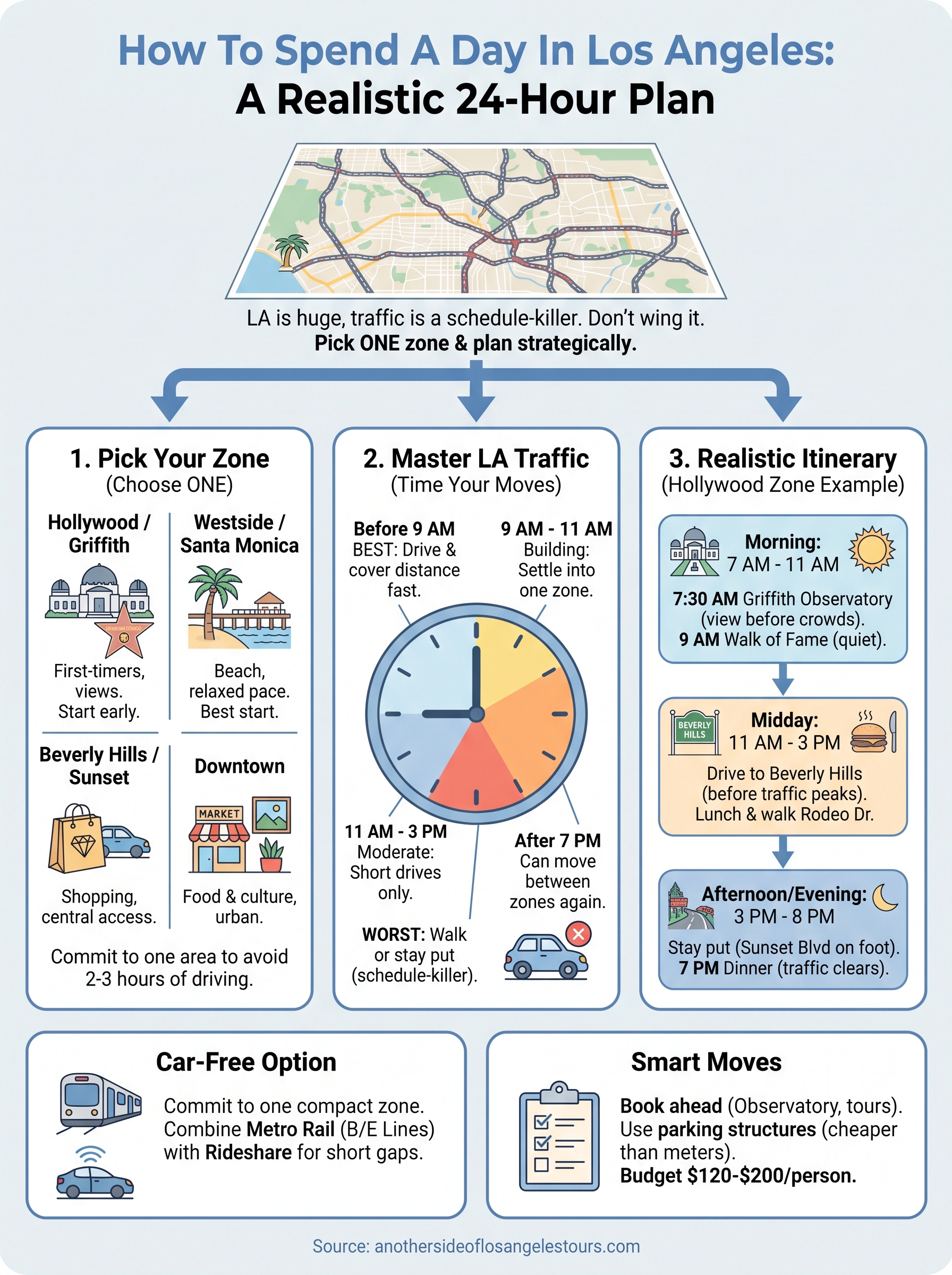
Knowing how to spend a day in Los Angeles comes down to three decisions: pick a zone, time your moves around traffic, and book the high-demand stops in advance. The city rewards visitors who plan ahead and punishes those who try to improvise across 500 square miles. Stick to one geographic area, front-load your morning with the stops that get crowded fast, and you’ll cover far more ground than most people manage in twice the time.
You don’t have to figure all of this out on your own. A guided tour takes the navigation, parking, and timing pressure completely off your plate, so you spend the day actually experiencing the city instead of managing logistics. Another Side Tours offers private Los Angeles tours with hotel pickup, expert local guides, and itineraries built around how LA actually works. Book your spot before your trip and show up ready to go.