You’ve watched the movies. Now you want to stand where they were filmed. Tracking down famous Hollywood film locations on your own usually means driving in circles, squinting at Google Maps, and standing outside a building wondering if you’ve got the right address. Half the time you’ll find a parking structure where a movie moment used to be, or a private residence you can’t actually approach.
This list solves that problem. Below are 13 real, visitable spots where iconic scenes were shot, from downtown LA rooftops to Griffith Park trails, with enough detail on exact filming spots that you can find them without wasting your afternoon. Some are free to walk up to. Others are best seen with someone who knows the backstory and the shortcuts.
We run guided tours through many of these same neighborhoods every week, so we know which locations photograph well, which ones disappoint in person, and which require a guide to get the full story instead of just a building facade. Whether you’re planning a self-guided movie tour or thinking about booking a Hollywood locations tour with local guides, this rundown gives you the map before you start walking.
1. The Hollywood Sign
No location says "Los Angeles" faster than the Hollywood Sign, and it’s the first stop most visitors picture when they imagine famous Hollywood film locations. Built in 1923 as an ad for a real estate development called Hollywoodland, the sign outlived the company by a century and became the city’s unofficial logo. It sits on Mount Lee in Griffith Park, visible from dozens of angles around the city, but only a handful actually get you close enough for a good photo.
What was filmed here
The sign itself shows up constantly as a backdrop, but a few films use it as more than scenery. "Superman" (1978) has Christopher Reeve flying past it, and "The Day of the Locust" opens with a shot of the original nine letters (it used to read "Hollywoodland") before four were removed in 1949. More recently, "La La Land" leans on the hills below it for its opening freeway dance number, and countless music videos and commercials use the sign as instant shorthand for "you’ve made it in show business."
How to visit
You can’t walk right up to the letters anymore; the area behind the sign is fenced off and monitored to stop people from climbing on it. Your best options are the Hollywood Sign Viewpoint on Mulholland Drive, the Griffith Observatory lawn, or the Brush Canyon Trail (also called Cahuenga Peak Trail), which gets you closest on foot, about a 3.5-mile round trip with real elevation gain. Wear real shoes and bring water; this isn’t a stroll.
The closer you get to the Hollywood Sign, the worse the photo usually looks.
That’s the trick nobody tells you: distance shots from Griffith Observatory or the Hollywood and Highland rooftop deck often beat the up-close hike for a clean, iconic frame.
Insider tip
Skip the Lake Hollywood Park view if you’re short on time. It’s popular on Instagram, but parking is brutal on weekends and the angle makes the sign look smaller than expected. Griffith Observatory gives you the sign, the Griffith Park Observatory itself, and a downtown skyline view in one stop, which makes it the more efficient choice if you’re combining this with other locations on your list. Go early morning or right before sunset to avoid both the crowds and the haze that settles over the basin by midday.
2. TCL Chinese Theatre and the Walk of Fame
Before the Hollywood Sign became the city’s logo, the TCL Chinese Theatre already had the job locked down. Sid Grauman opened it in 1927 with pagoda roofs, giant stone dogs, and a forecourt full of handprints that turned a movie premiere into a permanent tourist stop. Walk a few steps in any direction and you’re standing on the Hollywood Walk of Fame, over 2,700 bronze stars stretching along Hollywood Boulevard and Vine Street.
What was filmed here
The theatre’s forecourt shows up in dozens of films as shorthand for "Hollywood has arrived," including scenes in "Ocean’s Eleven" (2001) and "Hollywood Homicide." The building itself, along with the surrounding blocks of the Walk of Fame, appears constantly in music videos, awards-show footage, and studio comedies that need one quick establishing shot to tell the audience where they are. Real premieres still happen here, which means you might roll up on a red carpet without any warning.
How to visit
The forecourt is free and open daily; you can wander among the handprints of stars from Marilyn Monroe to Robert Downey Jr. any time you like. Paid theater tours run several times a day if you want to see inside the auditorium itself, which still screens films on one of the largest screens in the country.
The handprints are free, but the crowds around them are relentless, so time your visit for early morning.
Insider tip
Arrive before 9 a.m. on a weekday. The forecourt empties out, the light is better for photos, and you’ll dodge the costumed street performers who charge for pictures later in the day.
3. Griffith Observatory
High above the Hollywood Sign sits the Griffith Observatory, a 1935 Art Deco building that’s shown up in more films than most working actors. Its copper domes and citywide view make it an easy stand-in for both science and romance, and directors have leaned on that combination for nearly a century. You’ll recognize the terrazzo terrace even if you’ve never been to Los Angeles, thanks to how often it appears in trailers and postcards alike.
What was filmed here
James Dean’s "Rebel Without a Cause" (1955) used the observatory’s planetarium and lawn so heavily that a bronze bust of Dean now sits on the grounds. "La La Land" sends its two leads dancing among the stars inside the planetarium during a key scene, and the building pops up in "Transformers" and "The Terminator" as a backdrop for citywide chaos.
How to visit
Admission to the grounds and public telescopes is free, though the planetarium shows charge a small ticket price. Parking fills up fast on weekends, so arrive before noon or take the DASH shuttle from the Vermont/Sunset Metro stop if you want to skip the lot altogether.
A free viewpoint that gives you the Hollywood Sign, downtown skyline, and a real filming location in one stop is hard to beat.
Insider tip
Sunset draws the biggest crowds, so if you want a quieter visit, come an hour after opening instead. The lawn behind the building offers the same James Dean sightline without the tripod traffic jam near the front steps, and you’ll still catch the sign in daylight before the haze rolls in.
4. The Bradbury Building
Downtown LA hides one of the city’s most photographed interiors behind a plain brick exterior. The Bradbury Building, finished in 1893, looks unremarkable from the street, but step inside and you get open ironwork staircases, exposed brick, and a skylight-flooded atrium that feels lifted from a different century entirely. It’s the oldest commercial building still standing in central LA, and filmmakers have used that faded grandeur for over a hundred years.
What was filmed here
Science fiction directors love this place. "Blade Runner" (1982) built its entire final act around the Bradbury’s atrium, turning the ironwork into a rain-soaked maze for Harrison Ford’s last confrontation. "(500) Days of Summer" uses the same staircases for a much gentler scene, and "The Artist" shot here too, proof the building photographs equally well in black and white as it does in neon-soaked color.
How to visit
The ground floor lobby is open to the public daily during business hours, free of charge, though you’re limited to the first floor; the upper levels are working office space. Weekday mornings are quietest, since the building sits in the Historic Core and doesn’t pull weekend foot traffic the way Hollywood Boulevard does.
A century-old office lobby doubles as one of cinema’s most recognizable sets, and you can walk into it for free.
Insider tip
Bring a wide-angle lens or just your phone held flat against your chest, tilted up. Shooting straight upward from the center of the lobby captures the full cage of ironwork and skylight in a single frame, the same angle Ridley Scott used to make the space feel infinite.
5. Union Station
A few blocks from the Bradbury Building sits Union Station, opened in 1939 and still the last of the great American train terminals built on this scale. High ceilings, Mission Revival arches, and leather chairs in the main waiting room give it a timeless quality that filmmakers have leaned on for over 80 years. It’s still a working transit hub, which means you’re sharing the space with actual commuters, not just camera crews and tourists.
What was filmed here
Union Station has doubled for train stations, courthouses, and even other cities across dozens of productions. "Blade Runner" (1982) used its interior for the Tyrell Corporation scenes, and "Catch Me If You Can" shot pivotal chase sequences through its halls. The station also shows up in "The Dark Knight Rises" and countless music videos looking for a grand, old-world backdrop without leaving Los Angeles.
How to visit
Union Station is free to enter and open daily, since it’s an active Metro and Amtrak hub at 800 N Alameda St. Walk through the main hall, the ticketing concourse, and the outdoor patios; all are accessible without a ticket unless you’re actually boarding a train.
A working train station doubles as one of LA’s most reliable movie sets, and you don’t need a reason to walk in.
Insider tip
Visit midweek around 10 a.m., after the morning commute clears but before tour groups arrive. The south patio, with its fountains and tile work, gets skipped by most visitors headed straight for the main hall, and it’s often used in productions needing a quieter, garden-like frame away from the crowds inside.
6. The Gamble House
Pasadena’s Gamble House, built in 1908 by architects Greene and Greene, is the finest surviving example of American Craftsman architecture in the country. Commissioned for David and Mary Gamble of the Procter & Gamble family, the house sits on a quiet street lined with sycamores, its low-pitched roofs and exposed joinery looking more like a Japanese temple than a typical Southern California home. You won’t find crowds here, which is part of what makes it worth the drive out of Hollywood proper.
What was filmed here
Movie fans know this house best as Doc Brown’s residence in "Back to the Future" (1985), where the exterior served as the mad scientist’s home and lab. The production dressed the porch and driveway for the role, though the interior scenes were shot elsewhere on a studio set. The house also appears in "Blade Runner 2049" promotional material and has drawn location scouts for decades who want a genuine, unaltered piece of early 20th-century California design.
How to visit
The Gamble House offers docent-led tours several days a week for a modest ticket price, and the grounds themselves can be viewed from the public sidewalk any time. Check the current tour schedule before driving out, since hours shift seasonally and the house occasionally closes for private events.
A single house exterior gave a whole generation their picture of a movie scientist’s home, and it still stands exactly as it looked in 1985.
Insider tip
Park on Walnut Street and walk the full block before you shoot photos. The angle from across the street, slightly off-center from the front walkway, matches the classic "Back to the Future" shot almost exactly.
7. Los Angeles Theatre
Downtown’s Los Angeles Theatre opened in 1931 with a lobby so lavish it nearly bankrupted its builder before the doors even opened. Crystal chandeliers, a Versailles-style fountain, and a ten-story marble staircase were designed to make moviegoers feel like royalty during the Depression, and the interior still looks that way today. It’s one of the last great movie palaces on Broadway’s Historic Theatre District, a stretch that once held a dozen similar houses.
What was filmed here
Directors treat the Los Angeles Theatre as an instant time machine. "The Artist" (2011) used the lobby and auditorium for its premiere sequences, leaning on the gilded details to sell the 1920s Hollywood setting without a single digital touch-up. "Chaplin" and several Michael Jackson music videos, including "Speed Demon," also shot here, and the theater regularly hosts real-world premieres and events that borrow the same old-Hollywood glamour the movies keep chasing.
How to visit
The theater isn’t open daily like Union Station or the Bradbury lobby. It operates as an event venue, so public access depends on scheduled tours, film screenings, or private bookings you can find listed online. Check ahead before making a special trip, since the building sometimes sits closed between events with no walk-in access.
A theater built to distract Depression-era audiences from bad news now does the same job for movie fans chasing old Hollywood glamour.
Insider tip
Broadway’s theater district rewards a slow walk, not just a stop at one address. The Palace, the Orpheum, and the Tower Theatre sit within a few blocks, and several run their own occasional public tours, so pair your Los Angeles Theatre visit with a short stroll down Broadway before you move on.
8. Santa Monica Pier
Out at the edge of the city, where Route 66 officially ends, the Santa Monica Pier has been drawing filmmakers since 1909. The wooden pier, its arcade lights, and the Pacific Park Ferris wheel behind it give directors an instant "end of the road" image, a spot where characters go to either escape LA or finally arrive at the ocean. Between the carousel, the roller coaster, and the fishing deck, there’s more variety here than a single postcard shot suggests.
What was filmed here
The pier’s carousel building anchors "The Sting" (1973), and its arcade and midway show up in "Forrest Gump" during Lieutenant Dan’s beach scenes. "Iron Man 3" stages an action sequence along the pier’s edge, and countless TV shows use the Ferris wheel silhouette against sunset as a closing shot for a season finale. Music videos treat the pier the way Hollywood Boulevard treats the Walk of Fame, as a reliable backdrop that needs no explanation.
How to visit
The pier is free and open daily, with individual ride tickets sold at Pacific Park for anyone who wants the Ferris wheel or coaster experience. Parking on the pier itself gets expensive fast, so most locals park a few blocks inland on side streets or use the beach lot south of the pier for a flat daily rate.
A wooden pier at the end of Route 66 has closed out more films than almost any other single location in Los Angeles.
Insider tip
Skip the pier deck around sunset for photos and walk down to the beach instead. Shooting up toward the Ferris wheel from the sand gets you the full colored lights against the sky, the same angle most productions use once the sun drops.
9. Venice Beach Boardwalk
A few miles south of Santa Monica, the Venice Beach Boardwalk trades postcard polish for something rawer. Muscle Beach, street performers, palm-lined bike paths, and graffiti-covered handball courts give the boardwalk a lived-in energy that filmmakers use whenever a scene needs to feel unscripted, even when every shot is carefully staged. Locals still work out at the original outdoor gym here, the same one that’s been drawing bodybuilders since the 1930s.
What was filmed here
Bodybuilders and boardwalk chaos made this stretch famous long before tourists showed up with cameras. "White Men Can’t Jump" (1992) shot its basketball hustling scenes on the courts near the gym, and "Baywatch" used the sand and lifeguard towers just north of the boardwalk for years of beach footage. "L.A. Story" leans on the boardwalk’s street performers for comic relief, and skateboarding documentaries keep coming back to the same half-pipe near Windward Avenue.
How to visit
The boardwalk is free and open around the clock, though most of the energy shows up between late morning and early evening when vendors, performers, and the muscle gym are all active. Parking runs expensive close to the beach, so many visitors park inland near Abbot Kinney Boulevard and walk in.
A free outdoor gym from the 1930s still draws the same crowds that put Venice Beach on film in the first place.
Insider tip
Head to the boardwalk on a weekday afternoon instead of a weekend. You’ll get the same performers and the same Muscle Beach backdrop, minus the shoulder-to-shoulder crowds that make weekend photos nearly impossible to frame cleanly.
10. Bronson Caves in Griffith Park
Tucked into a hillside off Canyon Drive, Bronson Caves isn’t actually a cave at all. It’s a man-made tunnel left over from a rock quarry that operated here in the early 1900s. Studios discovered the site decades ago because the dark opening and rocky terrain around it could double for almost anywhere, a desert planet, a rebel hideout, or a stretch of rugged American wilderness, all without leaving Griffith Park.
What was filmed here
Generation after generation of TV fans know this spot as the entrance to the Batcave in the 1960s "Batman" series, and that single association still pulls more visitors than anything else on this list. Beyond Gotham, the tunnel and surrounding rocks show up in dozens of Westerns from the 1940s and 1950s, plus science fiction titles like "Star Trek" episodes and "Invasion of the Body Snatchers" (1956), which used the rocky canyon walls as an all-purpose alien landscape.
How to visit
Access is free, but you’ll need to hike in. Park at the small lot on Canyon Drive, then walk roughly a half-mile up a paved fire road to reach the tunnel itself. There’s no shade on the walk, so morning visits beat afternoon ones, especially in summer.
A quarry tunnel with no ticket booth and no gift shop has still outlasted most Hollywood studio backlots as a working filming location.
Insider tip
Bring a flashlight if you want to walk all the way through the tunnel; it’s short but pitch black in the middle. Weekday mornings mean you’ll likely have the whole canyon, and the photo, to yourself.
11. The Sunset Strip and Whisky a Go Go
The Sunset Strip runs about 1.5 miles through West Hollywood, and it’s been packing more neon, music history, and film cameos into that stretch than almost anywhere else in the city. The Whisky a Go Go, opened in 1964, anchors the Strip’s rock and roll reputation, having launched go-go dancing as a nightclub trend and hosted The Doors as house band before Jim Morrison got them fired for an unreleased song about his father.
What was filmed here
Rock documentaries and biopics treat the Whisky as a required stop, including footage tied to The Doors, Van Halen, and Motley Crue, whose early years get retold in "The Dirt." The wider Strip shows up in "The Doors" (1991) biopic, "Almost Famous," and countless music videos that need a marquee-lit street to signal LA nightlife without any dialogue explaining it. Paparazzi footage and reality shows have used the same block for decades, since the Strip photographs like a set even when nobody’s filming.
How to visit
Walking the Strip costs nothing, and the Whisky’s exterior is visible any time from the sidewalk on Sunset Boulevard near Clark Street. Catching a live show inside means checking the venue’s calendar and buying tickets, since it still operates as a working club most nights of the week.
A working nightclub from 1964 has outlasted most of the bands that made it famous.
Insider tip
Go after dark. The marquee and neon read as flat, ordinary signage in daylight, but at night the Strip looks exactly like it does in the footage, gridlocked traffic, glowing signs, and all.
12. The Ennis House
Perched in Los Feliz above Griffith Park, the Ennis House is Frank Lloyd Wright’s largest and most imposing textile-block design, finished in 1924 from over 27,000 custom-cast concrete blocks. Wright built it for Charles and Mildred Ennis, and the Mayan Revival style makes it look less like a Los Angeles residence and more like a temple that wandered down from the hills. Its scale and shadows have made it one of the most recognizable private homes in film, even though most visitors only ever see it from the street.
What was filmed here
Horror and noir directors keep returning to this house because its geometric blocks read as menacing on camera. "Blade Runner" (1982) used its interior for Deckard’s apartment, and "House on Haunted Hill" (1959) leaned on the exterior for its opening dread. Ridley Scott, Rian Johnson’s "The Brothers Bloom," and music videos for artists chasing a gothic Los Angeles look have all shot here, drawn by the same textured concrete that made the house famous in the first place.
A private home built from concrete blocks has scared audiences longer than most horror franchises have existed.
How to visit
The Ennis House is a private residence, so there’s no public entry and no scheduled tours most of the year. You can view and photograph the exterior from Glendower Avenue, where the street offers a clear, legal vantage point without trespassing on the property.
Insider tip
Go in the late afternoon. The low sun rakes across the textile blocks and throws deep shadows across the facade, the same lighting effect that gives the house its ominous look on screen.
Planning your own Hollywood location tour
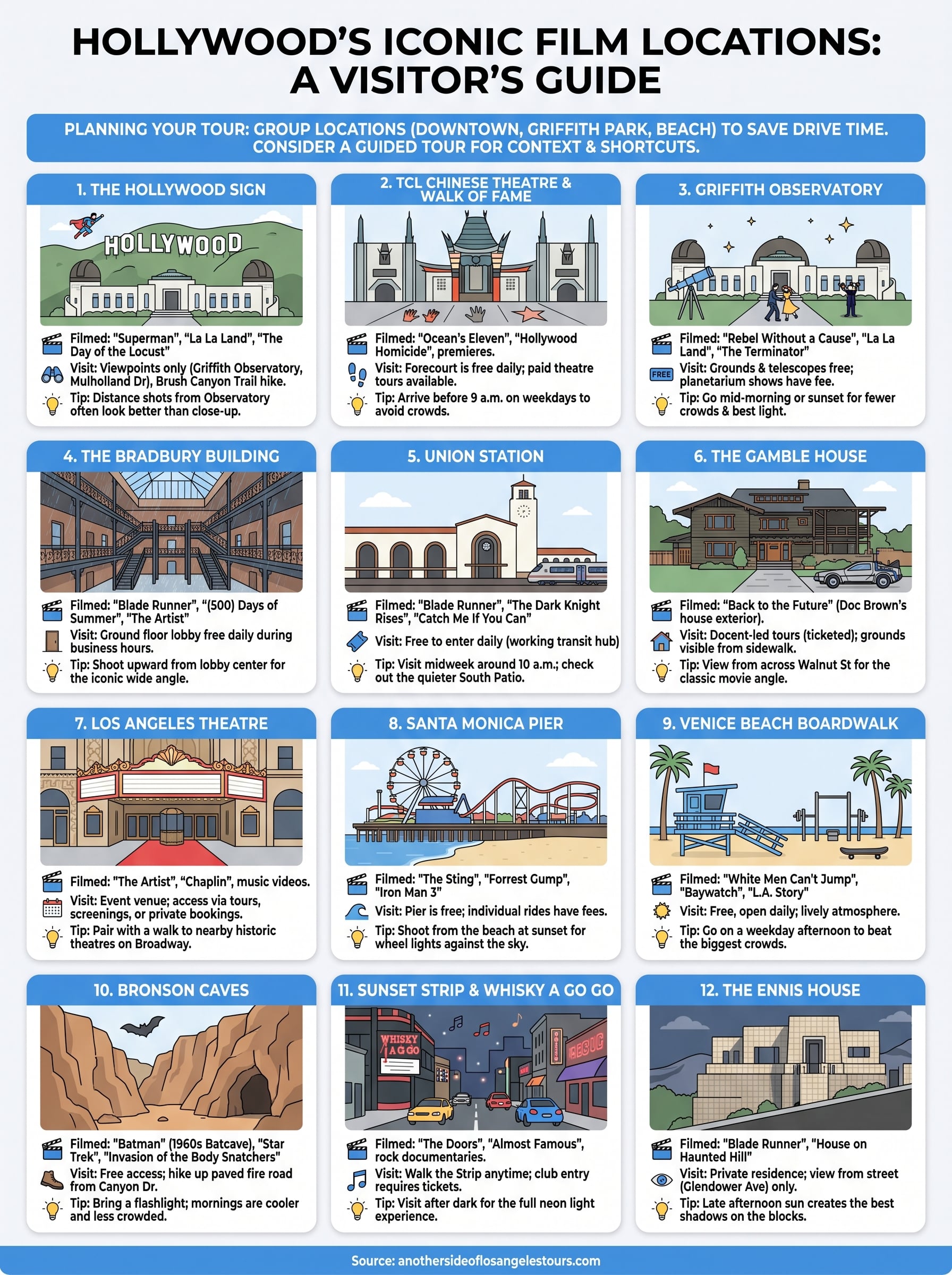
Thirteen locations sounds manageable until you’re actually mapping the drive between the Ennis House in Los Feliz, the Bradbury Building downtown, and Santa Monica Pier by the ocean. Each cluster works as its own half-day trip: Griffith Park sites together, downtown movie palaces together, beach spots together. Trying to hit all of them solo in one day means more time parking than photographing.
Guides make the difference here, not because you can’t find these addresses yourself, but because context turns a facade into a story. Local guides know which angle matches the shot, which hour avoids the tour buses, and which nearby spot didn’t make this list but should be on yours. That’s the gap between seeing a building and actually understanding why a director picked it.
If you’d rather skip the parking apps and let someone else handle the route, book a private Los Angeles tour and let a local guide take you through these locations properly.