
You're probably deciding whether this is the Day of the Dead event you finally commit to, or the one you admire from afar because the logistics sound like a headache. If you want the honest answer, Hollywood Forever Cemetery Day of the Dead is worth the trip, but only if you choose the right admission window and arrive with a plan.
The event has grown far beyond a local observance. It's now one of Los Angeles' signature cultural gatherings, held at 6000 Santa Monica Blvd. in Hollywood, with a scale that makes timing and crowd management the difference between a magical visit and a frustrating one. If you're visiting from Beverly Hills, Santa Monica, Venice, or downtown, treat this like a premium ticketed experience, not a casual drop-in.
Table of Contents
- Why Hollywood Forever Cemetery Day of the Dead Is a Must-See Los Angeles Experience
- Understanding Ticket Tiers and Admission Windows
- Daytime Altars Versus Nighttime Performances
- Getting There and Navigating the Neighborhood
- What to Expect Inside the Celebration
- Photography Tips and Cultural Etiquette
- Building a Full Los Angeles Itinerary Around the Celebration
- Your Essential Day-of-Dead Visit Checklist
Why Hollywood Forever Cemetery Day of the Dead Is a Must-See Los Angeles Experience
If you want the event at its most striking, arrive near golden hour. The marble catches the last light, the marigolds glow, and the whole cemetery shifts into a scene that feels staged without ever losing its sense of place. Hollywood Forever Cemetery Day of the Dead works because it is not just an altars-and-music event, it is a living cultural gathering inside one of the city's most recognizable memorial grounds, where remembrance, performance, and neighborhood energy all share the same space.
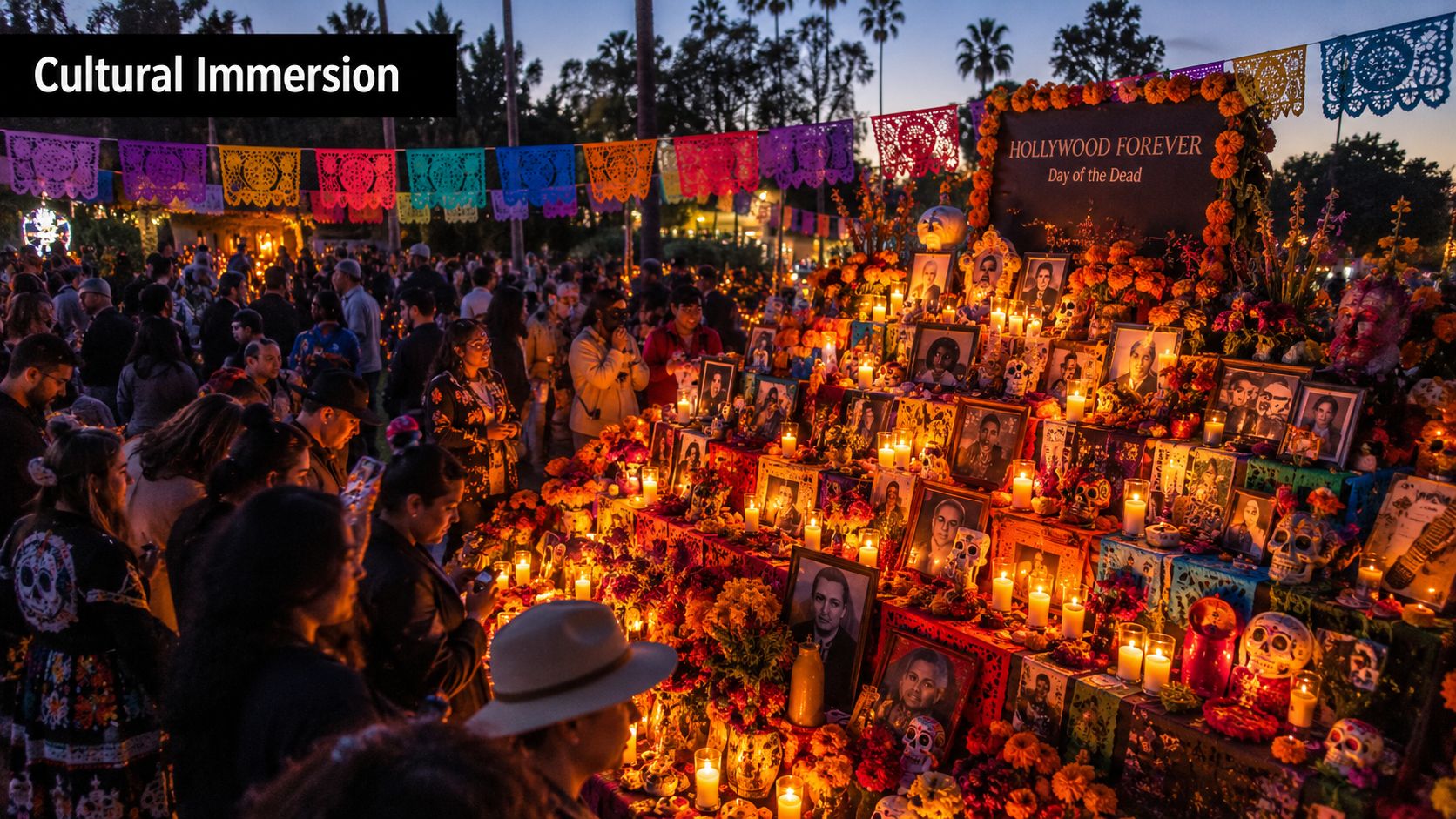
The size of the celebration is part of the draw. Coverage has described the event as bringing in very large crowds and filling the cemetery with dozens of altars honoring the dead, which is why the setting now functions as a major cultural venue rather than a quiet burial ground (Fifty Grande). That scale changes how you experience it. The pace is slower than a typical nightlife event, but busier than a museum visit, and every movement, from the food queues to the walk between altars, reflects that pressure. It is also a one-day gathering, with altar participation organized as a community-facing part of the celebration.
The experience feels public and intimate at the same time. Families come to honor their dead, visitors come to learn, photographers come for the light, and locals show up because the cemetery has become part of Los Angeles' cultural calendar.
If you are planning from afar and need your phone to stay reliable while you handle tickets, rideshares, and event updates, a practical guide on mobile internet for travelers will save you from the usual last-minute scramble.
Practical rule: Choose the admission window that matches your priorities. Daytime works better for families, calm walking, and altar viewing. Nighttime suits live energy and a more dramatic atmosphere. If your goal is culture and atmosphere, treat it like a timed heritage event with performance layers.
Understanding Ticket Tiers and Admission Windows
The biggest mistake first-timers make is assuming one ticket gets them the same experience all day. It doesn't. The festival is designed as a time-sliced event, and the admission window you choose shapes everything from crowd density to what you'll get to see.
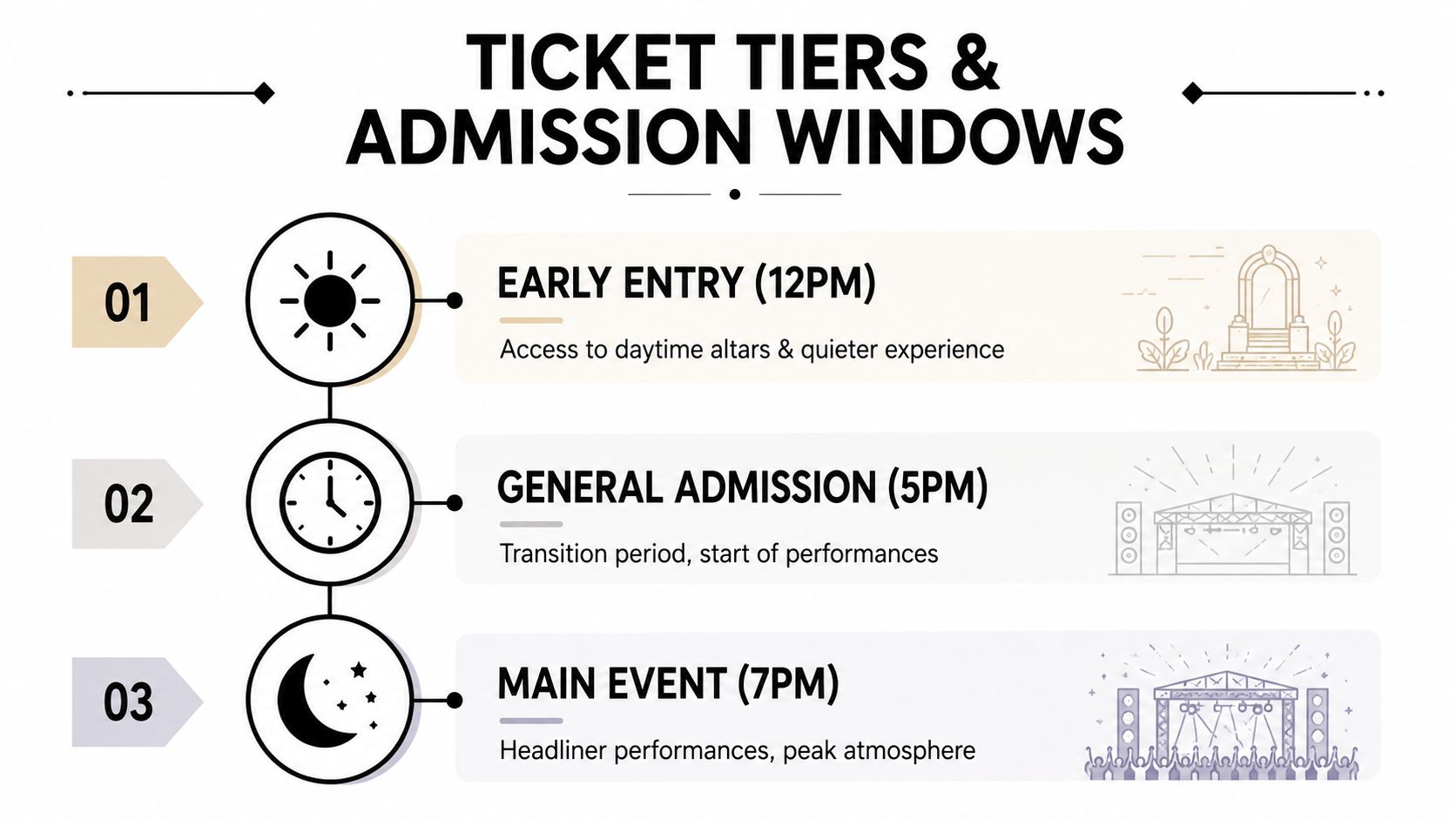
How the windows work
The official 2025 schedule shows three separate event windows, 1:00–3:30 p.m., 4:30–9:00 p.m., and 9:30 p.m.–1:30 a.m. (Los Angeles Day of the Dead). Other years have used similarly segmented blocks, including 10:00 a.m.–2:00 p.m., 2:00 p.m.–6:00 p.m., and 6:00 p.m.–11:00 p.m., with event pages stating that guests may remain past their window of admission in some formats (Hollywood Forever). That's the detail most visitors miss. The ticket system is a capacity tool, it spreads arrivals, reduces congestion, and lets the organizers match staffing to demand.
Which ticket should you choose
If you want a quieter, more reflective visit, choose the earliest window you can. That's the time for altars, slower walking, and photos without the heaviest crush of bodies.
If you want the full spectacle, choose the later window. That's when the energy rises, and the evening programming becomes the main draw. Current listings also show a daytime low-cost option and a higher-priced nighttime ticket, which is why you should decide based on your goal, not just the price tag. One current listing even labeled the 2025 event “SOLD OUT,” so buying early or planning around the window structure matters more than usual (PBS SoCal).
My advice: first-timers who care more about the cemetery experience than the headline show should prioritize earlier access or the golden-hour transition, not the latest slot.
A simple decision rule
- Choose daytime if you want calmer movement, families in tow, and altar viewing.
- Choose golden hour if you want the best visual balance.
- Choose nighttime if your priority is entertainment and atmosphere.
Daytime Altars Versus Nighttime Performances
The choice is simple. Do you want the cemetery's contemplative side or its festival side? They are different experiences, and treating them like the same thing only sets you up for the wrong ticket window.
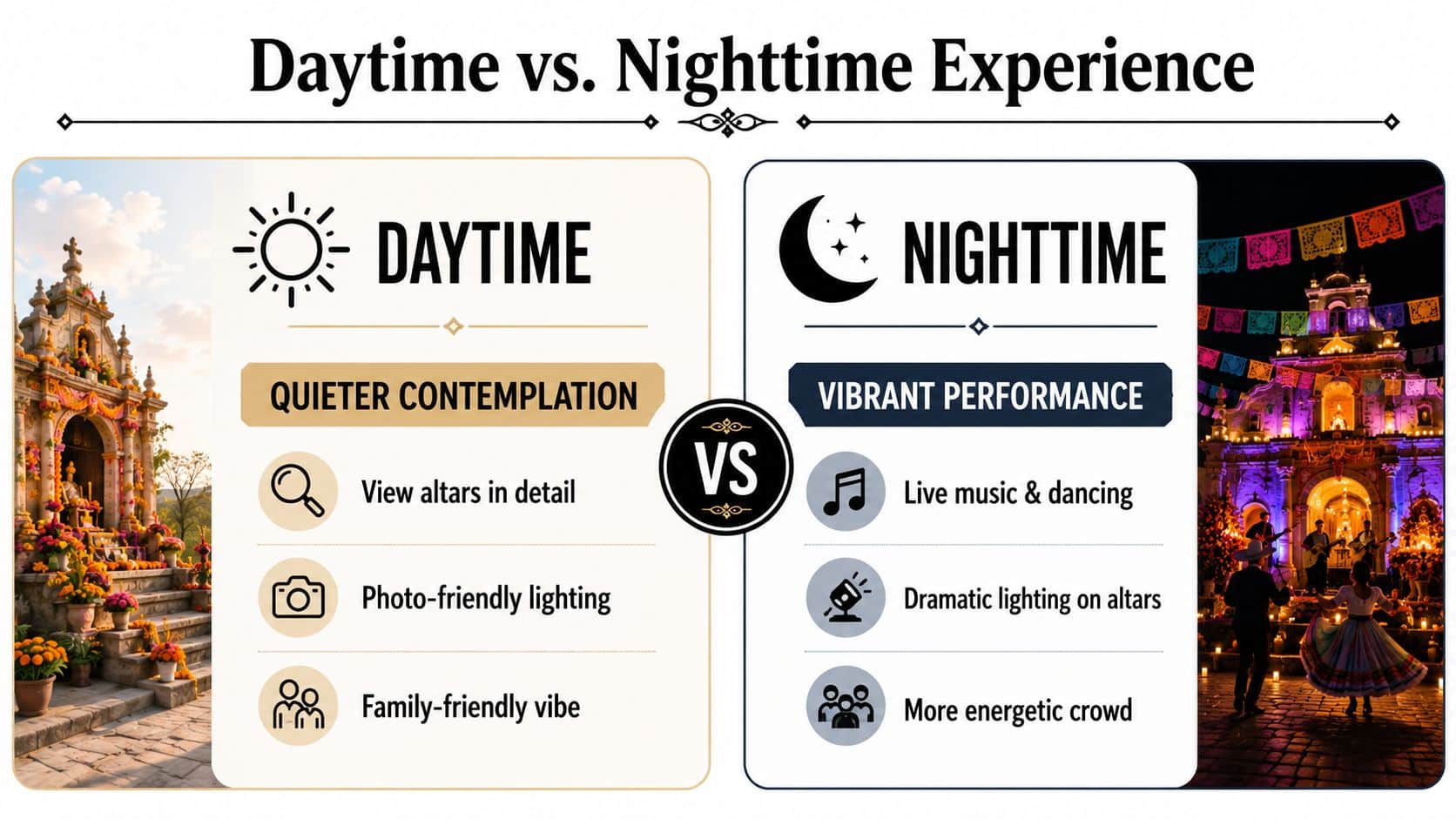
Daytime gives you the altar experience
In daylight, the altars are easier to study. You can see the photographs, candles, marigolds, and personal objects without pressing forward through the densest part of the crowd or losing detail in the dark. Families and community groups are usually more visible earlier in the day, and the mood feels reflective rather than theatrical.
That is why I recommend daytime for families, older visitors, and anyone who wants to understand the cultural meaning of the event instead of just chasing the spectacle. The cemetery itself becomes the main attraction, not the stage programming.
Nighttime is built for performance
The festival's official description lists altars, processions, music, costumes, cultural performances, food vendors, and Aztec dancers (Los Angeles Department of Cultural Affairs). A separate event listing from PBS SoCal points to the same evening emphasis, with layered programming that is clearly designed for motion, sound, and a bigger crowd.
Nighttime works if you want energy, music, and a visually dramatic setting. It suits groups of friends, couples looking for a livelier night, and visitors who want a festival atmosphere instead of a meditative one.
The sweet spot most guides miss
The best compromise is the golden hour period between roughly 4 p.m. and 6 p.m. That window gives you daylight for the altars, then dusk for mood, which is the cleanest transition the event offers. It is the right choice for travelers who care about both photos and feeling, because it gives you the visual clarity of day with the emotional lift of night.
If you are trying to balance crowds, photography, and comfort, read a practical guide on how to get around Los Angeles as a visitor before you pick your arrival time. The same logic applies here. Earlier access gives you room to move, while the later window gives you more atmosphere.
Who should pick what
- Families should choose daytime or golden hour.
- Couples usually get the most out of the shift into dusk.
- Photographers should avoid the deepest night unless they want atmosphere over detail.
- Solo travelers can choose based on energy, but earlier windows stay calmer.
Getting There and Navigating the Neighborhood
Start with the address, because that's the easiest part. Hollywood Forever Cemetery's Día de los Muertos celebration is held at 6000 Santa Monica Blvd., Los Angeles, CA 90038 (Los Angeles Day of the Dead). The hard part is everything around the address, because event-day traffic and curbside congestion are real.
What to do if you're driving
If you insist on driving, arrive earlier than your ticket window would suggest. The surrounding blocks handle a heavy flow of pedestrians during the event, and with attendance reaching nearly 30,000 in past years, the neighborhood absorbs a lot of pressure (Forbes). Don't assume parking will be easy just because the cemetery is easy to find.
Use side streets only if you know the neighborhood and are willing to walk. Otherwise, rideshare is the cleaner move, especially if you're coming from Beverly Hills, Santa Monica, or downtown Los Angeles. A private driver also makes sense here because you avoid the surge-price panic after the event ends.
What to do if you're using rideshare
Pick a drop-off point a short walk away from the main entrance instead of asking your driver to fight the bottleneck at the gate. That small move saves time and irritation. You're better off walking the last stretch than sitting in a car while everyone else is doing the same thing.
What to do if you want a calmer arrival
If you're staying in Hollywood, arrive early and plan to stay in the area before heading in. If you're traveling from another part of town, a guided service can remove the uncertainty altogether. One practical planning resource is how to get around Los Angeles as a tourist, especially if you want to pair the event with other stops and avoid parking math.
Concierge rule: for this event, transportation is part of the experience. If arrival feels rushed, the whole evening feels rushed.
What to Expect Inside the Celebration
You feel the event before you sort it out. The cemetery opens into a dense mix of altars, performances, vendors, and moving foot traffic, and each part pulls at your attention in a different way.
The altar walk
The altars are the reason many people come back year after year. One report described over 90 altars honoring the dead, which explains why experienced visitors arrive early and move with patience. You'll see family tributes, artistic installations, candles, photos, and offerings that make each altar feel personal rather than decorative (Fifty Grande).
The cemetery's meaning comes through here. You are not looking at generic festival decor. You are seeing public remembrance built with care.
The performance zones
Once the evening builds, the mood shifts. Aztec dancers bring ceremonial movement, music changes the pace of the crowd, and cultural performances make the event feel less like a walk-through and more like a full program. The official city listing also highlights food vendors, processions, and costumes, which adds to the sense that several experiences are unfolding at once (Los Angeles Department of Cultural Affairs).
ABC7's coverage showed how wide the programming can be, with vendor areas, DJ sets, a Coco screening, and a drone show woven into the schedule. That matters because different kinds of visitors can get what they want from the same night.
If you care about photos, this split matters even more. The later hours bring more atmosphere and crowd energy, while the earlier window is calmer and better for seeing details clearly, which is exactly why a resource like this Los Angeles photography tour guide can help you plan your timing with a sharper eye.
How it feels in practice
Stay long enough and the whole place moves from reverent to celebratory without losing its emotional center. The food stalls create pauses. The music creates movement. The altars create stillness. That contrast is why the event works so well in Hollywood, where spectacle is normal but meaning is harder to fake.
I'd call the experience crowded, vivid, and specific. You are not wandering through an abstract festival, you are moving through a public ritual with real visual richness and a lot of human attention behind it.
Photography Tips and Cultural Etiquette
This is one of the most photogenic events in Los Angeles, but it's not a free-for-all. The people building altars are honoring loved ones, and your camera should never come before that fact.
How to shoot it well
Arrive while there's still natural light if you want altar details to read clearly. The early and golden-hour windows are the most forgiving for color, shadows, and faces. Later at night, the lighting becomes more dramatic, which can be beautiful, but it also makes fine details harder to capture cleanly.
If you want to photograph an altar creator or a family group, ask first. Keep the question short, respectful, and easy to decline. The same goes for close-ups of offerings. The rule is simple, if you'd hesitate to touch it, don't treat it like a prop.
What to do and what to avoid
- Speak softly near altars. This is a remembrance space first.
- Don't touch offerings. Even a light adjustment can cross a line.
- Dress thoughtfully. This is not a costume party.
- Ask before photographing people. Especially families at altars.
- Watch your step. Crowds compress around popular displays.
The event rewards patience more than aggression. The best photos come when you slow down and wait for people to clear naturally, not when you push into a scene.
If you want a broader visual strategy for Los Angeles, including event photography, my preferred reference is this Los Angeles photography tour resource, because the same principles that work at the cemetery apply across the city.
Etiquette beats enthusiasm. If you're careful and discreet, people usually respond warmly. If you act like the altar is a set piece, they won't.
Building a Full Los Angeles Itinerary Around the Celebration
The smartest way to do this event is to make it part of a fuller Los Angeles day. If you only show up for the cemetery and nothing else, you'll miss the chance to balance the emotional weight of the evening with the kind of classic sightseeing that makes a trip feel complete.
A better day shape
For visitors staying in Beverly Hills or Hollywood, a strong plan is a relaxed morning in the city, then a late-afternoon move toward the cemetery. You could pair the day with the Hollywood Walk of Fame, a visit to Griffith Observatory, or a slow brunch before heading to the event. Those earlier activities give the evening context, especially if you're only in town for a few days.
Why a private tour works here
A private tour makes particular sense if you want to combine a few iconic stops and still arrive at the cemetery without feeling rushed. Another Side Of Los Angeles Tours can handle the logistics of a custom day that moves between landmarks and the cemetery, which is useful if you're traveling with family, a couple, or a corporate group and don't want to think about routing or parking.
That matters in Los Angeles because the city rewards planning. If your tour vehicle drops you in the right place and picks you up without the after-event scramble, you get to spend your energy on the actual experience instead of the curbside logistics.
What to do after the event
If you choose a daytime or golden-hour window, you still have room for dinner afterward. Keep the meal simple and nearby rather than trying to cross half the city after a long evening. The point is to preserve the mood, not to overpack the night.
For a broader city framework, especially if you're trying to see more than one neighborhood in a single day, how to spend a day in Los Angeles is the kind of planning reference that helps the day feel intentional rather than improvised.
Your Essential Day-of-Dead Visit Checklist
Save this before you go. The best visits are the ones where you've already made the small decisions.
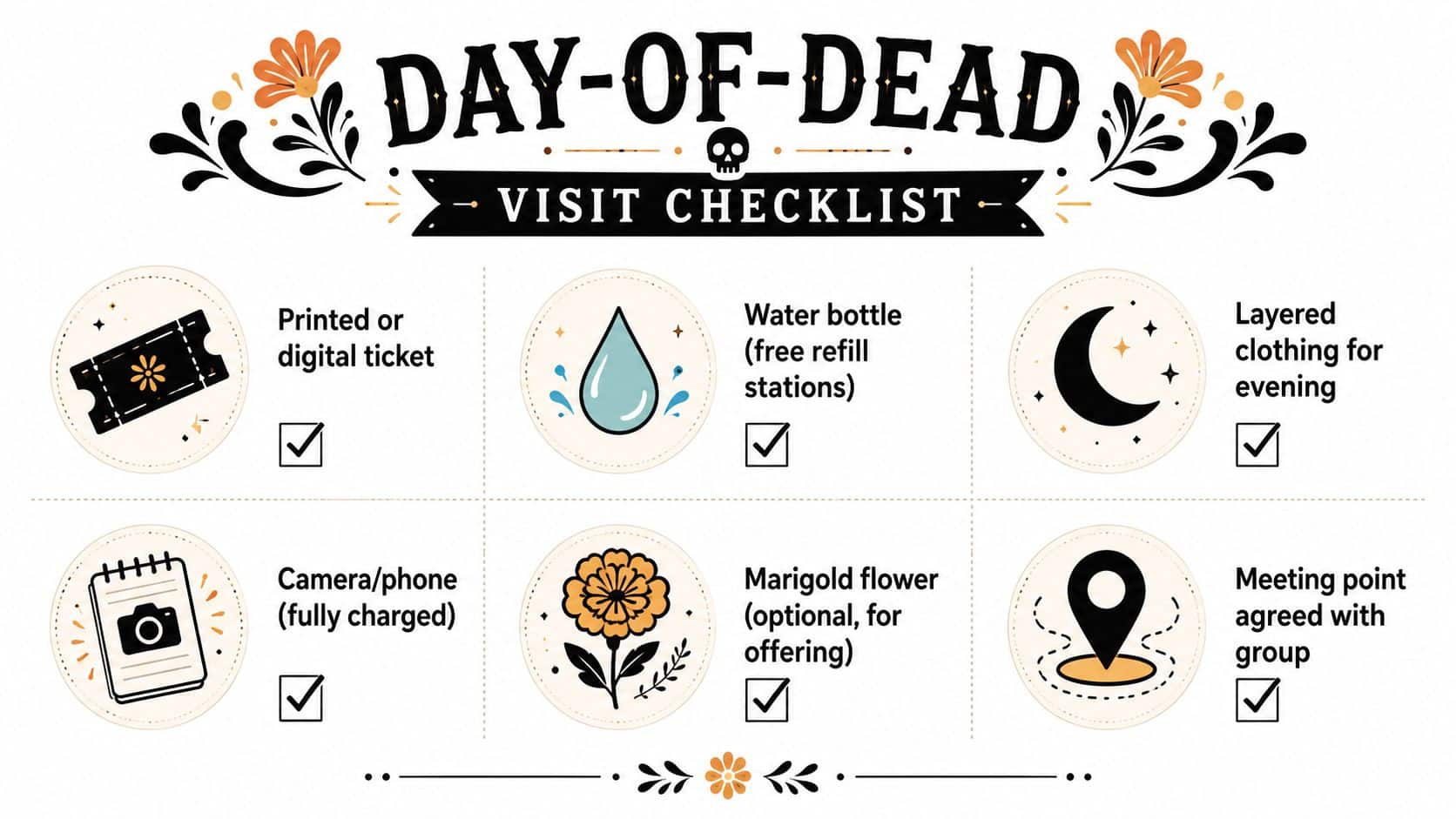
Your quick checklist
- Confirm your ticket tier and know your admission window before you leave.
- Plan arrival early if you want easier entry and less stress.
- Bring a fully charged phone and a portable charger.
- Wear comfortable shoes because you'll be walking and standing a lot.
- Pack layers for the evening temperature drop.
- Carry water and a little cash for small vendors.
- Agree on a meeting point if you're going with a group.
- Respect the altars by asking before photographing people or touching offerings.
The cemetery grounds are largely flat, but crowds can make movement slower than expected, so visitors with mobility concerns should plan carefully and avoid the most compressed arrival times. If you want a calmer experience, earlier windows are easier to manage than late-night arrival.
The rule is simple. Buy the right ticket, arrive with a transportation plan, and decide in advance whether you want reflection, photography, or nightlife. That's how you turn a popular event into a memorable one.
A CTA for Another Side Of Los Angeles Tours. If you want to fold Hollywood Forever Cemetery Day of the Dead into a polished Los Angeles day without dealing with traffic, parking, or timing confusion, book a private tour that handles the logistics and lets you focus on the experience.