You’ve probably heard that Hollywood got its name from the film industry, or maybe from a stretch of holly bushes that once lined the hills. Neither story tells the whole picture, and most articles online repeat the same guesses without checking the actual record. If you’re wondering how Hollywood got its name, the real answer traces back to 1886, decades before a single movie camera showed up in Los Angeles.
The name belongs to Daeida Wilcox, wife of real estate developer Harvey Wilcox, who chose it for their new ranch subdivision. The most credible explanation involves a chance encounter on a train and a friend’s summer home in Ohio, not a plant or a studio executive. We’ll walk through the documented version of events and clear up the competing theories that still get repeated as fact.
By the end, you’ll know exactly who named Hollywood, why the story has gotten muddled over the past century, and how the name eventually became shorthand for the entertainment industry itself. And if the history makes you want to see the neighborhood in person, our guides on Another Side Tours walk these same streets daily and share the details that never make it into the guidebooks.
Why Hollywood’s naming story still fascinates visitors today
Millions of people fly into Los Angeles every year expecting Hollywood to feel like the movies. Instead they find a busy commercial strip with souvenir shops, street performers, and a sidewalk full of stars. That gap between expectation and reality is exactly why the origin story matters so much. Once you know Hollywood existed as a quiet citrus ranch almost thirty years before the first film studio arrived, the neighborhood starts making more sense, and the letters on the hillside stop feeling like the whole story.
A name older than the industry it represents
People assume the word "Hollywood" was invented by studio executives looking for a catchy brand. It wasn’t. The subdivision name predates the film business by decades, and the timeline throws most visitors off the moment they hear it. Daeida Wilcox picked the name in 1886 for a rural development of orchards and dirt roads, long before anyone in California had heard of moving pictures.
Hollywood was a name in search of a movie industry, not the other way around.
That single fact reshapes how people think about the neighborhood. It also explains why so many local landmarks, like the old Hollywood Hotel or the original street grid, have nothing to do with entertainment history at all. They belong to an earlier chapter that most tourists never hear about.
Curiosity about the founders themselves
Visitors also get pulled in by the human details behind the name. Harvey Wilcox was a teetotaling developer who banned alcohol sales on his land, a strange footnote given what Hollywood Boulevard looks like on a Saturday night now. Daeida, his wife, gets credit for the actual naming decision, which surprises people who assume a male studio boss dreamed it up. These small contradictions between the founders’ intentions and the neighborhood’s later reputation keep the story interesting long after the basic facts are known.
A story that keeps getting retold wrong
Blogs and travel sites frequently repeat the holly bush theory or claim a silent-film director coined the term, and neither claim holds up against the historical record. Wrong information spreads fast because it sounds plausible, and few writers bother checking primary sources like early Los Angeles land records or newspaper archives from the 1880s. That’s part of why this origin story keeps circling back into travel articles, podcasts, and guided tours: people want the accurate version once they realize how much misinformation is out there. Getting it right also adds real context to a visit, turning a photo stop at the Hollywood Sign into something with actual historical weight instead of just another item on a checklist.
The competing legends behind the Hollywood name
Ask five people how Hollywood got its name and you’ll likely hear five different answers. Some stick around because they’re colorful, others because they’ve been copied from one blog to the next without anyone checking a land deed or newspaper clipping. Sorting through the noise means separating folklore from what actually shows up in the historical record.
The holly bush theory that won’t die
The most repeated claim says the hills were once covered in holly bushes, and settlers simply named the area after the plant. It’s a tidy story, but botanists and local historians have pointed out for decades that holly doesn’t grow naturally in this part of Southern California’s dry chaparral. No survey maps, nursery records, or early resident accounts mention holly groves anywhere near the Wilcox property.

If holly bushes never grew there, the name never came from holly bushes.
The Ohio connection that actually holds up
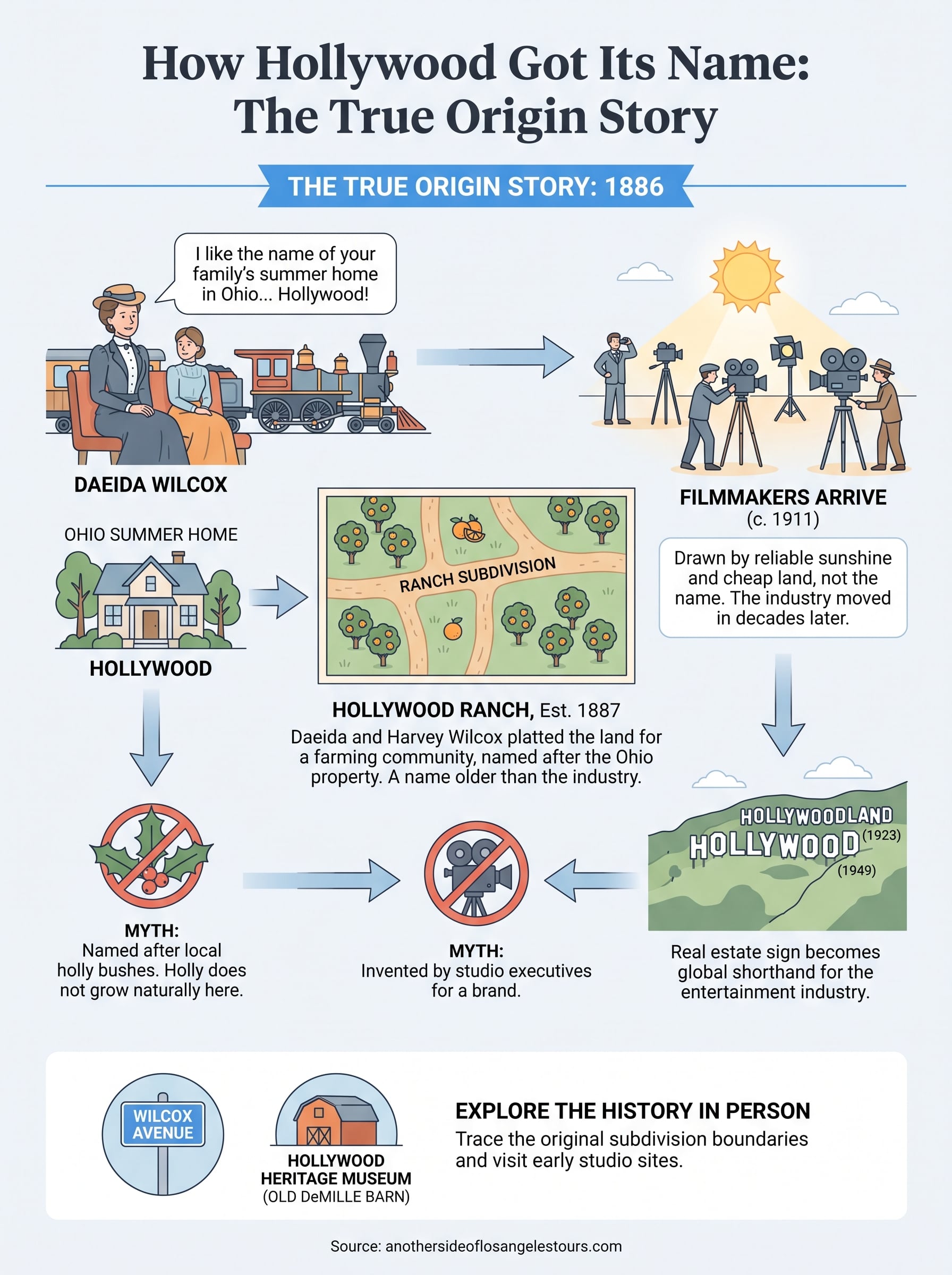
The better-supported version traces back to a train conversation Daeida Wilcox had with a woman heading to her family’s summer home in Ohio, a property already called "Hollywood." Daeida liked the sound of it and borrowed the name for her own subdivision. This account appears in early biographical sketches of the Wilcox family and lines up with land records from 1886, which is more documentation than the holly story ever produced.
| Theory | Core Claim | Historical Support |
|---|---|---|
| Holly bush myth | Named after local holly plants | None found in botanical or land records |
| Ohio train story | Borrowed from a friend’s Ohio property name | Matches Wilcox family accounts and 1886 filings |
| Studio-era invention | Coined by early filmmakers | Contradicted by the 1886 subdivision date |
Once you line these theories up side by side, the Ohio story is the one that survives scrutiny.
How the name evolved from a ranch to a global brand
Harvey and Daeida Wilcox platted their subdivision in 1887, and for the next two decades Hollywood stayed exactly what it looked like on paper: a farming community with citrus groves, dirt roads, and a couple hundred residents. Nothing about it suggested global fame. The transformation started only after the film industry began looking for cheap land and reliable sunshine, and that search had nothing to do with the name itself.
Filmmakers arrived for the weather, not the word
Early filmmakers left the East Coast because New York and New Jersey winters killed shooting schedules. Southern California offered year-round light, varied scenery within a short drive, and land prices low enough for studios to build permanent lots. Companies like Nestor Studios set up shop in Hollywood proper around 1911, and within a few years the area had dozens of production companies operating out of converted barns and storefronts. The name was already sitting there waiting to be claimed by an industry that hadn’t existed when Daeida picked it.
The sign that sealed the association
The famous hillside sign didn’t start as a monument to the movies either. Real estate developers erected it in 1923 to read "HOLLYWOODLAND," advertising a housing development, not a studio system. Crews removed the last four letters in 1949, and the sign became the visual shorthand people now associate with the entertainment world. You can read more about the sign’s origin through the Los Angeles Public Library’s historical archives.
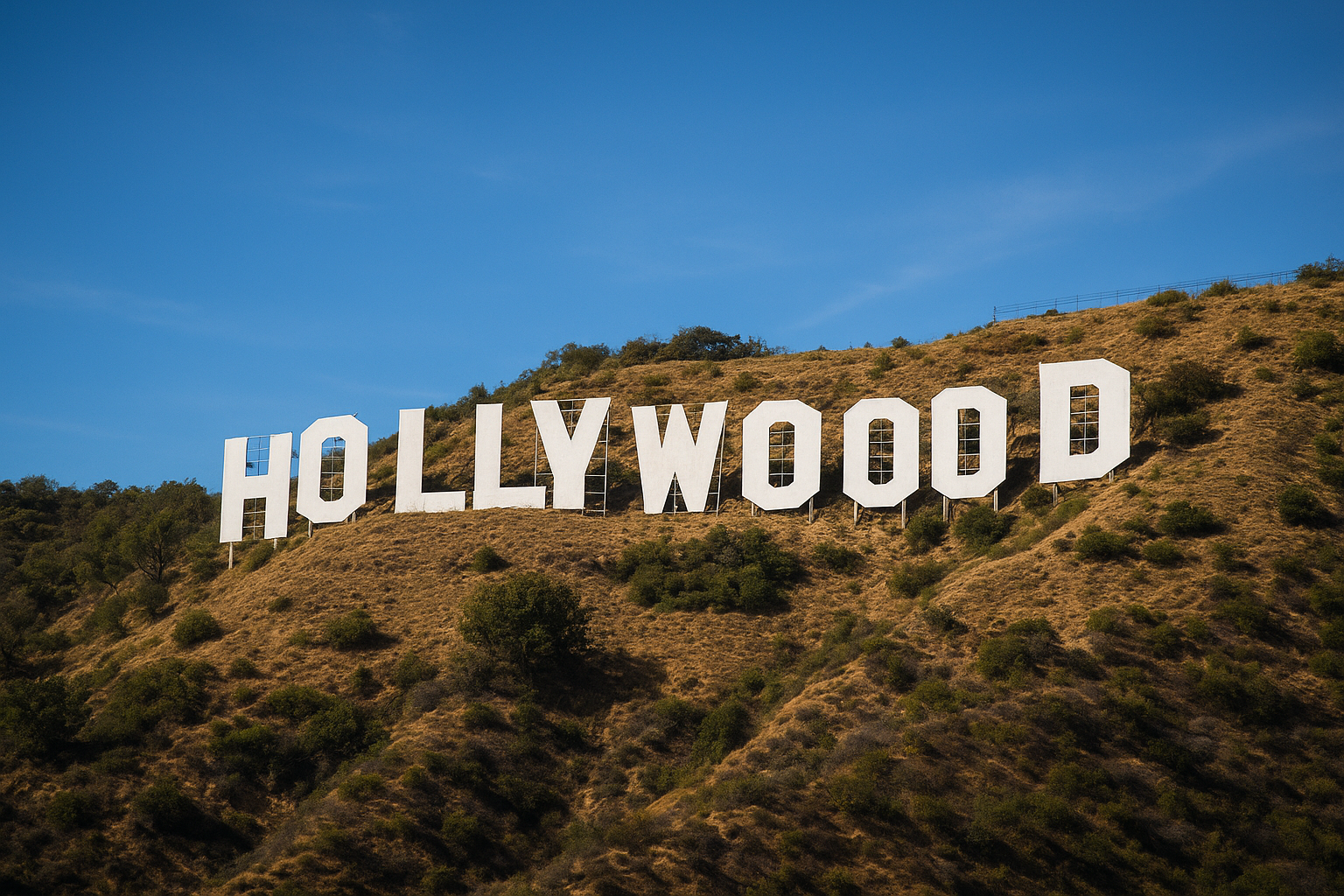
A real estate sign meant to sell houses ended up selling an entire industry’s image instead.
By the 1930s, "Hollywood" had shifted from a place name to an industry shorthand, used the same way people now say "Wall Street" or "Silicon Valley." The ranch was gone. The brand had taken over completely.
How to explore the history behind the Hollywood name in person
Knowing how Hollywood got its name means little until you stand on the streets that still carry it. Several spots around the neighborhood connect directly to the Wilcox subdivision, and a short walk turns the history lesson into something you can actually see and touch.
Trace the original subdivision boundaries
Wilcox Avenue, named for Harvey himself, cuts through the heart of the old ranch and still marks part of the original property line. Nearby, the Hollywood Heritage Museum sits inside a barn that once served as one of the first film studios in the area, giving visitors a physical link between the ranch era and the studio era that followed. Consider stopping at:
- Wilcox Avenue and Hollywood Boulevard, near the original subdivision plat
- Hollywood Heritage Museum, housed in the old DeMille Barn
- Hollywood Sign viewpoints at Griffith Observatory or Lake Hollywood Park
Each location adds a layer most guidebooks skip entirely.
Join a guided tour for the full context
Self-guided walks work fine, but a knowledgeable guide fills in gaps that plaques and museum placards leave out. Local guides who know the land records and family history can point out which buildings sit on former citrus grove soil and which arrived later with the studio boom.
The streets look ordinary until someone tells you what used to stand there.
Rather than piece the story together from mismatched blog posts, Another Side Tours runs Hollywood-focused walking tours that cover the Wilcox origin story alongside the studio-era landmarks, so you leave with the accurate version instead of another round of guesswork.
The name that became a legend
Hollywood’s name started as a personal choice by a woman naming her husband’s ranch, not a marketing plan for an industry that didn’t exist yet. The Ohio train story holds up against every record historians have checked, while the holly bush myth and studio-invention theories keep getting repeated without evidence. Once you know the real timeline, the neighborhood reads differently. The old subdivision boundaries, the DeMille Barn, the sign that once advertised houses instead of movies, all of it fits into a single story instead of a jumble of unrelated facts.
That kind of context is what turns a quick photo stop into an actual visit worth remembering. If you’d rather hear the full story on the ground than piece it together from another blog post, book a private Hollywood tour with a guide who knows exactly which streets still belong to Daeida Wilcox’s original ranch.