You've just landed in Los Angeles, the family is asking where the stars are, and your phone is offering three different routes to Hollywood. The key question isn't which freeway leads to the Walk of Fame. It's whether you should carry luggage through a station, hunt for a garage, wait through a rideshare surge, or let a local guide handle the entire arrival.
Hollywood is compact on a map but demanding in practice. The Hollywood Walk of Fame runs along an 18-block stretch of Hollywood Boulevard and Vine Street, was established in 1960, and became a Los Angeles Historical-Cultural Monument in 1978, according to the Los Angeles Times history of the Walk of Fame. That concentration of landmarks makes walking attractive, but it also concentrates traffic, tour buses, event crowds, and curbside confusion.
This concierge guide treats directions to Hollywood as a mode-and-timing decision. You'll find practical route advice from LAX, Downtown LA, and Santa Monica, plus Metro guidance, parking strategy, Griffith Observatory logistics, and private-tour planning for first-time visitors, families, couples, corporate groups, and travelers who'd rather spend their afternoon sightseeing than negotiating Los Angeles traffic.
Table of Contents
- Arriving in Hollywood Without the Guesswork
- Driving, Rideshare, or Transit
- Directions to Hollywood from LAX
- Directions to Hollywood from Downtown LA
- Directions to Hollywood from Santa Monica
- Parking and Drop-Off Around Hollywood
- Riding the Metro to Hollywood
- Getting to Griffith Observatory
- Event Nights, Closures, and Timing
- Why Travelers Choose a Private Guide
- Quick Reference for Your Hollywood Trip
- Frequently Asked Questions
Arriving in Hollywood Without the Guesswork
Step onto Hollywood Boulevard and the district can feel instantly crowded: palm-lined sidewalks, terrazzo stars underfoot, costumed characters, and the rooftop outlook from Ovation Hollywood. First-time visitors often ask whether the Walk of Fame, TCL Chinese Theatre, Dolby Theatre, and Hollywood Sign fit into one easy stroll. Several landmarks do. Griffith Observatory does not.
Choose how you want to arrive before choosing a route. A couple carrying bags to dinner may need a direct car. A family with a stroller should prioritize a garage with an elevator. Anyone attending the Hollywood Bowl needs a timed plan that accounts for the event, not just a map pin.
Concierge rule: Match your arrival mode to luggage, mobility, schedule, and events. The route is only half the decision.
Hollywood's popularity explains the district's tight, busy feel. The Walk of Fame has drawn about 10 million visitors annually, while Hollywood tourism formed part of a Los Angeles County economy that attracted nearly 26 million visitors and about $14 billion annually, according to the Los Angeles Times. The boulevard is a memorable first stop and a high-volume urban corridor.
A reliable arrival plan considers traffic on the 101, theatre crowds near the Pantages and Dolby, Hollywood Bowl concerts, premieres, and temporary boulevard closures. It also settles the details generic route guides skip: where to leave a car, when a TAP card helps, where rideshares should unload, and when a private vehicle is worth the added cost.
For private tours, timing matters as much as the pickup point. A guide can coordinate luggage, curb access, and event-day changes before your group reaches Hollywood, keeping the first few hours focused on sightseeing rather than roadside decisions.
Driving, Rideshare, or Transit
Three arrival styles cover most Hollywood trips. Driving offers the most flexibility for luggage, strollers, late dinners, and multi-stop itineraries, but parking near Hollywood Boulevard can be expensive and garages around Ovation Hollywood can develop queues. Rideshare gives you door-to-door convenience without the parking search, although prices can rise sharply after premieres, Bowl concerts, and Pantages performances. Metro avoids surface traffic and works especially well for travelers staying near a rail station.
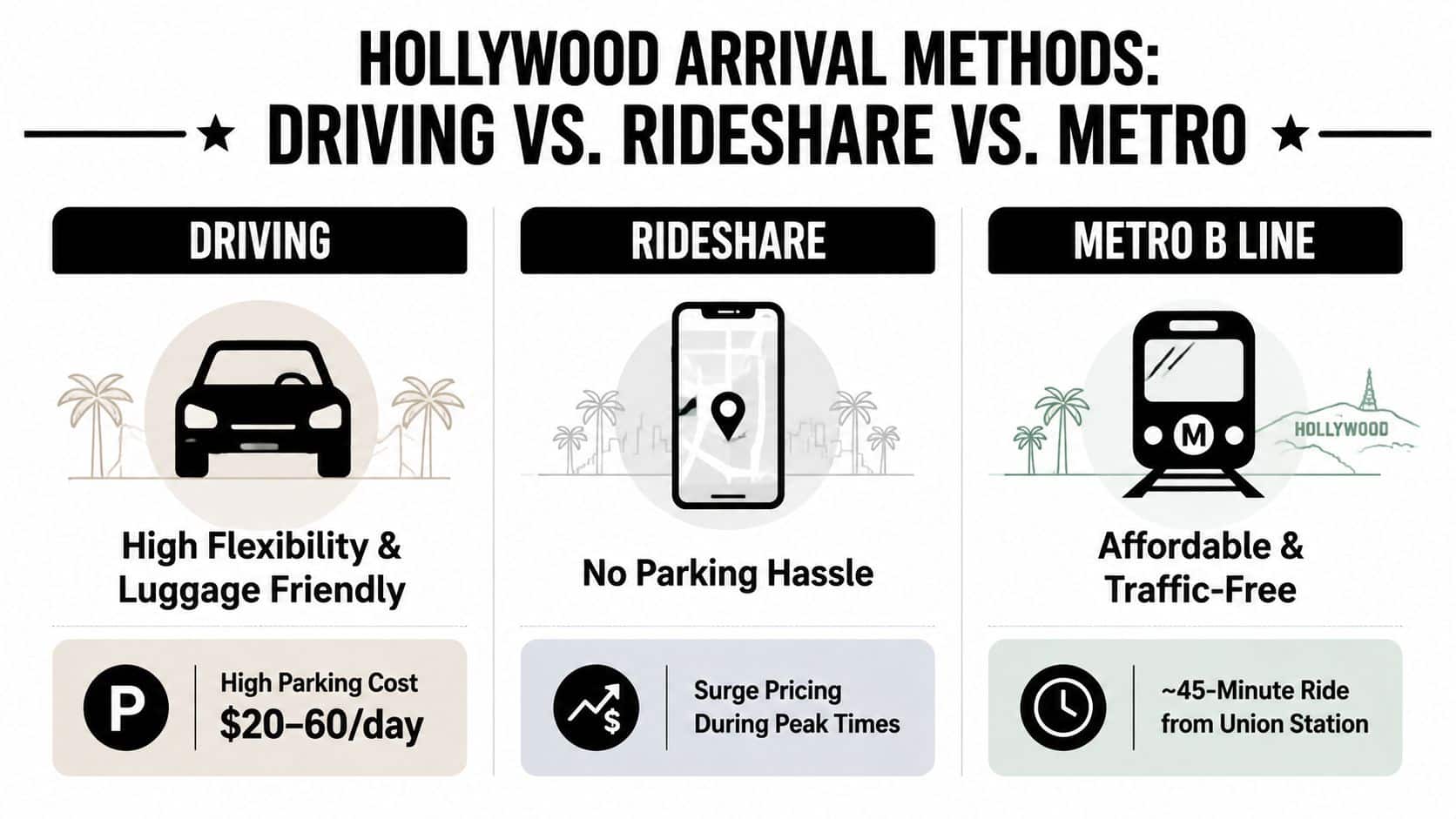
The Metro B Line runs from Union Station through Downtown LA toward Hollywood, including Hollywood/Highland and Hollywood/Vine. It's the most predictable choice when traffic is thick and your group can manage luggage and station walking. For visitors comparing independent travel options, this guide to getting around Los Angeles as a tourist offers useful context for combining rail, cars, and walking.
| Mode | Main advantage | Main drawback | Best match |
|---|---|---|---|
| Driving | Flexible, luggage-friendly | Parking and traffic | Families, late dinners, multi-stop days |
| Rideshare | Simple curb-to-curb arrival | Event-related surge pricing | Couples, hotel guests, light luggage |
| Metro B Line | Traffic-free and dependable | Less convenient with bulky bags | Budget-conscious visitors near stations |
My recommendation is straightforward. Use Metro when timing matters more than door-to-door comfort, rideshare when convenience is the priority, and a private car when Hollywood is one stop within a larger Beverly Hills, Santa Monica, Malibu, or Griffith itinerary. Travelers arriving by air through Hollywood Burbank Airport may also want to review options for a luxury private jet at KBUR before planning the ground transfer.
Directions to Hollywood from LAX
From LAX, you have three sensible choices: FlyAway and rail, rideshare, or a private car. The right one depends on your arrival hour, luggage, and whether Hollywood is your final destination or the opening stop in a full Los Angeles day.
For a self-guided drive, head east on the 105, continue north on the 110, then take the 101 north past Downtown LA toward Hollywood. The usual destination is Hollywood/Highland, with Highland Avenue providing the most recognizable entry into the Walk of Fame district. The trip commonly takes 35 to 75 minutes, with the biggest delays building near the 101 and 110 interchange during afternoon rush hour. Those travel-time figures and route conditions are practical planning guidance, not a guarantee. Los Angeles traffic can change quickly.
Three ways to leave the airport
- FlyAway plus Metro: Take the airport bus toward a rail connection, then continue toward Hollywood. This is economical, but it's less appealing with several suitcases or tired children.
- Rideshare: Follow airport signs for the LAX-it area, then request the vehicle from the designated pickup zone. It's convenient, though a post-flight surge can make the price unpredictable.
- Private car service: A guide or driver can meet you at baggage claim, manage luggage, and select the 101 or surface streets through Beverly Hills based on live conditions.
If you're resting between flights, consult the practical Los Angeles airport day rooms guide before committing to a long sightseeing day. For smoother road conditions, arrivals before 2 p.m. or after 7 p.m. are generally preferable to the afternoon crush. Those windows are planning recommendations, not fixed guarantees.
Hollywood Bowl nights and major premieres can change the final approach even when the freeway is moving. Build in extra time, confirm the venue's arrival instructions, and expect that your driver may use a different drop-off street than the one shown on your original map.
Directions to Hollywood from Downtown LA
Downtown LA and Hollywood are linked cleanly by both the 101 and the Metro B Line. Driving makes sense when you're carrying shopping bags, traveling with a stroller, or continuing directly to Beverly Hills or Santa Monica. Otherwise, rail is usually the calmer choice.
By car
Take the 101 north from the 110 interchange. For the Walk of Fame, Hollywood Boulevard, and Dolby Theatre, use Highland Avenue or Cahuenga Boulevard depending on your final block and current congestion. Off-peak trips can take 20 to 30 minutes, while rush hour and event nights can push the journey beyond 45 minutes.
By Metro
Walk to Pershing Square or 7th Street/Metro Center and board the northbound B Line. Ride toward Hollywood/Highland for Ovation Hollywood, Dolby Theatre, TCL Chinese Theatre, and the core Walk of Fame area. Hollywood/Vine is more useful for the Pantages Theatre and the eastern side of Hollywood Boulevard.
Buy or load a TAP card at a station kiosk. Visitors staying downtown should choose transit on nights when games at Dodger Stadium or Crypto.com Arena make surface streets especially unpleasant, though always check current service and event conditions before leaving.
| Mode | Typical time | Approx. cost | Best for | Key stop |
|---|---|---|---|---|
| 101 north | 20 to 30 minutes off-peak | Varies | Luggage and flexibility | Highland or Cahuenga |
| Metro B Line | About 15 to 20 minutes | Varies by fare product | Predictable arrival | Hollywood/Highland or Hollywood/Vine |
| Private car | Traffic-dependent | Quoted by provider | Multi-stop sightseeing | Hotel or chosen venue |
Directions to Hollywood from Santa Monica
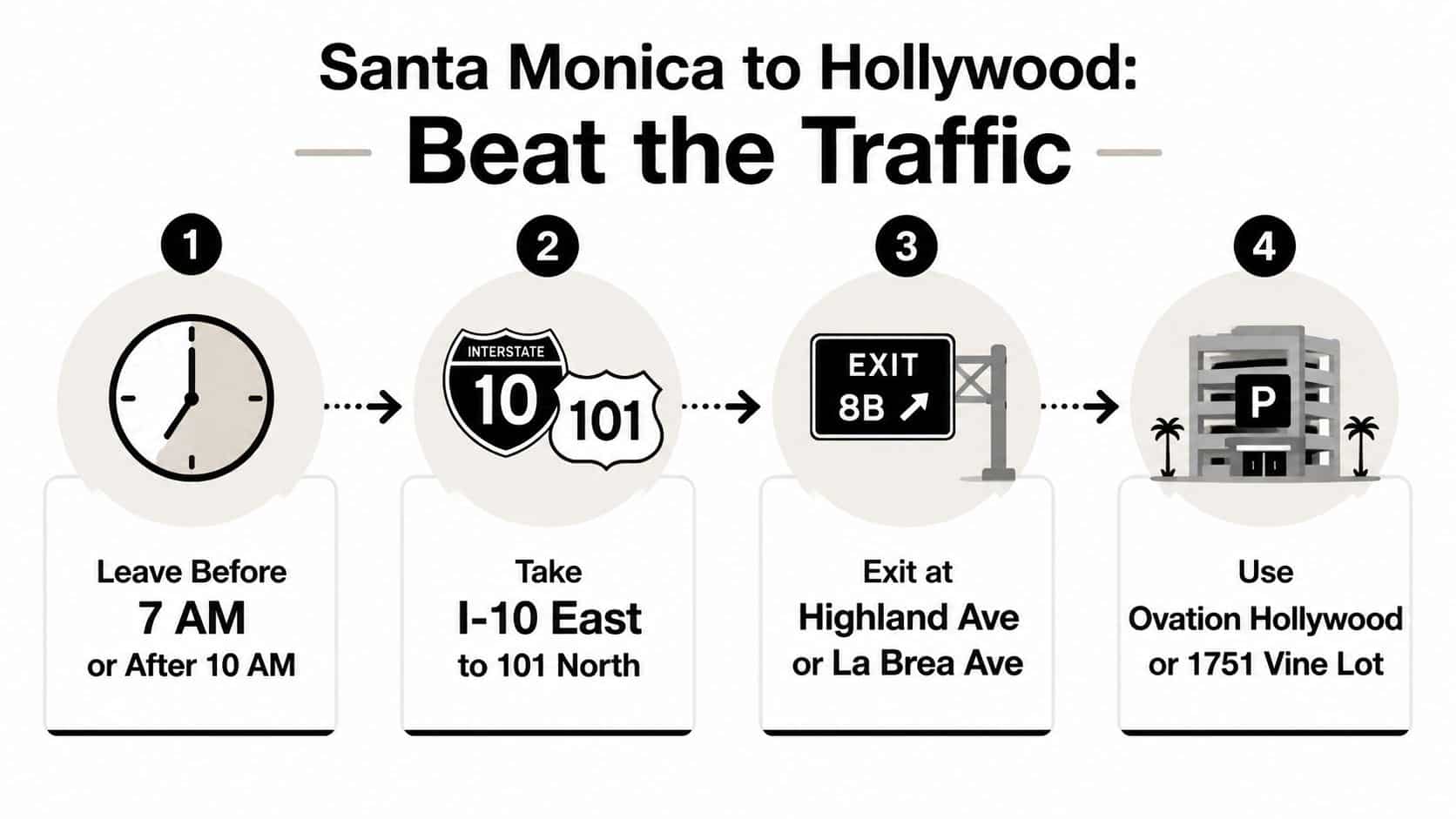
The Westside requires timing discipline. The direct route is I-10 east to the 101 north, followed by an exit at Highland Avenue or Vine Street. Weekday mornings and weekend afternoons can be especially slow as beach traffic feeds the freeway, so allow a broad travel window rather than trusting a best-case map estimate.
For a more composed drive, take surface streets through Beverly Hills and follow Sunset Boulevard eastbound. This route can take longer on paper, but it offers a more pleasant approach past the Chateau Marmont and avoids relying entirely on freeway conditions. It's a strong choice for a private sightseeing day where the drive itself can become part of the experience.
Midmorning is generally more comfortable than the 3 to 7 p.m. rush. If you're taking transit, board the Metro E Line at Downtown Santa Monica, transfer to the B Line at 7th Street/Metro Center, and continue to Hollywood/Highland. The full rail journey typically takes 60 to 75 minutes, and bikes can be brought onto rail when space and current Metro rules permit.
A TAP card handles the fare, and station kiosks are the simplest place to buy or reload one. If you're traveling with children, bulky beach gear, or luggage, a car remains easier. If you're a couple with light bags and a flexible itinerary, rail removes the stress of watching freeway colors change while you sit in traffic.
Parking and Drop-Off Around Hollywood
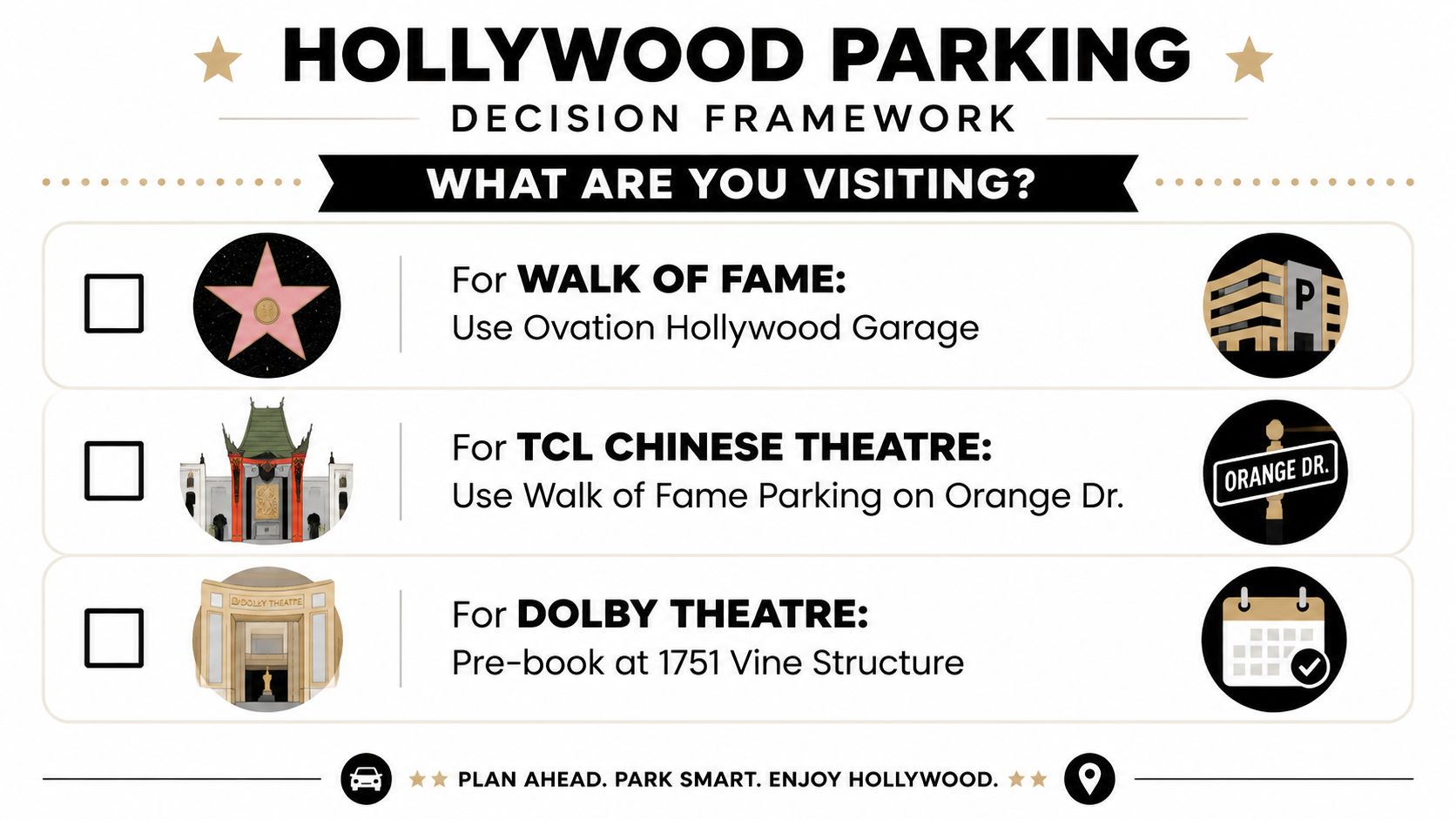
Choose the arrival point before choosing the route. For the Walk of Fame, TCL Chinese Theatre, and Dolby Theatre, Ovation Hollywood is the most practical parking anchor. It puts you beside the main attractions and offers elevator access to the boulevard. Selma Avenue lots are useful backups when the primary garage is full.
A quick photo stop needs a different curb strategy. Use signed loading areas, never a travel lane, and treat Beachwood Drive and Lake Hollywood Park as separate destinations from the Walk of Fame. Hollywood Sign viewpoints may have their own restrictions, pedestrian traffic, and very little curb space.
For private tours, families, and event guests, plan the drop-off before the vehicle enters Hollywood Boulevard. A legal curbside meeting point keeps the driver moving and gives your group a clear place to regroup.
- Walk of Fame and TCL Chinese Theatre: Park at Ovation Hollywood or a nearby structure, then walk.
- Dolby Theatre: Check event parking instructions before performances and premieres.
- Quick sign-viewpoint photo: Use signed loading zones and keep residential access clear.
- Rideshare arrival: Request a legal curbside location, not a stop in the middle of Hollywood Boulevard.
- Tour buses and accessible vehicles: Use designated loading areas and confirm clearance requirements in advance.
Parking changes throughout the day. LA Metro's parking-by-line resources make it easier to check available facilities before committing to a garage. ParkMobile may work at participating locations, and Ovation Hollywood has EV charging. Street meters are enforced until 8 p.m. most days, so read the sign at the exact space. Event nights require extra time, and a guide should set the meeting point before arrival.
Riding the Metro to Hollywood
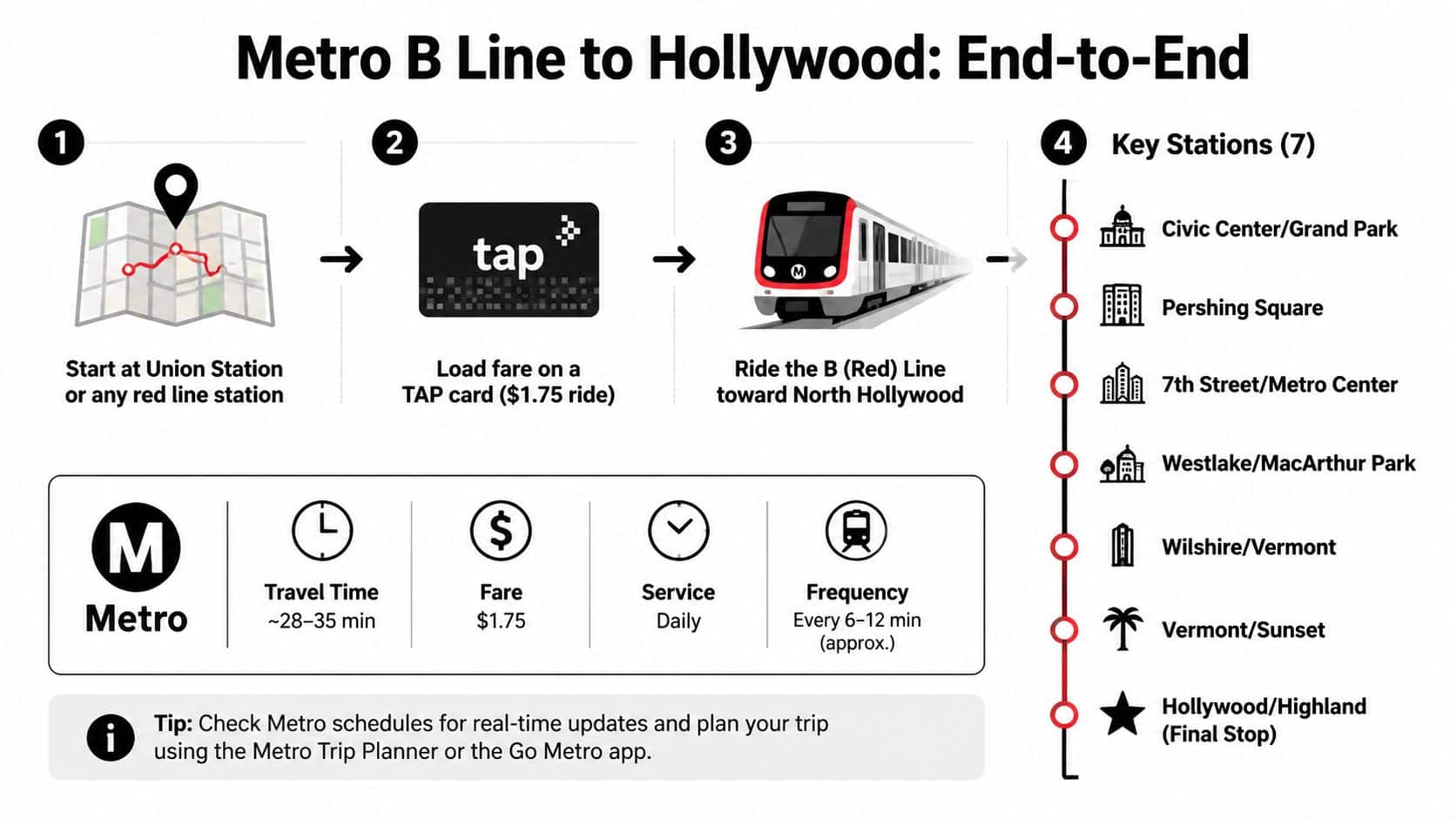
For first-time visitors, families, and private-tour guests, the B Line is often the smartest way to reach Hollywood when traffic and event-day drop-offs will slow a car. From Union Station, follow signs for the B Line toward North Hollywood and remain aboard through Downtown LA and the central Wilshire corridor. The main stops are Civic Center/Grand Park, Pershing Square, 7th Street/Metro Center, Westlake/MacArthur Park, Wilshire/Vermont, Vermont/Sunset, and Hollywood/Highland.
Hollywood/Highland puts you closest to the Walk of Fame, TCL Chinese Theatre, Dolby Theatre, and Ovation Hollywood. Hollywood/Vine serves the eastern boulevard and Pantages area. Choose the station that matches your destination, then follow the exit signs carefully. On busy evenings, confirm the meeting point with your driver or guide before leaving the platform.
TAP card basics
Buy or reload a TAP card at station kiosks. A Metro ride costs $1.75 each way, with free transfers within 90 minutes, according to Metro's official fare information. Check Metro before departure for current frequency, late-night service, elevator status, and bike policies.
The B Line generally arrives about every 12 minutes midday and about every 20 minutes at night. Service ends around midnight on weekdays and later on weekends, based on the route-planning details provided. Verify the live schedule before booking a late theatre performance or restaurant reservation.
For Hollywood Bowl events, ride to Hollywood/Highland, then use the venue's free shuttle from Ovation Hollywood. The official Hollywood Bowl venue guide states that shuttles run about every 15 to 20 minutes and begin 2.5 hours before showtime. A valid Metro TAP card or GoMetro Round-Trip Pass is accepted, so transit is a strong choice on concert nights.
Getting to Griffith Observatory
Griffith Observatory sits high above Hollywood Boulevard, so treat it as a separate destination when planning your day. Combining it with the Walk of Fame requires a deliberate choice of transport and timing. A rushed afternoon can turn into a long uphill approach and a difficult parking search.
The Observatory is located at 2800 East Observatory Road, Los Angeles, CA 90027. It is open Tuesday through Friday from noon to 10 p.m., Saturday and Sunday from 10 a.m. to 10 p.m., and closed Monday, according to Griffith Observatory's visitor information.
Your best approach depends on the group. Driving via Vermont or Fernwood from Los Feliz gives you direct access, but hilltop parking is paid and fills quickly on weekends, holidays, and during summer. The DASH Observatory shuttle from Vermont/Sunset is my recommendation for visitors who want to avoid circling for a space. Fit travelers can walk on the paved road or use Hogback Trail, provided they allow for elevation, carry water, and wear suitable shoes.
Griffith Park's higher elevations can become heavily congested, with limited parking during busy periods. Visit California's Griffith Park guidance notes that, when the Greek Theatre has no show, visitors can park there for free and take the DASH Observatory shuttle for 50 cents. The DASH Observatory/Los Feliz shuttle runs every 15 to 20 minutes.
Entry to the park is free, while Planetarium shows require admission. On weekends, arriving around 9 a.m. is the practical choice. After sunset, stay on paved paths, follow closure signs, and bring layers. Wind across the open slope makes the hilltop cooler than Hollywood's sidewalks.
A private outing can simplify the logistics. The Hollywood Sign and Griffith Observatory tour coordinates viewpoints, route planning, and timing, which suits families, first-time visitors, and guests working around a fixed dinner or event reservation.
Event Nights, Closures, and Timing
A Hollywood arrival can go wrong even with a sensible route. The deciding factors are often the calendar, your travel mode, and the time you reach the district. A quiet morning drive behaves very differently from an evening affected by a Bowl concert, film premiere, television taping, or major Los Angeles sports event.
The Hollywood Bowl opened its first official season on July 11, 1922. Its long history and large event crowds make arrival planning part of the visit, not a minor detail. On concert nights, I recommend transit or a prearranged private vehicle over last-minute curb searches.
Match the plan to the event
- Hollywood Bowl concerts: Use the B Line and Bowl shuttle when possible. Confirm shuttle details and leave a generous buffer.
- Premieres at TCL Chinese or Dolby Theatre: Expect sidewalk crowds, restricted curb access, and changing rideshare staging.
- Pantages performances: Hollywood/Vine may offer the more practical station choice than Hollywood/Highland.
- Jimmy Kimmel Live tapings: Activity along Hollywood Boulevard can alter your drop-off plan.
- Dodgers, Lakers, or major arena nights: Downtown congestion can slow the approach before you reach the 101.
- Marathon mornings: Posted closures may affect Highland, Sunset, and Hollywood Boulevard.
| Event type | Typical day or time | Recommended buffer |
|---|---|---|
| Weeknight premiere | Evening | 45 to 60 minutes |
| Hollywood Bowl show | Concert evening | 90 minutes |
| Weekday general visit | Around 4:30 p.m. | Arrive before the heavier evening buildup |
| Marathon or closure day | Morning | Check posted street restrictions first |
For a general weekday visit, a 4:30 p.m. weekday arrival often provides daylight without placing you at the height of evening movement. Before leaving, check official city closure notices, venue instructions, and live parking information. Rideshare staging zones can change, so use the app's designated pickup point instead of selecting a familiar curb from memory.
Private-tour guests should give their guide the full event details, including venue, start time, and any dinner reservation. That information allows the driver to choose a practical drop-off and build time around closures rather than reacting to them at the curb.
Why Travelers Choose a Private Guide
Self-navigation is perfectly reasonable for independent travelers on a budget. Download a map, use the B Line, and accept that a few walks and transfers are part of the experience. Families with young children, couples on a tight itinerary, and corporate groups usually value something different: door-to-door coordination.
A private guide changes the day in three ways. First, the guide can meet you at your hotel or agreed pickup point and reduce the sequence of station transfers, garage searches, and long walks. Second, you gain context that a sidewalk map can't provide, from the identity of stars along the Walk of Fame to the stories behind the Dolby Theatre and surrounding landmarks. Third, you can compare the tour's per-person cost against separate rideshares, parking, ticket queues, and the time lost when a route goes wrong.
Another Side Of Los Angeles Tours offers private and small-group itineraries across Hollywood, Beverly Hills, Santa Monica, Venice, Malibu, and Griffith Observatory, with options that combine major landmarks, celebrity locations, hikes, e-bike or Segway experiences, and VIP vehicle service.
A guide is especially useful when you want to connect Hollywood with Beverly Hills, Santa Monica, Venice, or Malibu in one day. The guide can also coordinate Walk of Fame crowd flow, Ovation Hollywood timing, and Griffith Observatory viewpoints without asking your group to solve every transition on the fly.
Quick Reference for Your Hollywood Trip
Use this as the decision card you'd want open in the back seat. Travel times are planning windows, not promises, because Los Angeles conditions change with traffic, events, and closures.
| Origin | Best mode | Typical time | Pro tip |
|---|---|---|---|
| LAX | FlyAway plus rail, rideshare, or private car | 30 to 60 minutes | FlyAway and subway can beat rush-hour driving |
| Downtown LA | Metro B Line or private car | 15 to 25 minutes | Use rail when arena or downtown events clog streets |
| Santa Monica | Rideshare, private car, or E Line plus B Line | 35 to 70 minutes | Leave midmorning and avoid the 3 to 7 p.m. crush |
For the Walk of Fame, aim for an earlier boulevard arrival when possible. For the Bowl, choose transit and confirm the shuttle plan before leaving. For Griffith Observatory, treat the hilltop as a separate destination and check parking, hours, and closure notices.
Travelers with luggage, children, mobility considerations, or a multi-neighborhood itinerary will usually appreciate a private vehicle. Visitors staying near rail stations and carrying light bags can keep the plan simple with the B Line and a TAP card.
Frequently Asked Questions
How early should I leave LAX for a 7 p.m. Hollywood Bowl show?
Leave LAX with a substantial event buffer. The B Line to Hollywood/Highland, followed by the Bowl shuttle, is the most efficient public-transit choice for many concertgoers. The shuttle starts 2.5 hours before showtime, according to the Hollywood Bowl's getting-there guidance. Confirm the current shuttle plan on the day of the concert, since event operations can change.
Is the Metro B Line safe for tourists, and where do I buy a TAP card?
Tourists regularly use the B Line to reach Hollywood. Stay aware of your belongings, follow current Metro advisories, and check live service information before a late return. Buy or reload a TAP card at station kiosks, including Union Station and Downtown LA stations.
Are rideshares allowed on the Walk of Fame?
Rideshares may drop off only where stopping is legal and safe. Ask the driver to use the app's designated zone or a nearby side street instead of stopping in a busy travel lane on Hollywood Boulevard. At the Bowl, use 6655 Odin St. for rideshare drop-off to avoid main-entrance congestion.
Which attractions are wheelchair accessible?
Ovation Hollywood, Dolby Theatre, and the main boulevard area offer accessible routes. Construction, crowds, and temporary closures can change the easiest path, so confirm the practical route before arrival. A private guide can coordinate the curb-to-venue transfer and account for mobility equipment.
Can a private guide hold bags between checkout and a flight?
Bag handling depends on the provider, vehicle, and itinerary. Confirm whether pickup, luggage storage, airport transfer, and sightseeing can be combined before booking. Reserve guided Hollywood touring early if your schedule includes a premiere, Bowl concert, or another fixed event.
Another Side Of Los Angeles Tours arranges private experiences in Hollywood, Beverly Hills, Santa Monica, Venice, Malibu, and Griffith Observatory, with coordinated transportation, local storytelling, and flexible pickup planning. Visit Another Side Of Los Angeles Tours to request an itinerary built around your timing.