You've got one day in Los Angeles and want the two photographs everyone associates with Hollywood: the Hollywood Sign above the hills and Griffith Observatory overlooking the city. On a map, they look like an easy pairing. In practice, visitors often arrive at the wrong time, lose minutes searching for parking, discover that the sign itself is off-limits, and end up rushing the observatory before the light changes.
A well-planned Hollywood Sign and Griffith Observatory tour solves a simple but important problem: these landmarks are close, but they aren't the same experience. Griffith Observatory delivers the elegant, accessible viewpoint. A sign-focused hike is a separate outdoor adventure with its own trailhead, effort level, and access restrictions. Treat them as two distinct stops, and the day becomes relaxed, photogenic, and enjoyable.
Table of Contents
- Why Combining These Two Icons Requires Strategy
- Understanding Access and Operational Realities
- Timing Your Visit for the Best Experience
- Observatory Viewpoint Versus Hiking to the Sign
- Why a Private Tour Transforms the Experience
- Photography Tips and Instagram-Worthy Moments
- Planning Your Complete LA Itinerary
Why Combining These Two Icons Requires Strategy
A couple staying in Beverly Hills once described the perfect plan to me. They'd drive up after breakfast, park at Griffith Observatory, photograph the sign, walk around the building, and continue toward Santa Monica and Venice Beach before dinner. On paper, it sounded efficient. Their first mistake was assuming that a nearby landmark automatically means an easy transfer.
They arrived while other visitors were competing for the same spaces, then spent time looking for parking and reached the terraces after the strongest light had shifted. The sign was visible, but distant, and the couple had expected to get much closer. By the time they understood that the Hollywood Sign sits in a restricted area and that touching or approaching it is prohibited, their carefully timed afternoon had become a series of compromises. The observatory itself remained worthwhile, but the day felt managed by traffic and uncertainty rather than by them.
The sign's history makes that expectation especially understandable. It began in 1923 as a temporary real-estate advertisement reading “HOLLYWOODLAND,” with letters about 50 feet tall and a structure roughly 450 feet long. The final four letters were removed in 1949, and the structure was replaced in 1978 with a more durable steel version using 45-foot-tall letters and concrete footings. That evolution helped turn a short-lived promotion into one of Los Angeles's defining visual anchors. Hollywood Sign history
What tends to go wrong
- Visitors confuse a view with access. Seeing the sign from an observatory terrace doesn't mean you're on a route to the sign.
- Drivers underestimate parking friction. The observatory is a major attraction, and arriving without a timing plan can turn a short stop into a frustrating search.
- Photographers arrive without allowing for distance. The sign photographs beautifully from the observatory, but it isn't a close-up selfie backdrop.
- Groups plan a hike without discussing stamina. Families, corporate groups, and couples often have different ideas of what “a little hiking” means.
A private itinerary gives you room to adjust. Your guide can prioritize the west-facing observatory terraces, select a legitimate sign-viewing route when hiking suits the group, and protect the rest of the day for Beverly Hills, Hollywood Boulevard, Santa Monica, Venice Beach, or Malibu. That's the difference between collecting landmarks and enjoying Los Angeles.
Understanding Access and Operational Realities
Griffith Observatory is straightforward once you separate building access, grounds access, and parking. The observatory provides free access to the building, grounds, and public telescopes, but its schedule changes by weekday and weekend. It's closed on Mondays, while weekday and weekend hours follow separate schedules, so a Monday itinerary must treat the observatory as an exterior viewpoint rather than an open indoor attraction. Official Griffith Observatory visiting information
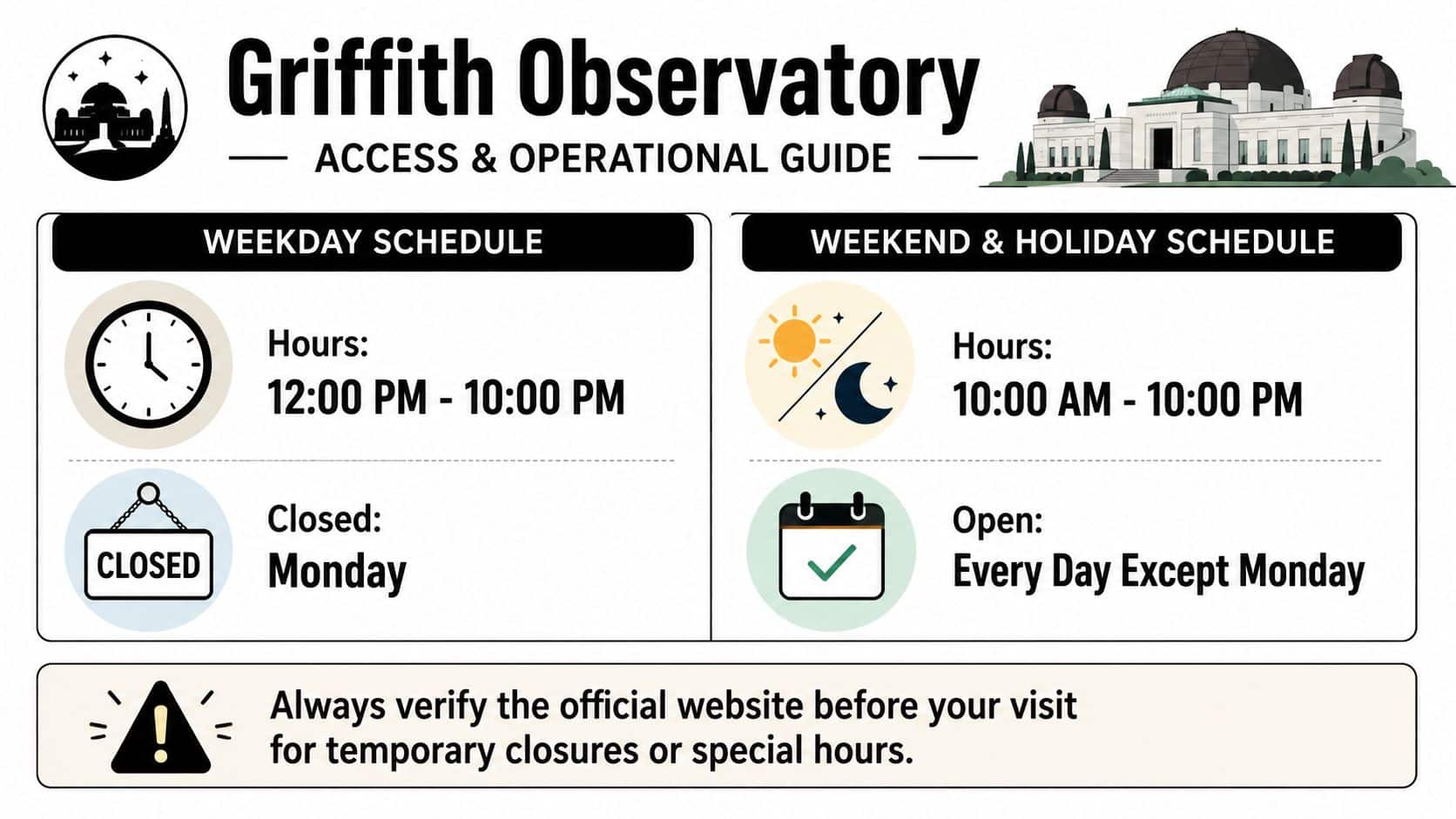
Parking follows its own rules. Griffith Park grounds, roads, and parking lots are generally open from 5:30 a.m. to 10:00 p.m., while paid parking at the observatory lot and nearby parallel spaces is charged from 12:00 noon to 10:00 p.m. on weekdays and 10:00 a.m. to 10:00 p.m. on weekends. Los Angeles Parks parking and access guidance
The rules visitors need to understand
Los Angeles Parks states that parking enforcement operates every day of the year, including Mondays when the observatory building is closed. The grounds may be available for a scenic drive or outdoor visit, but a closed building doesn't suspend parking rules. Griffith Park planning information
The Hollywood Sign itself is in a restricted area. There are no official tours of the sign, and attempting to get close to or touch it is prohibited. Viewpoints are self-guided and free, but reaching a legal viewpoint can require a longer or more complicated route. The former Beachwood Drive access point has been permanently closed since 2017, so outdated guides promising a simple approach from that trailhead should be ignored. Hollywood Sign and Griffith Observatory visitor guidance
For visitors who want a proper hike, the departure point matters as much as the destination. A guide to Griffith Observatory hiking trails can help you understand the terrain before committing, but always verify current trail access locally. A private guide should also confirm whether the route fits your group rather than treating every guest as an experienced hiker.
Timing Your Visit for the Best Experience
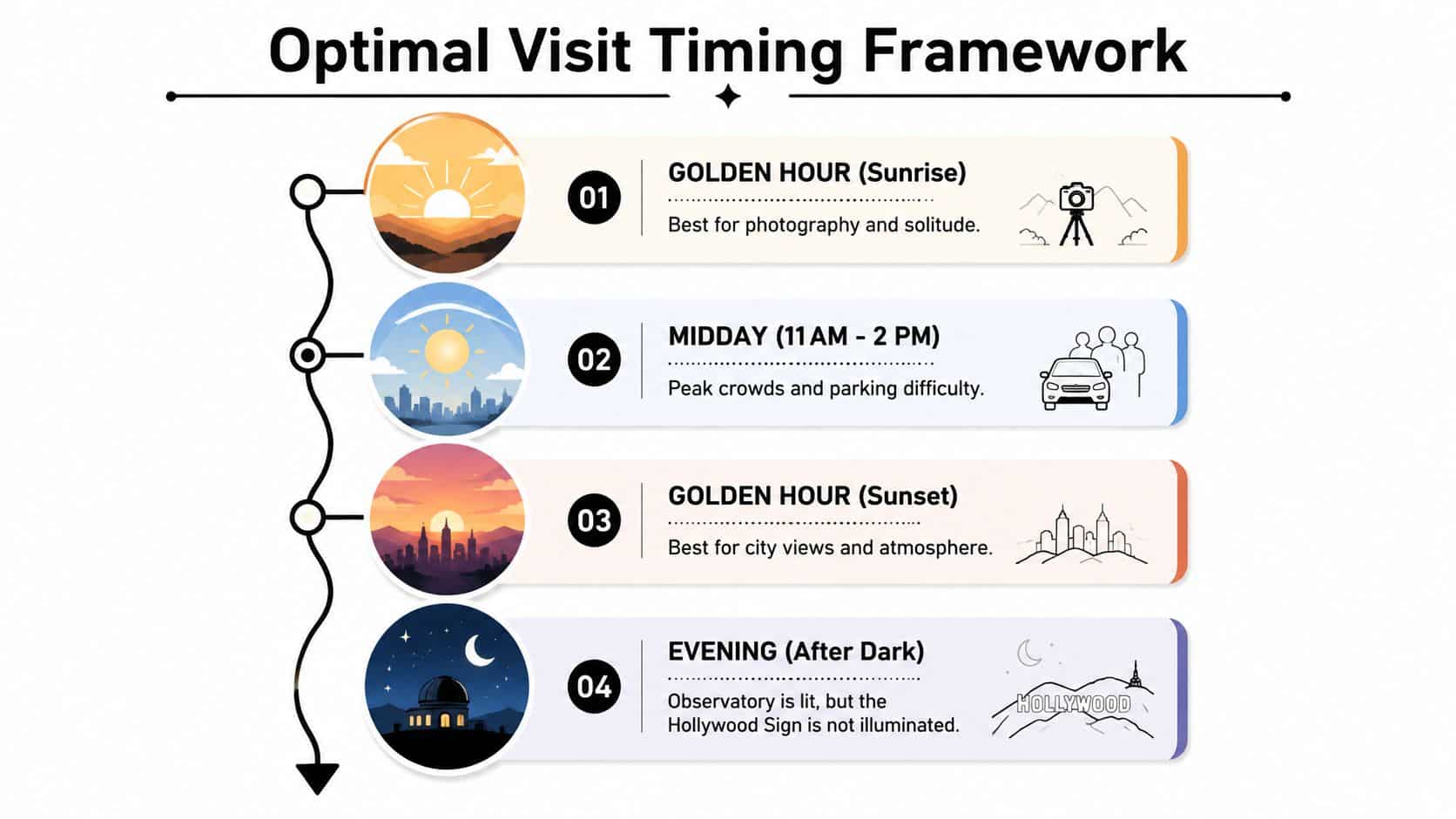
A quiet morning gives you cleaner photographs and a more relaxed start. Sunset delivers the strongest atmosphere. From the observatory's west-facing terraces, the city, hills, and distant Hollywood Sign take on richer color as daylight fades. Choose the window that matches your priorities, then let the rest of the itinerary follow it.
Match the time to your priorities
- Choose early morning for calm. Gentle sunrise light, more comfortable temperatures, and less pressure on the terraces make this my preferred option for families with young children, travelers with connecting plans, and content creators seeking clean compositions.
- Use midday as a logistics window. Harsh sun, stronger parking demand, and flatter contrast can weaken the photographs. If midday is unavoidable, keep the schedule flexible and bring water.
- Reserve sunset for the visual payoff. Allow time to park, reach the terraces, and settle before the light changes. Couples and private groups marking an occasion usually appreciate this timing most.
- Use evening for observatory atmosphere. The building and grounds can feel dramatic after dark when open. The Hollywood Sign remains unlit, so night photographs will not show a glowing sign.
The observatory closes on Mondays and follows separate weekday and weekend schedules. Confirm the calendar before reserving dinner, a show, or a hotel transfer. Special events and temporary closures can change the hours, so use the official Griffith Observatory visiting page for the final check.
Seasonal conditions also affect the plan. Summer favors earlier departures and sensible sun protection. Winter brings shorter daylight, making sign photography more time-sensitive. Holiday periods call for advance planning, especially when your group needs accessible parking or climate-controlled transportation.
Practical rule: Protect the photo window, then let the rest of the itinerary flex around it.
Observatory Viewpoint Versus Hiking to the Sign
The observatory viewpoint and the sign hike belong in different categories. The first is a refined sightseeing stop with broad views, indoor exhibits, public telescopes, and a comfortable setting for guests who want the icon without a demanding walk. The second is an outdoor route that requires preparation, stamina, and realistic expectations about distance.
Griffith Observatory's west-facing terraces offer a clear, postcard-style view of the Hollywood Sign without requiring a hike. Because access to the building, grounds, and public telescopes is free, the observatory works particularly well for first-time visitors, families, corporate groups, and travelers with mobility considerations. You can enjoy the city panorama, learn the observatory's story, and photograph the sign from a legitimate public viewpoint.
The route from Griffith Observatory toward the Hollywood Sign is a different commitment. It measures 8.8 miles round trip with about 575 feet of total elevation change, but the effort isn't one continuous gentle climb. The path crosses Mount Hollywood and includes two separate ascents of roughly 425 feet and 525 feet. Route details for the Griffith Observatory to Hollywood Sign hike
Choose by group, not by ambition
| Experience | Best for | What to expect |
|---|---|---|
| Observatory viewpoint | Families, couples, corporate groups, and mixed-mobility parties | Drive or take a short walk, enjoy panoramic distant views, and keep the day flexible |
| Sign-focused hike | Prepared walkers who want an immersive outdoor experience | Repeated climbs, water planning, time buffers, and route-specific access considerations |
The trail may be physically manageable for an active guest yet still feel longer than expected because fatigue accumulates between climbs. That distinction matters when a group has a later reservation in Beverly Hills, Santa Monica, or Malibu. The sign is protected, and no legal route gives visitors permission to touch it. For useful historical context before your visit, explore these facts about the Hollywood Sign.
My direct recommendation is simple. Choose the observatory viewpoint unless hiking is a primary purpose of the day. It delivers the strongest return for mixed groups, leaves energy for the rest of Los Angeles, and avoids the common mistake of calling a long trail excursion a casual landmark stop.
Why a Private Tour Transforms the Experience
You can visit both landmarks independently. The question is whether you want to spend your limited Los Angeles time coordinating parking, checking closures, interpreting trail access, and negotiating traffic, or whether you'd rather focus on the city around you.
A private tour removes the most irritating decisions. Your driver and guide can coordinate the departure from Beverly Hills, Hollywood, Santa Monica, or another hotel area, select a legal viewing point, and adjust the sequence when traffic or crowd conditions change. That matters at Griffith Observatory, where parking rules remain active even when the building is closed, and where accessible spaces are located in the south part of the lot.
Where private service earns its place
- Families get a more forgiving pace, fewer unnecessary transfers, and an itinerary that can move from the sign viewpoint to an easy lunch or beach stop.
- Couples can prioritize sunset, scenic overlooks, and a quieter rhythm without managing directions while dressed for a special evening.
- Corporate groups need dependable movement, clear timing, and a plan that doesn't leave part of the team searching for parking.
- Luxury travelers benefit from climate-controlled transportation, discreet coordination, and a guide who can connect the landmarks to Beverly Hills, Hollywood history, and the wider city.
The guide's interpretation also changes the stop. The Hollywood Sign isn't merely a backdrop, and Griffith Observatory isn't just a building on a hill. Their stories connect Los Angeles real estate, film culture, civic ambition, preservation, and the city's appetite for spectacle. The observatory opened to the public on May 15, 1935, after its formal dedication the previous day. The observatory's official historical timeline records how quickly it became a major public attraction, welcoming more than 13,000 visitors in its first five days and more than 85 million visitors since opening.
Another Side Of Los Angeles Tours offers private Los Angeles itineraries that can incorporate Hollywood Sign viewpoints and Griffith Observatory alongside other city highlights. Review the available private tours of Los Angeles and ask specifically how the operator handles accessibility, current trail conditions, parking, and sunset timing. Those details separate a polished itinerary from a generic list of stops.
Photography Tips and Instagram-Worthy Moments
The observatory terraces are the smart starting point for strong Hollywood Sign photographs. Use the sign as a distant anchor and include the city below or the observatory architecture in the foreground. A wider lens works well for a sense of place, while a telephoto lens helps compress the hills and make the sign more prominent without pretending you're standing beside it.
Golden hour gives the west-facing views their best character. The softer light defines the ridgelines, creates more dimensional skyline photographs, and flatters portraits without making the sign look pasted into the frame. Arrive before the light peaks, because the best composition often requires a few quiet minutes to choose your angle rather than shooting the first open space.
Build the frame deliberately
- Include context. A photograph with the sign, hills, and city tells a fuller Los Angeles story than a tight crop of letters.
- Use the terraces. Railings, stonework, and observatory lines can create leading lines toward the sign.
- Avoid the crowd center. Move along the west-facing areas and wait for natural gaps rather than forcing a busy foreground.
- Shoot portraits at an angle. Place your subject slightly off-center so the sign remains visible without overwhelming the face.
- Keep expectations realistic. The sign isn't a selfie backdrop, and that distance often produces a more elegant composition.
A private guide can help with positioning while another person handles the camera, which is particularly useful for couples, families, and executives who don't want to crowd around a phone. Add a Beverly Hills drive, a Hollywood Boulevard portrait stop, or a Santa Monica sunset for visual variety rather than repeating the same sign image.
For creators planning captions and discoverability after the shoot, this guide to viral photography tags to try can help organize your social posts. Use tags as a finishing touch, not as a substitute for a thoughtful frame and a memorable experience.
Planning Your Complete LA Itinerary
Start by deciding whether your group wants a viewpoint visit or a genuine hike. That single choice determines footwear, transportation, time buffers, water planning, and how much of the rest of Los Angeles fits comfortably into the day.
If the observatory is your priority, pair it with destinations that follow naturally from your base. Guests staying in Beverly Hills can begin with the hills, continue through Hollywood, and finish toward Santa Monica or Venice Beach. A private vehicle makes it easier to include Malibu when the group wants ocean scenery, while a shorter itinerary can combine Griffith Observatory with the Walk of Fame, Grauman's Chinese Theatre, or a relaxed meal in West Hollywood.
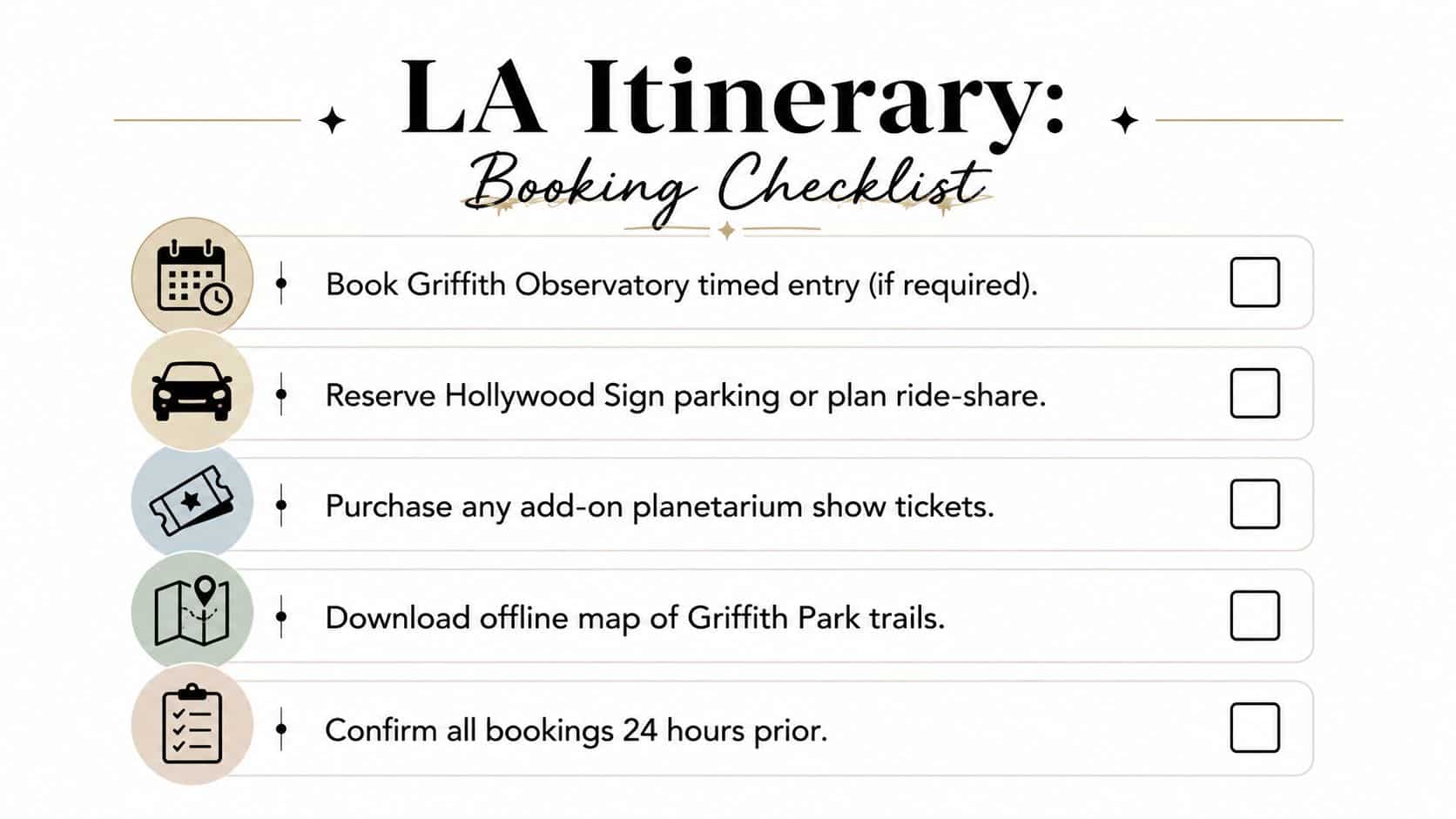
Your booking checklist
- Confirm the calendar. Check the official observatory schedule, Monday closure, special hours, and any temporary access changes before paying for other reservations.
- Clarify the experience. Ask whether the itinerary includes a distant observatory view, a legal sign-focused trail, or both. These aren't interchangeable.
- Discuss access needs. Tell the operator about mobility considerations, children, older guests, fitness levels, and accessible parking requirements.
- Protect the light. Choose sunrise for quieter photography or sunset for atmosphere, then build generous transfer time around Los Angeles traffic.
- Pack intelligently. Bring comfortable shoes, water, sun protection, a light layer, and a phone with enough battery for navigation and photographs.
- Plan add-ons carefully. Planetarium programs, meals, Beverly Hills, Santa Monica, Venice Beach, and Malibu can complement the observatory, but don't overload the day.
When comparing private operators, look for licensed transportation, climate-controlled vehicles, private or small-group options, and guides who can explain the city rather than just point at it. Corporate planners should confirm pickup logistics and group pacing. Families should ask how much walking is involved. Couples should request a sunset-forward route if photographs are central to the occasion.
The best Hollywood Sign and Griffith Observatory tour doesn't promise impossible access or squeeze every neighborhood into a rushed schedule. It gives you the right viewpoint, the right timing, and a smooth route through the city, leaving you with energy for the places that come after.
Another Side Of Los Angeles Tours can arrange a private Los Angeles experience with Hollywood Sign viewpoints, Griffith Observatory, professional local guiding, and flexible add-ons across Beverly Hills, Hollywood, Santa Monica, Venice Beach, and Malibu. Visit Another Side Of Los Angeles Tours to plan an itinerary that handles the logistics while giving your group the time and context to enjoy Los Angeles.