You've just checked into your Los Angeles hotel, dropped your bags, and decided to find murals the way locals do. You head toward the Arts District expecting color on every corner, then discover that the most interesting walls sit behind industrial corridors, down side streets, and in places no standard sightseeing map bothers to mark. By the time the light changes, you've taken a few photos, walked farther than planned, and still haven't found the pieces you saved online.
That's where a well-planned street art tour in Los Angeles earns its place. The right guide doesn't just point at painted walls. They connect neighborhoods, explain who made the work and why it matters, adjust for changing conditions, and make the city feel far less random. For first-time visitors, families, couples, photographers, and corporate groups, the format matters as much as the art.
Table of Contents
- Why a Street Art Tour Deserves a Spot on Your LA Itinerary
- Top Los Angeles Neighborhoods and Murals to Explore
- Sample Itineraries for Every Traveler Type
- Photography and Timing Tips from Local Guides
- Accessibility, Safety, and On-the-Ground Logistics
- Booking Choices and Why Private Tours Stand Out
- Frequently Asked Questions About LA Street Art Tours
Why a Street Art Tour Deserves a Spot on Your LA Itinerary
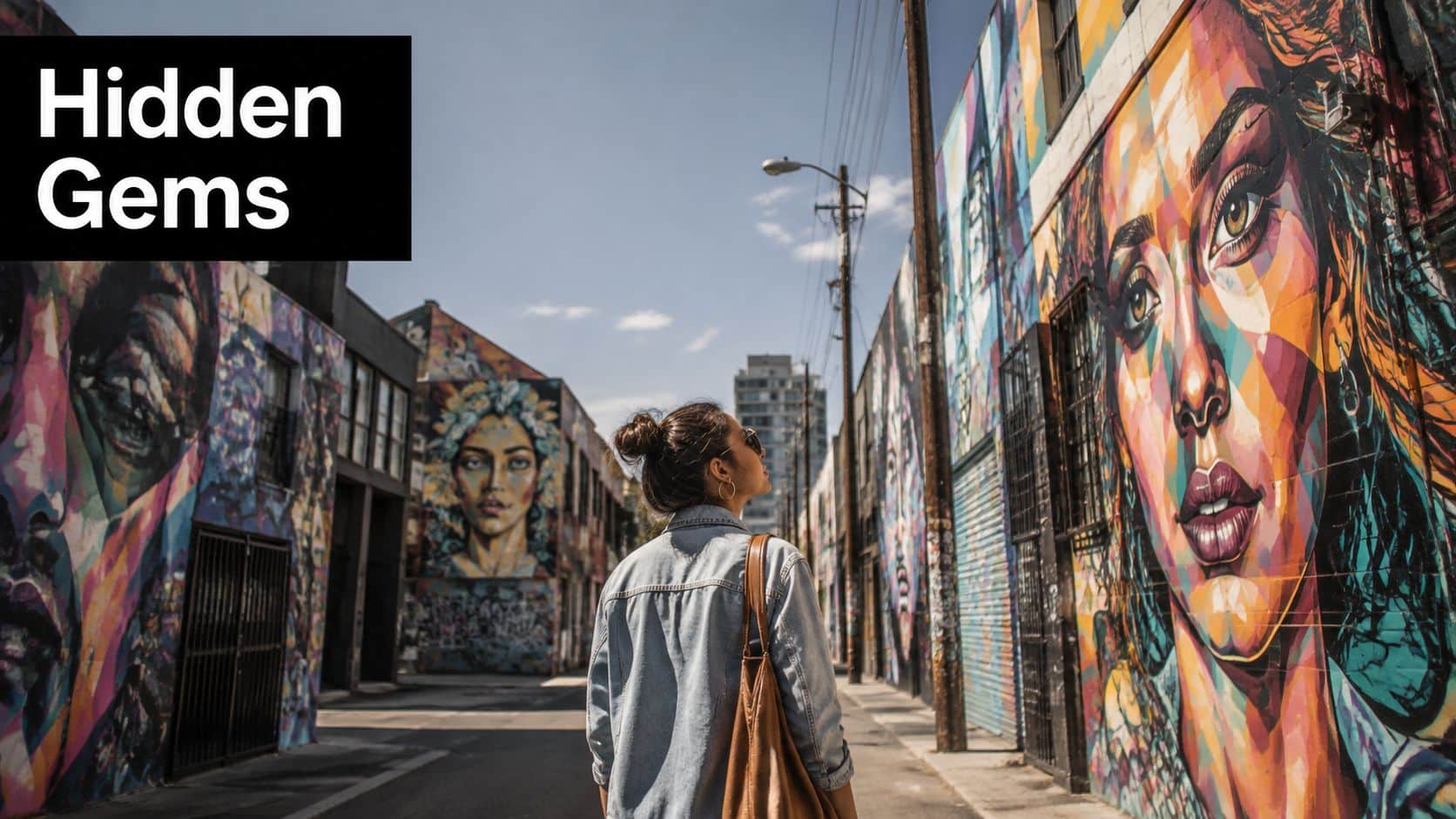
A visitor can spend an afternoon in the Arts District and see plenty of art without a guide. The problem is that Los Angeles doesn't present its mural culture in one tidy outdoor gallery. A large piece on a prominent building may sit close to a small, temporary work hidden beside a warehouse, while another celebrated wall may already be altered, covered, or inaccessible.
A local guide solves the routing problem first. Instead of treating every mural as an isolated photo stop, a good street art tour links the Arts District with Downtown corridors, Venice, Hollywood, or another neighborhood that suits the day. That saves time, but it also creates a more coherent experience. You're not merely collecting backdrops. You're seeing how different communities use public walls to express identity, memory, activism, humor, commercial ambition, and neighborhood change.
The category has outgrown the casual art walk
Street art tourism has become a documented tourism category. One industry report estimates that the global market was valued at $0.6 billion in 2025, up from $0.32 billion in 2019, and projects $1.2 billion by 2034 at a 7.8% CAGR. The same report identifies guided tours as the largest segment, with 38.2% of the market, while Asia Pacific leads regional revenue with 32.5%. The market overview reflects what experienced city guides already see, travelers want creative experiences packaged with reliable routing and cultural storytelling.
The data infrastructure is becoming more advanced, too. WIPO's 2026 street art insights initiative covers recorded pieces in 37 selected countries, and its technical note describes approximately 74,000 geolocated street art pieces in the dataset. WIPO also reports that more than 80% of artists create in one or multiple cities within a single country, which reinforces the importance of local context and place-based storytelling. The street art dataset discussion shows why a city-specific tour can offer something a global image search can't.
Practical rule: Choose a tour that explains the neighborhood around the mural, not just the mural's camera angle.
Why guidance is especially useful in Los Angeles
LA's mural scene is fluid. Buildings change owners, construction blocks sidewalks, new commissions appear, and older pieces disappear under fresh paint. A guide who works the corridors regularly can replace a closed stop, choose a better-lit wall, or explain why a once-famous piece is no longer there.
The strongest routes also rely on concentration and access. A 2025 European city comparison gave its highest score to destinations with 300 or more documented murals in open databases, emphasizing mural density, mapped trails, legal walls, artist prestige, festival support, and visitor friendliness. That comparison supports a point I make to guests often: the famous mural matters less than the quality of the route connecting several worthwhile works.
Top Los Angeles Neighborhoods and Murals to Explore
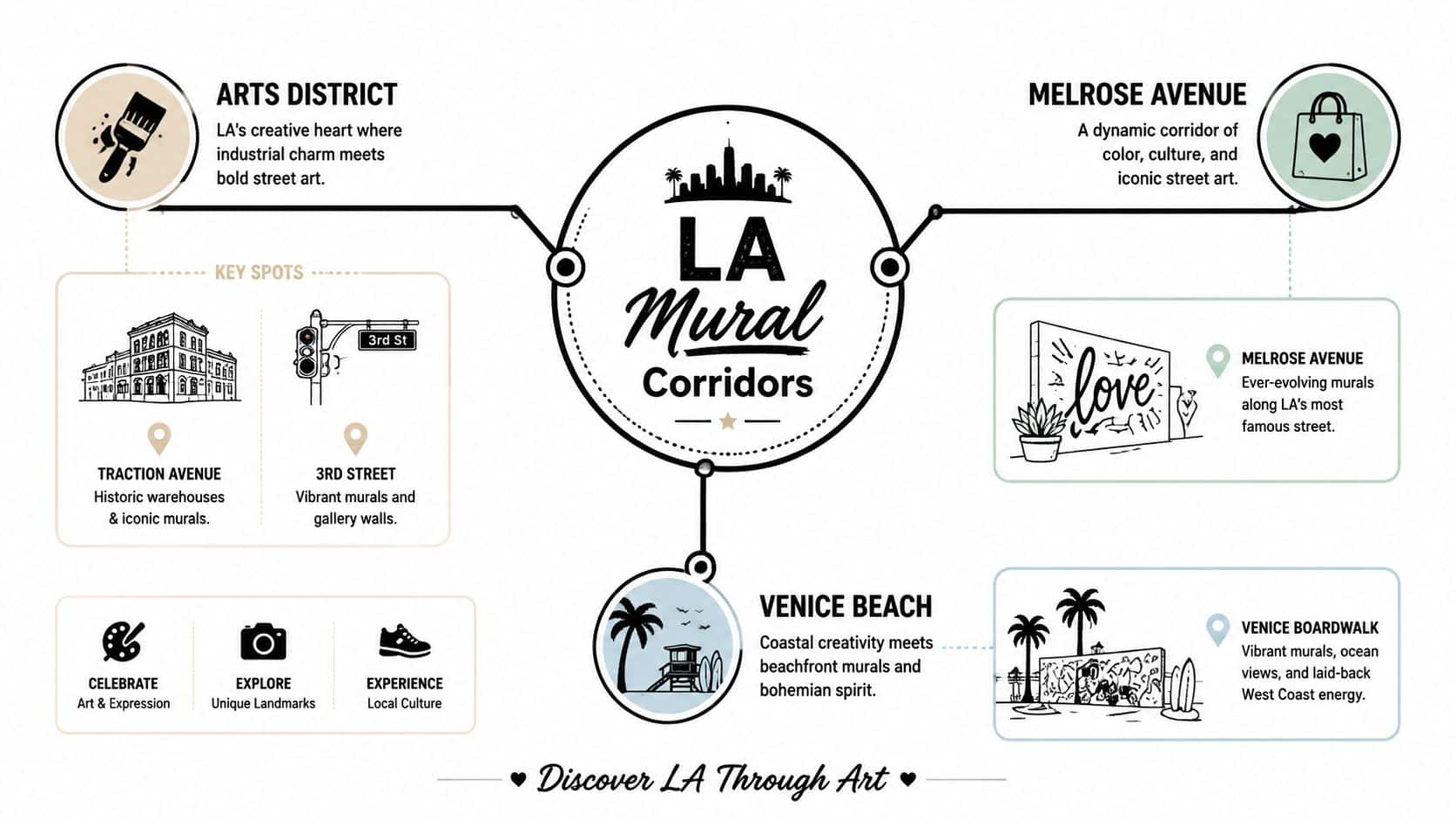
Los Angeles rewards visitors who choose a corridor instead of trying to “see all the murals.” Start with the neighborhood that matches your interests, then add a second area only if transportation and walking time make sense.
Begin in the Arts District
The Arts District remains the natural first choice for industrial-scale work and a strong sense of urban transformation. Focus on Traction Avenue, 3rd Street, and the blocks around the American Hotel, where large walls, alley pieces, and rotating installations create visual variety within a compact urban setting.
This is the right area for travelers who want bold compositions, exposed brick, painted façades, and the contrast between working architecture and contemporary art. It's also the corridor where a guide's knowledge helps most. Some pieces are easy to spot from the street, while others require knowing which side streets are worth the detour and which are just dead ends.
Add Venice for a different visual language
Venice combines surf culture, counterculture, neighborhood activism, and commercial design. Include the Venice Art Walls, then continue toward Abbot Kinney Boulevard and the Windward Avenue corridor. The result feels less industrial than Downtown and more connected to the beach community's long-running mix of artists, performers, independent businesses, and visitors.
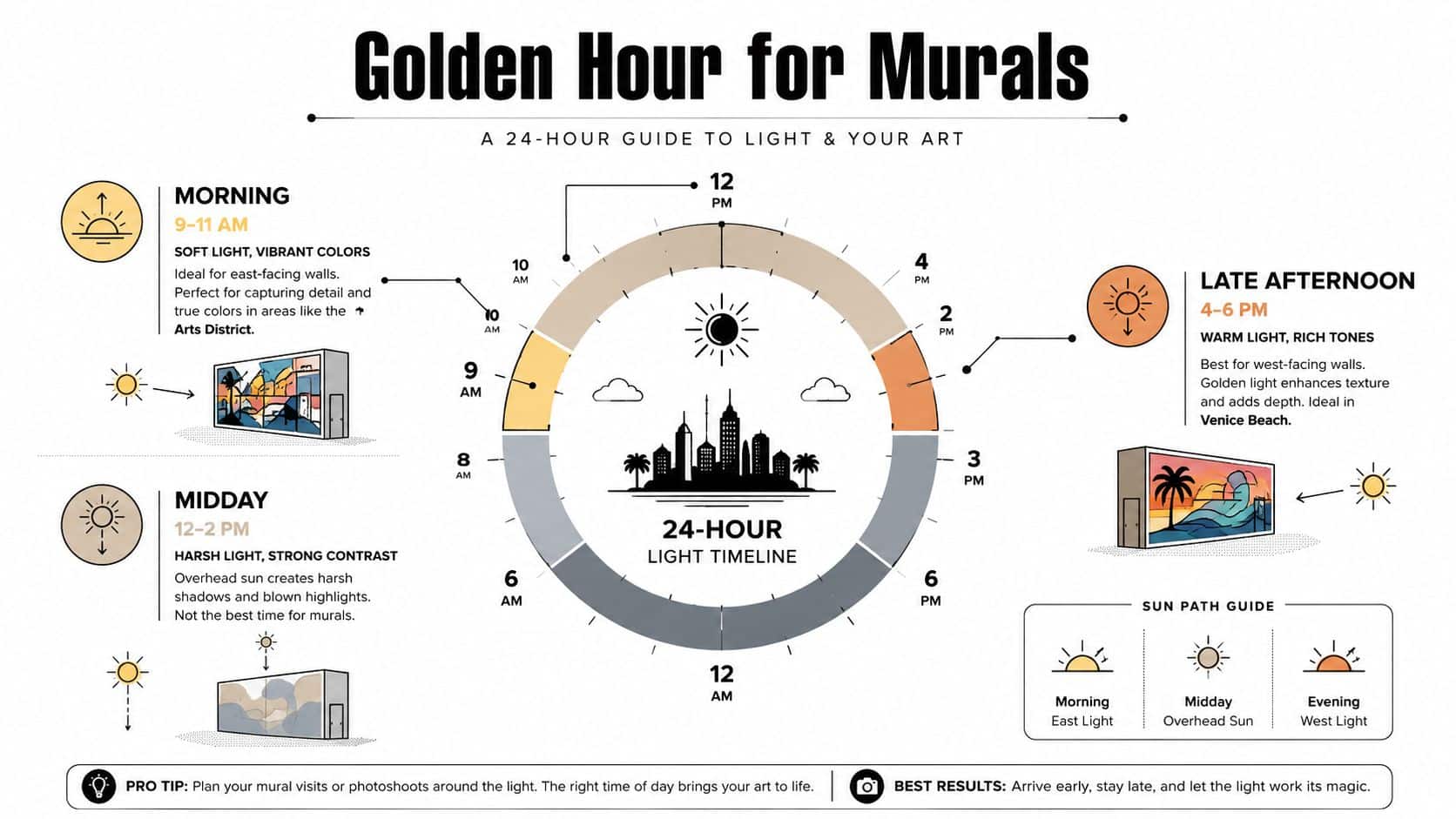
Late afternoon is usually the most attractive time for west-facing Venice walls, especially when you want warm light rather than flat midday glare. Expect heavier pedestrian traffic than in many Arts District lanes, so a guide who knows quieter viewing angles can make the experience more comfortable.
Read Downtown's contrasts
Downtown LA's Financial District offers another useful contrast. Look around Spring Street and Main Street for large-scale works shaped by corporate commissions, redevelopment, and grassroots expression. The polished, highly visible pieces deserve attention, but don't ignore smaller interventions nearby. Their scale and placement often tell you more about how artists respond to the surrounding street.
For a deeper Downtown route, the Downtown LA street art guide is a helpful starting point before you decide whether you want a self-guided visit or a guide-led itinerary.
Consider Hollywood and the wider west side
Hollywood's mural scene tends to lean into entertainment, portraiture, music, film, and celebrity culture. Explore areas near Sunset Boulevard and the murals surrounding the Pantages Theatre, then compare that atmosphere with the more residential and design-forward walls along Melrose Avenue.
Artists and installations change, so I won't promise that every photographed landmark will still look exactly as it does online. That's part of the nature of street art. A thoughtful tour treats long-standing pieces, new commissions, and recently altered walls as part of the story rather than pretending the city is a static museum.
Sample Itineraries for Every Traveler Type
There isn't one universally correct street art tour. A solo traveler with a free afternoon needs a different plan from a family staying in Santa Monica, a couple chasing perfect portraits, or a company organizing a private outing between meetings.
A short group walk
A 2 to 3 hour group walk through the Arts District or Venice suits budget-conscious solo travelers and couples who want structure without giving up an entire day. The physical demand is moderate, and the social atmosphere can be part of the appeal.
The compromise is fixed pacing and limited geographic range. You'll see a focused selection rather than several distant neighborhoods, and popular walls may allow only a short photography stop. Smaller groups generally create better sightlines and make it easier to hear the guide beside busy streets.
A private vehicle route for photographers
A 3 to 4 hour private, vehicle-based itinerary is my recommendation for content creators, couples celebrating something special, and travelers who care about lighting and composition. A vehicle lets you connect the Arts District, Downtown, Hollywood, Melrose, or Venice without turning the day into a long transfer between unrelated walking zones.
You'll pay more, but you gain control over timing, stops, wardrobe changes, equipment, and the amount of time spent at each wall. The physical demand is lower because walking is concentrated at selected locations. A private guide can also adjust the sequence when a wall is in shadow, a street is crowded, or a construction barrier makes the original plan impractical.
A culture-and-food combination
A 5 to 6 hour combination works best for families and first-time visitors who want mural culture alongside food, architecture, or another major LA experience. Build in a proper meal break rather than treating food as an afterthought. This format also suits corporate groups because it gives participants several ways to engage with the city.
The tradeoff is depth. You won't study one corridor as closely as you would on a dedicated walk, but you'll leave with a broader sense of how art fits into LA's neighborhoods.
| Tour Format | Duration | Best For | Key Tradeoff | Price Range |
|---|---|---|---|---|
| Short group walk | 2 to 3 hours | Solo travelers and couples | Limited range and fixed pacing | Budget tier |
| Private Instagram-focused vehicle tour | 3 to 4 hours | Photographers and couples | Higher cost | Premium tier |
| Street art and food or culture combination | 5 to 6 hours | Families, first-time visitors, and corporate groups | Less depth in one corridor | Custom or premium tier |
Book popular private dates early, especially during holidays, school breaks, and periods when major events affect Downtown, Hollywood, or Santa Monica. Seasonal availability can also influence which walls are comfortable to visit and how long you'll want to remain outdoors.
Photography and Timing Tips from Local Guides
Good mural photography starts before you raise the camera. Look at the wall's orientation, note reflective surfaces, and decide whether you want even color, dramatic contrast, or a warm evening glow.
Match the wall to the light
Arts District pieces often photograph well in the morning, before harsh shadows develop across industrial façades. East-facing walls can benefit from the morning window shown in the guide's visual, while midday frequently creates strong contrast and glare.
Venice is different. Many walls face west, so late afternoon brings warmer light and longer shadows. That's particularly useful for portraits and large compositions, although the best moment can be brief when a neighboring building begins to block the sun.
Overcast days deserve more respect than they get. Diffused light can produce saturated color without the hard shadows that split a mural across its central subject. If the sky is bright but soft, use it to your advantage.
Compose around the street, not only the artwork
For a building-scale mural, use a wide lens carefully and keep the camera level to avoid exaggerated distortion. For intimate alley pieces, a standard lens often preserves the relationship between the work and its wall texture.
Power lines, parked cars, signs, and pedestrians are part of LA's visual vocabulary, but they can also distract. Walk a few steps to either side before shooting. A local guide can often identify a clean angle that isn't obvious from the main sidewalk and can help you avoid queues at famous photo stops such as the Pink Wall.
For visitors who want a dedicated photography itinerary, the Los Angeles photography tour format can be adapted around preferred neighborhoods, subjects, and shooting conditions.
Photographer's habit: Take one frame that isolates the mural, then another that includes the pavement, storefronts, utility lines, and people. The second image usually tells you more about Los Angeles.
Sun angle shifts between summer and winter, so don't assume an online photo's timing will work on your visit. A guide who checks the route regularly can sequence stops around current light, shade, and pedestrian patterns rather than relying on a generic “golden hour” label.
Accessibility, Safety, and On-the-Ground Logistics
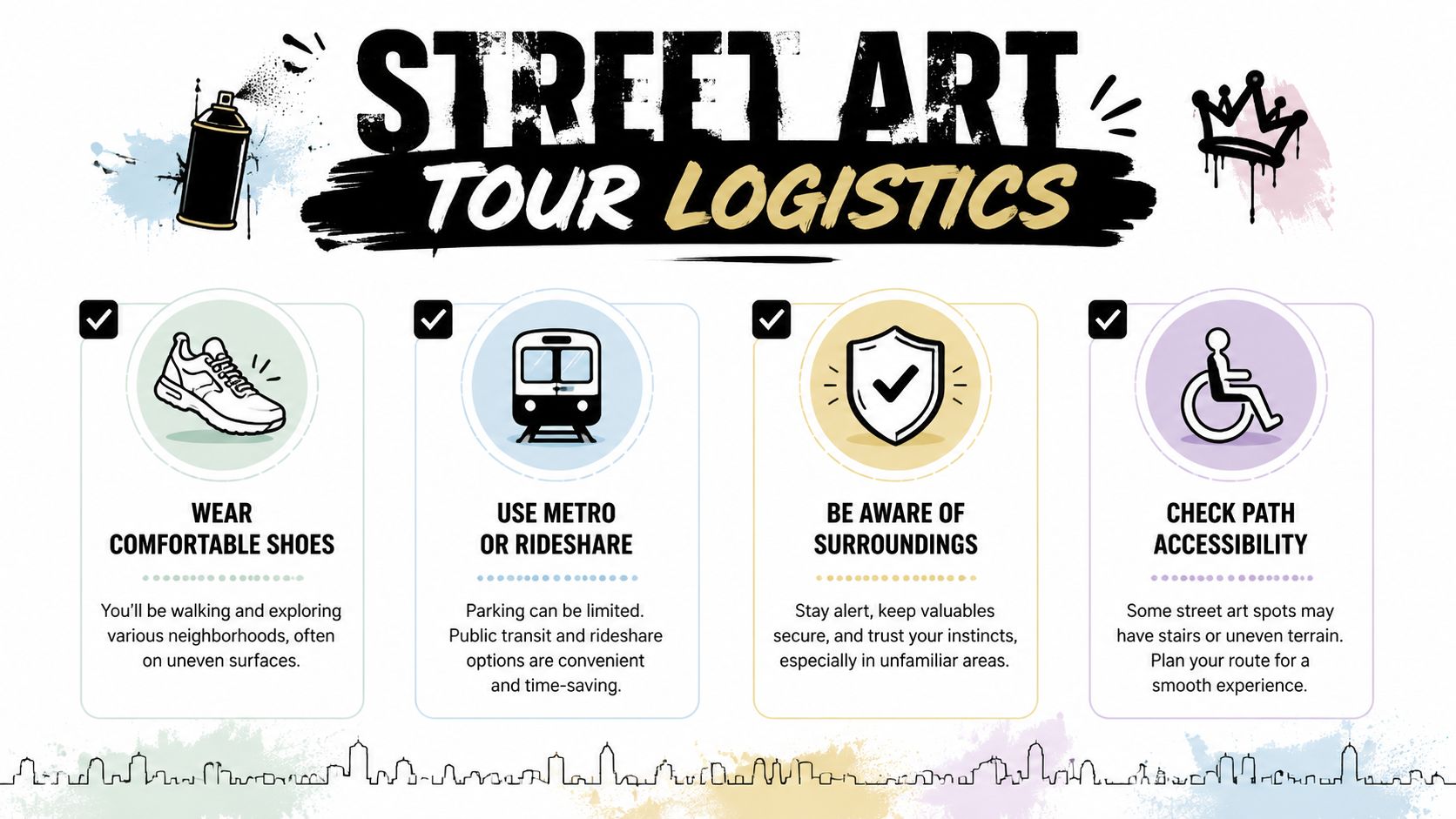
A street art tour should be planned around the people taking it, not around an idealized route. The Arts District includes uneven industrial sidewalks and limited shade. Venice generally offers flatter terrain, but heavy foot traffic can make navigation slower for wheelchairs, strollers, and guests who need more personal space.
Start by asking for the route details, not merely whether a tour is “accessible.” Request information about curb cuts, sidewalk width, restrooms, seating, street crossings, and the distance between vehicle drop-offs and mural walls. A private operator can often substitute a more practical viewing point when a narrow alley or rough surface isn't suitable.
Choose transportation with intention
Parking conditions vary by corridor. In some areas, a rideshare drop-off makes more sense than searching for a space, while a climate-controlled vehicle is valuable when the itinerary links distant clusters or includes guests who tire easily.
Families should mention stroller size and children's ages before booking. Travelers with limited mobility should explain whether they can walk short stretches, manage uneven pavement, or need a fully step-free route. Those details let the guide build a route that feels relaxed rather than improvised.
Treat safety as part of the route design
Most mural visits work best during daylight. Neighborhood conditions can change quickly, and an experienced guide knows when to shorten a stop, avoid a quiet side street, or move the group toward a busier corridor.
Wear shoes with stable soles, carry water, and use sunscreen even when the temperature feels mild. Ask about restroom access before you start, particularly with children and older guests. Construction, festivals, traffic controls, and recently painted-over work can disrupt a plan, so flexibility is a practical safety feature, not a sign of poor preparation.
A premium private tour earns its price here by removing friction. Between mural clusters, a comfortable vehicle can provide shade, air conditioning, storage, and a place to reset before the next walk.
Booking Choices and Why Private Tours Stand Out
A group walk is a sensible choice when price and social energy matter most. It's less sensible when your group has different walking abilities, a short LA schedule, or a specific visual brief that requires time at selected walls.
The common market tiers are easy to understand qualitatively. Budget group walks prioritize affordability and shared logistics. Mid-range small-group vehicle tours add geographic reach. Premium private experiences focus on control, personal pacing, and a route built around your priorities.
| Tour Type | Price Range | Group Size | Duration | Flexibility | Best For |
|---|---|---|---|---|---|
| Budget group walking tour | $25 to $45 | Shared group | Short | Limited | Solo travelers and budget-conscious couples |
| Mid-range small-group vehicle tour | $75 to $120 | Small shared group | Half day | Moderate | Visitors wanting more neighborhoods |
| Premium private experience | $150 to $300+ per person | Private party | Custom | High | Families, photographers, couples, and corporate groups |
A shared tour may move past a mural just as you're finding the right angle. It may also keep the same route even when construction blocks a wall or your children need a break. Private guiding changes that equation. Your guide can spend longer with an artist or style you care about, skip a stop that doesn't interest you, and combine several neighborhoods with vehicle support.
The cultural difference matters as well. A thoughtful guide should explain permissions, commissioned work, traditional graffiti, neighborhood change, and the tension between sanctioned public art and unsanctioned expression. That context protects the experience from becoming a parade of Instagram backdrops.
My recommendation: If you have limited time in Los Angeles, book private transportation and use walking only where the murals justify it.
For operators managing reservations, guest details, and availability across walking and vehicle experiences, city tour reservations software can help organize the operational side of a polished booking process. Travelers don't need the software themselves, but a well-run reservation system often shows up in the details, clear confirmations, accurate pickup information, and fewer avoidable surprises.
Another Side Of Los Angeles Tours offers guided Downtown and Arts District mural experiences alongside private sightseeing, photography-focused itineraries, Beverly Hills, Hollywood, Santa Monica, Venice, Malibu, Griffith Observatory, and custom corporate outings. Its vehicle-supported approach is useful when you want street art folded into a broader LA day rather than treated as an isolated walk. You can compare that format with other options through its guide to the best private tours in Los Angeles.
Frequently Asked Questions About LA Street Art Tours
Do murals disappear before the tour?
They can. Street art is temporary by nature, and walls may be painted over, damaged, blocked by construction, or changed by a new commission. Reliable operators keep alternate stops in mind and adjust the route instead of pretending every online image remains current.
What group size works best?
Small groups are easier to manage around narrow sidewalks and busy corners. Groups larger than 12 people often struggle with viewing angles, listening conditions, and photography space, especially when several guests want the same composition.
Can I combine street art with other LA experiences?
Yes, and combination itineraries work particularly well when you use a vehicle. Pair Downtown murals with a food stop, add Hollywood and the Pantages Theatre to an entertainment-focused day, or connect Venice art with Santa Monica and the coast. Beverly Hills, Malibu, and Griffith Observatory make better additions when the itinerary is designed around transfers rather than forced into one walking route.
Are tours suitable for children?
A dedicated mural walk can work well for children if the guide keeps the stops varied and includes food, shade, and movement. Families should ask about stroller access, restroom locations, street crossings, and the amount of time spent on uneven pavement before booking.
Are evening tours a good idea?
Evening visits can be atmospheric, but lighting and neighborhood conditions change after dark. I prefer daylight for first-time visitors unless the operator has specifically designed an evening route with safe viewing points and adequate illumination.
What should I wear?
Wear closed-toe shoes with dependable traction, breathable layers, sun protection, and a hat. Bring water, and avoid carrying more camera equipment than you can comfortably manage between stops.
How much walking should I expect?
That depends on the format. A corridor-based group walk involves more continuous walking, while a private vehicle itinerary concentrates walking at selected murals. Ask for an approximate route description and disclose mobility needs before the day begins.
Do tours operate in light rain?
Some do, but murals photograph differently in wet conditions and outdoor stops may become uncomfortable. Confirm the operator's cancellation and modification policy, especially if your route includes exposed sidewalks or alleyways.
Another Side Of Los Angeles Tours can build a private street art itinerary around the Arts District, Downtown, Venice, Hollywood, or a broader day that includes Beverly Hills, Santa Monica, Malibu, and Griffith Observatory. Visit Another Side Of Los Angeles Tours to discuss your group's interests, mobility needs, photography goals, and preferred pickup location before reserving your LA experience.