You're probably doing what most first-time Los Angeles visitors do. You've opened a dozen tabs, you've seen “studio tour,” “VIP experience,” “filming locations,” and “behind the scenes,” and now everything is starting to blur together. One option looks polished but rigid. Another promises movie magic but seems more like a theme park ride. A third sounds exclusive, but nobody explains what the access means.
That confusion makes sense. Hollywood sells a fantasy, but the modern visitor needs a strategy. The old studio era was built for scale and visibility. At the peak of Hollywood's Golden Age in the mid-1940s, studios produced around 400 films annually. By 1999, the average cost of a single blockbuster had climbed to $60 million before marketing, which pushed the business toward the high-security, tightly controlled environment travelers face today, as noted in this overview of the Cinema of the United States.
That shift is exactly why planning matters. The best Hollywood behind the scenes experience today usually isn't one thing. It's a smart combination of the right studio access, the right neighborhoods, and the right pacing for your group. If you're organizing a team outing alongside leisure plans, this guide for corporate event planners is also a useful reference for thinking through style, flow, and guest experience in a Hollywood-themed setting.
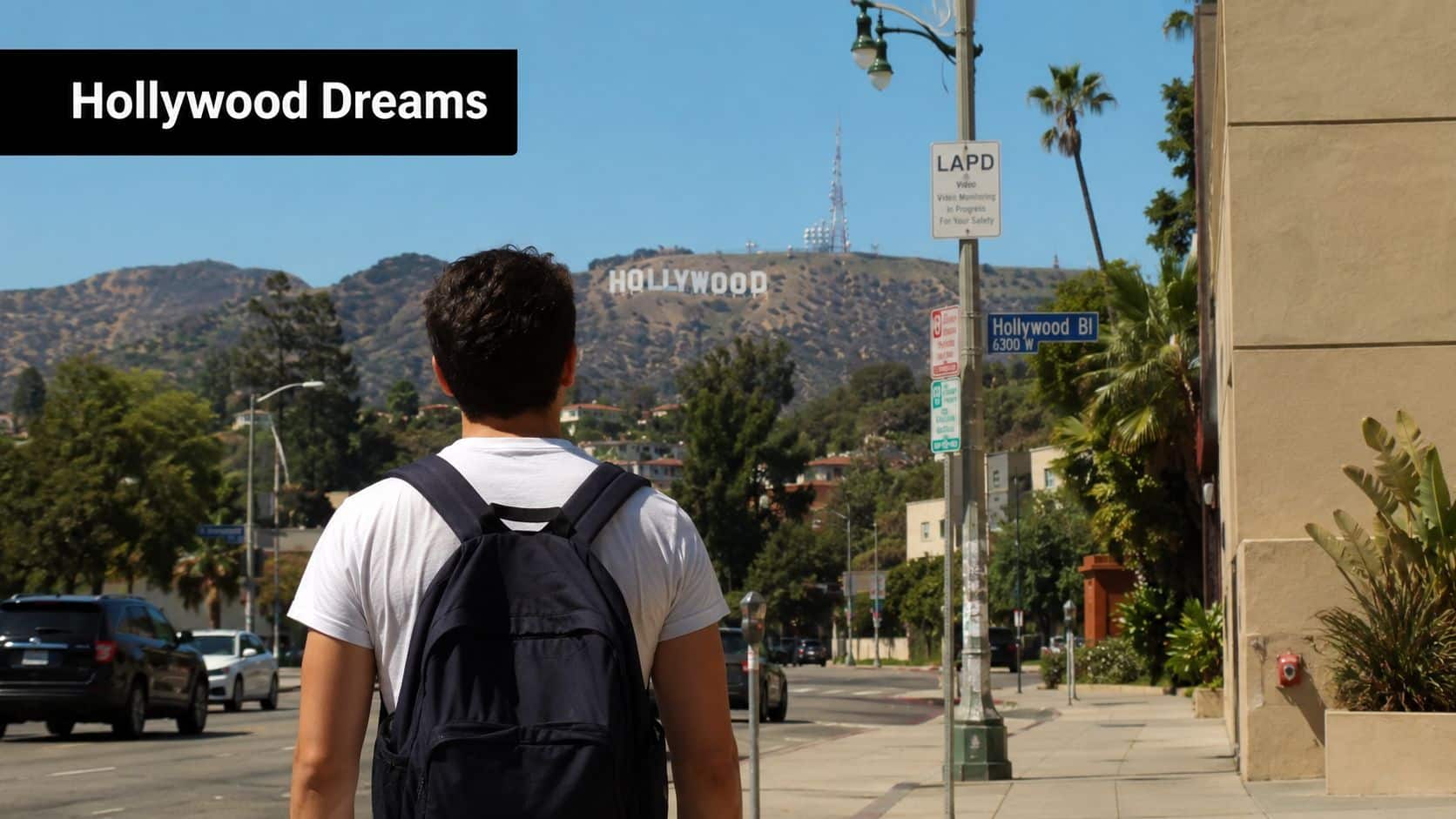
Table of Contents
- Beyond the Red Carpet Your Journey Begins
- Decoding Hollywood The Four Main Ways to Go Behind the Scenes
- A Closer Look at the Major Studio Tours
- Crafting Your Perfect Itinerary with a Private Tour
- Insider Tips for Families and Content Creators
- Understanding Key Roles on a Film Set
- Your Unforgettable Hollywood Story Awaits
Beyond the Red Carpet Your Journey Begins
Most travelers arrive with the same hope. They want to see where the magic happens, not just pose beside a star on the Walk of Fame. That's a good instinct. But in Los Angeles, “behind the scenes” can mean several completely different experiences.
For one guest, it means riding through a working backlot in Burbank. For another, it means standing in Beverly Hills outside a recognizable filming location and hearing what was shot there. Couples often want a polished day that blends old Hollywood glamour, scenic overlooks, and one memorable studio stop. Families usually need something easier to pace, with less waiting and fewer surprises.
Hollywood isn't open the way people think
The biggest mistake I see is assuming access is the product. It isn't. Fit is the product.
A great Hollywood behind the scenes day depends on matching the experience to your travel style:
- Film buffs usually want history, working production context, and time to ask questions.
- Families need realistic timing, easy transitions, and age-appropriate stops.
- Luxury travelers care about smooth routing, comfort, and not wasting half the day in traffic.
- Corporate groups need reliability, hospitality, and a schedule that doesn't unravel.
Practical rule: Don't book based on the word “VIP” alone. Book based on what you'll actually see, how long you'll spend in transit, and whether the day leaves room to enjoy Los Angeles beyond one attraction.
The real appeal is the combination
The city works best when you stop treating Hollywood as a single destination. Hollywood, Beverly Hills, Griffith Observatory, Santa Monica, Venice, and Malibu all tell different parts of the Los Angeles story. A visitor who only books one attraction often leaves with a thin version of the city.
The better approach is curated. Start with one anchor experience, then build around it. That could mean a studio tour in the morning, a scenic lunch in Beverly Hills or West Hollywood, and a sunset finish near Griffith Observatory or the coast.
That's how the city stops feeling chaotic and starts feeling cinematic.
Decoding Hollywood The Four Main Ways to Go Behind the Scenes
If you want a sharper trip, separate the options first. People lump everything into one “Hollywood tour” bucket, and that's why they end up disappointed. These are not interchangeable experiences.
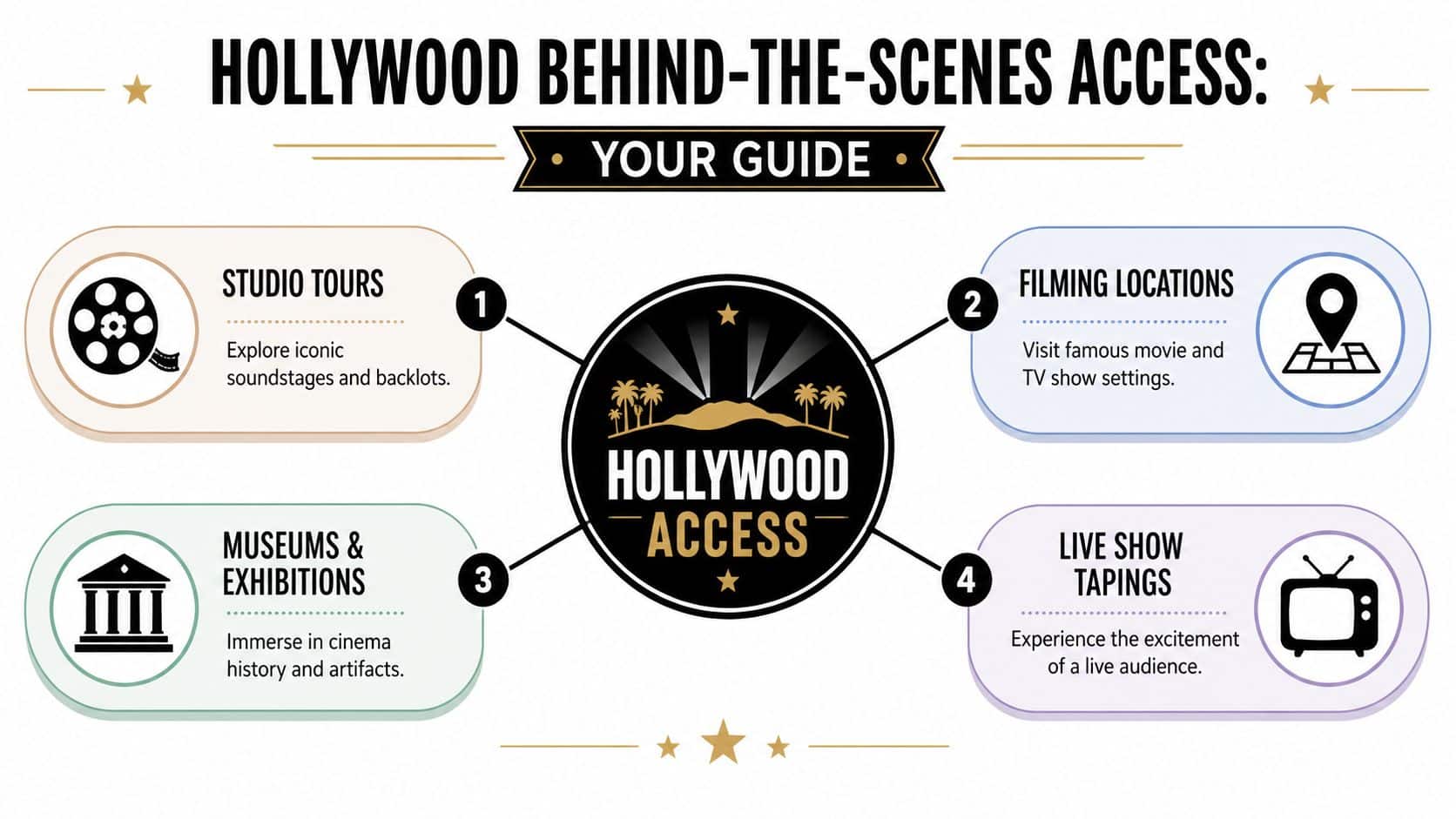
Studio tours
This is the classic choice. You enter an official studio environment, move through designated areas, and get a controlled look at how film and television spaces function.
Studio tours are best if you want:
- Recognizable infrastructure like backlots, soundstages, and production areas
- A polished format with a clear start and finish
- A legitimate working-studio atmosphere rather than a purely sightseeing experience
They are not the same as walking onto an active set whenever you want. They're structured, managed experiences.
Filming locations
This is the most underestimated category in Los Angeles. A filming location tour takes you into the city. You see streets, hotels, storefronts, staircases, viewpoints, and neighborhoods that have appeared on screen.
This option works especially well for travelers who want:
- A wider city experience beyond one lot
- More flexibility in pacing and routing
- A stronger sense of place, especially in Hollywood, Beverly Hills, Santa Monica, Venice, and Malibu
A good location tour can feel more personal than a studio tour because the city itself becomes the set.
Set visits and live tapings
People ask for active set access constantly. It sounds glamorous. In reality, it's selective, limited, and often driven by production relationships, invitations, or very specific audience systems.
If your goal is to feel the pulse of production, this category matters. But it's the least reliable for a general traveler. Think of it as a bonus, not the foundation of your itinerary.
Some experiences are bookable. Others are situational. Build your trip around what can be executed cleanly, then leave room for serendipity.
Private guide services
With this approach, the trip becomes personalized instead of transactional. A private guide doesn't replace official access. A good guide connects the pieces.
That means someone handles the timing, the neighborhood logic, the transitions, the pickup, and the “what matters here” questions. For first-time visitors, that matters more than people realize.
Here's a simple way to look at it:
| Experience type | Best for | Main strength | Main limitation |
|---|---|---|---|
| Studio tour | Film and TV fans | Official access and production atmosphere | Fixed format |
| Filming locations | Explorers and repeat visitors | Citywide storytelling | Less formal access |
| Set visit or live taping | Niche enthusiasts | Rare energy | Hard to secure consistently |
| Private guide service | Families, couples, VIP travelers, corporate groups | Custom pacing and seamless logistics | Depends on planning quality |
The smartest itineraries usually combine at least two of these. That's when Hollywood behind the scenes starts to feel satisfying instead of fragmented.
A Closer Look at the Major Studio Tours
If you're choosing between the best-known studio options, stop treating them as equals. They serve different moods, different groups, and different expectations.
According to the Discover Los Angeles guide to the Warner Bros. Studio Tour Hollywood, Warner Bros. Studio Tour Hollywood is a 3-hour experience with 1 hour guided and 2 hours self-guided, with tickets at $69 for adults ages 11+, $59 for children ages 5 to 10, and $57 for SoCal residents. The same source also notes that the Universal Studios Hollywood Studio Tour runs for about 60 minutes, while Universal says its World-Famous Studio Tour has welcomed over 200 million guests since 1964 in its official attraction overview.
Warner Bros for film lovers
Warner Bros feels more focused. You're there because you care about the mechanics, the legacy, and the studio environment itself.
It suits travelers who prefer:
- A slower, more curated rhythm
- Time to browse exhibits and studio spaces
- A film-and-TV-centered day rather than a ride-driven one
One important detail matters for families. Children under 5 are not permitted on the Warner Bros. Studio Tour, according to the Warner Bros. Studio Tour policy page. If you're traveling with very young kids, don't gloss over that.
For a broader sense of how visitors weigh different studio experiences, these Hollywood studio tour reviews are helpful for comparing tone and expectations.
Universal for energy and spectacle
Universal has a different personality. It's big, lively, and tied into a larger entertainment environment. If your group wants momentum, familiar attractions, and a studio component that feels easy to slot into a high-energy day, Universal usually wins.
This is often the stronger pick for:
- Families with mixed ages
- Travelers who want rides and movie-themed entertainment
- Guests who don't need an in-depth production-focused visit
The tradeoff is obvious. You get scale and excitement, but not the same intimate feel.
Which one should you book
My recommendation is simple.
Choose Warner Bros if you want a more serious Hollywood behind the scenes experience and your group is old enough to enjoy a longer, more focused visit. Choose Universal if the studio element is one part of a broader fun day and your travelers want more action.
Book Warner Bros for depth. Book Universal for momentum.
If you only have one day in this part of town, Warner Bros pairs beautifully with Beverly Hills, the Hollywood Hills, and Griffith Observatory. Universal works better if you want a park-style day with less need to layer additional city touring around it.
Crafting Your Perfect Itinerary with a Private Tour
Los Angeles isn't hard because there's nothing to do. It's hard because everything is spread out, traffic changes the mood of the day, and timing mistakes compound fast. That's why self-planned Hollywood itineraries so often feel rushed by lunch.
Why self-planning falls apart fast
A common itinerary looks good on paper. Morning studio tour in Burbank. Quick stop in Hollywood. Lunch in Beverly Hills. Griffith Observatory at sunset. Santa Monica if there's time.
That day usually collapses because visitors underestimate transfer time, parking friction, and how tiring LA becomes when every stop requires a new decision. The result is too much windshield, too little enjoyment.
Private touring solves a very specific problem. It turns a list of places into one coherent day.
A smarter way to build the day
The best private itineraries use one anchor, two supporting neighborhoods, and one scenic finish. That structure works because it gives the day shape without overpacking it.
A polished version might look like this:
- Morning anchor: Official studio tour or a film-history-focused stop
- Midday neighborhood: Hollywood and Beverly Hills for landmarks, stories, and lunch
- Afternoon contrast: Santa Monica or Venice for a different side of Los Angeles
- Finale: Griffith Observatory, a Hollywood Sign viewpoint, or Malibu depending on your base and energy
For travelers comparing formats, this overview of the best private tours in Los Angeles is useful because it highlights how much smoother the day becomes when routing is intentional.
What a premium day can include
Private service isn't about showing off. It's about removing friction.
That matters for:
- Families, because kids do better when transitions are short and snacks are easy.
- Couples, because romance disappears when you're arguing over parking or rideshare pickup zones.
- Corporate groups, because a tight schedule needs someone else watching the clock.
- Luxury travelers, because comfort, privacy, and local judgment are part of the experience.
A strong guide also knows where a classic Hollywood route should bend. Some groups want Sunset Boulevard and the Walk of Fame. Others should skip that entirely and spend more time in the hills, on Rodeo Drive, near the coast, or at a quieter overlook.
This is also where local storytelling changes the day from ordinary to memorable.
The point isn't to “see everything.” It's to come home feeling like Los Angeles made sense.
Insider Tips for Families and Content Creators
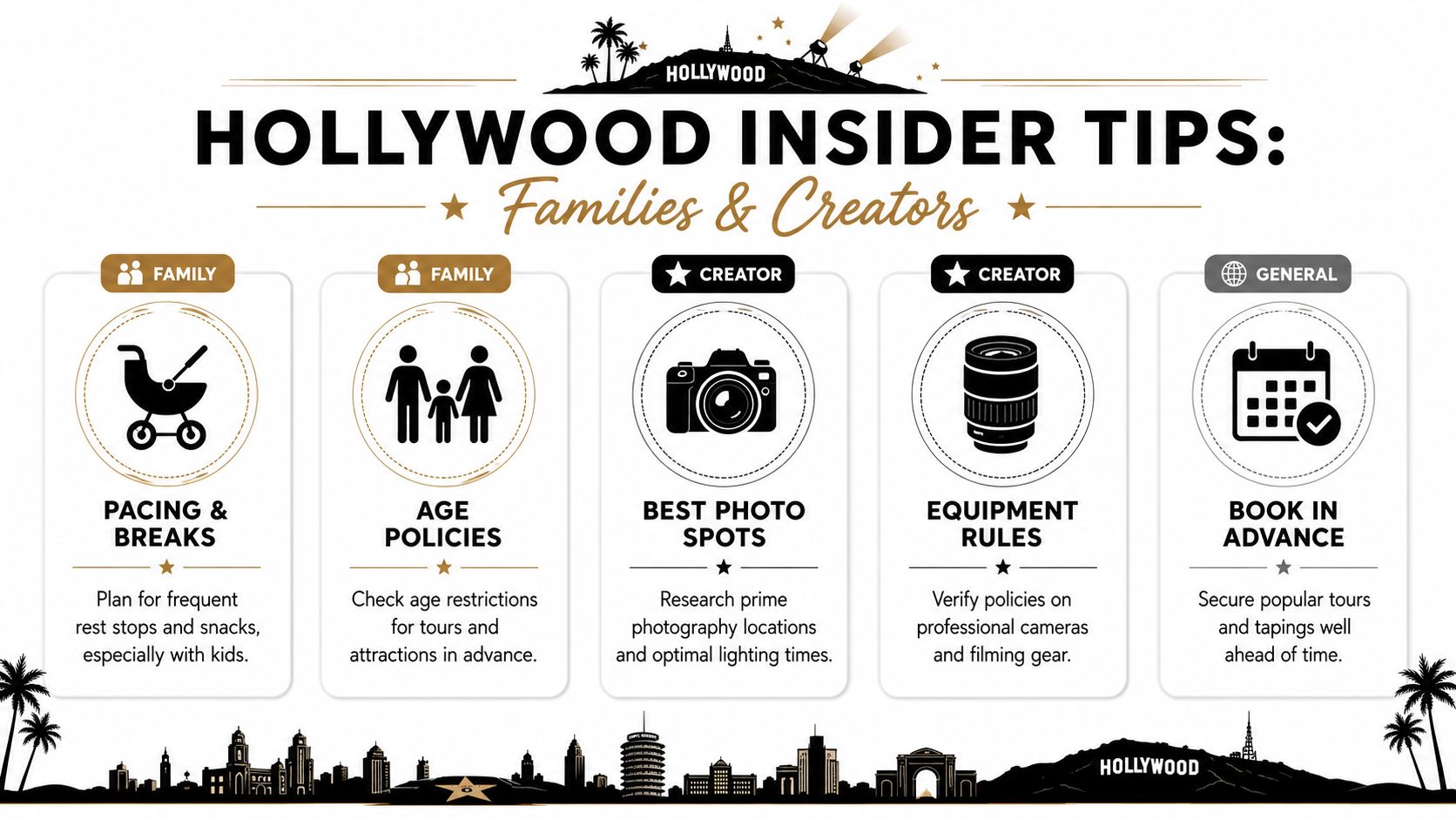
Families and creators both want access. They just define success differently. Families want a day that stays pleasant. Creators want visuals, context, and realistic expectations about what they'll be allowed to capture.
What families should do differently
Parents often overcommit in Los Angeles. Don't make the day a checklist. Make it breathable.
The better family approach is:
- Choose one high-structure attraction and balance it with open-air stops.
- Check age rules early so nobody gets surprised at the entrance.
- Keep meals easy and well-timed instead of pushing through hunger to fit one more landmark.
- Use neighborhoods strategically. Beverly Hills is clean and easy for a polished stop, Santa Monica offers space to reset, and Griffith Observatory gives you a visual payoff without needing a full production schedule.
If you're narrowing down family-friendly options, this guide to the best LA tours for families is a practical place to start.
The best family tour doesn't feel packed. It feels well-paced.
What creators need to understand now
This is the part most glossy travel content skips. A lot of visitors expect to film active moviemaking. That expectation is outdated.
According to the source provided in the planning brief, 92% of major studio backlots now enforce strict no-tourist filming zones during active production due to union rules and IP security, and AI now replaces 40% of background actors in blockbusters, which means what you see on a backlot may differ sharply from what appears onscreen, as referenced by this discussion of modern filming restrictions and changing production realities.
That changes how smart creators plan. If your goal is “real Hollywood,” you'll often get better material from architecture, public-facing landmarks, classic streetscapes, and neighborhoods with strong cinematic identity than from hoping to capture a live set.
A few practical creator notes:
- Prioritize legal shooting spaces over restricted production environments.
- Scout light, not just landmarks. Morning and late afternoon usually give Los Angeles its best texture.
- Build your shot list around story. Hollywood Boulevard, Beverly Hills, Venice, and Griffith all communicate different moods.
- Understand post-production reality. If you're trying to interpret how modern visuals get finished, these insights on modern video editing tools offer useful context for how polished footage comes together after filming.
Creators who accept the modern rules usually leave with better content. They stop chasing forbidden access and start capturing Los Angeles intelligently.
Understanding Key Roles on a Film Set
You don't need to work in the industry to enjoy the language of it. Knowing a few crew terms makes any Hollywood behind the scenes experience more interesting, because you start to understand who's shaping the image.
Three terms worth knowing
The gaffer is the chief lighting technician. This person controls the lighting setup that gives a scene its mood and visual tone, as explained in this overview of behind-the-scenes film set jobs.
Grips handle the physical rigging and support systems for cameras and lights. If equipment needs to be mounted, secured, shaped, or positioned safely, grips are central to making that happen.
A film fixer deals with logistics. That includes securing locations, handling permits, coordinating local needs, and preventing the kind of delays that throw off an entire day of production.
Here's the simplest way to remember them:
| Role | What they control | Why it matters |
|---|---|---|
| Gaffer | Lighting | The scene looks right |
| Grip | Rigging and support | The equipment works safely and precisely |
| Film fixer | Logistics and permits | The production keeps moving |
Once you know those terms, studio tours and location conversations become more meaningful. You stop seeing “movie magic” as abstract and start recognizing the crew choices behind it.
Your Unforgettable Hollywood Story Awaits
The best Hollywood trip isn't the one with the longest list. It's the one that feels coherent from the first pickup to the final view. That usually means choosing the right kind of behind-the-scenes access, pairing it with the right neighborhoods, and leaving enough room to enjoy Los Angeles.
For some travelers, that means a studio-focused day in Burbank with a polished finish in Beverly Hills. For others, it means skipping rigid schedules and leaning into filming locations, ocean views, and the city's more cinematic corners. Families need pacing. Couples want elegance. Corporate groups need precision. First-time visitors need somebody to cut through the noise.
That's why curated touring matters so much here. Los Angeles rewards local judgment. A smart plan gives you the glamour of Hollywood, the style of Beverly Hills, the views from Griffith Observatory, and the coastal ease of Santa Monica or Malibu without the stress that usually comes with trying to stitch those pieces together on your own.
A memorable LA day feels effortless to the guest because somebody else handled the hard parts.
If you want Hollywood behind the scenes to feel polished rather than confusing, choose experiences that fit your group and let the city unfold in the right order.
If you'd like a polished, concierge-style day in Los Angeles, Another Side Of Los Angeles Tours is a strong place to start. Their private experiences make it easy to combine Hollywood, Beverly Hills, Santa Monica, Venice, Griffith Observatory, and other iconic stops into one well-integrated itinerary, with expert local guides and the kind of white-glove planning that saves time and upgrades the entire trip.