You're probably planning Los Angeles right now with a familiar mix of excitement and mild overload. You want the Hollywood sign, Beverly Hills, Santa Monica, maybe Venice, maybe Malibu, maybe Griffith Observatory at sunset. You also don't want to spend your day in traffic, miss the best photo spots, or sit through a tour that feels like someone reading a Wikipedia page out loud.
That's where the difference between an average guide and an exceptional one becomes obvious.
A weak guide gives you information. A great guide gives you a day that feels effortless, personal, and memorable. In a city like Los Angeles, that difference matters even more because the experience isn't just about landmarks. It's about timing, mood, comfort, storytelling, routing, and knowing how to make a massive, layered city feel legible for first-time visitors, families, couples, and executive groups who don't have time to waste.
Table of Contents
- More Than a Megaphone What Truly Defines a Great Guide
- The Core Skill That Separates Good from Great Storytelling
- Managing the Experience The Guide as Diplomat and Operator
- Crafting the Perfect Los Angeles Tour In Action
- What We Look For When Hiring a Private Tour Guide
- The Lasting Value of an Expert-Guided Experience
More Than a Megaphone What Truly Defines a Great Guide
Most travelers have had both versions of a tour. One guide talks constantly but says very little that lands. You hear dates, names, and trivia, yet by lunch you're already forgetting half of it. The other guide makes the city click. The street suddenly has context. The landmark has tension, personality, and meaning. You don't just see Los Angeles. You understand why it feels the way it does.
That's what makes a good tour guide. Not volume. Not a script. Not the ability to recite facts from memory.
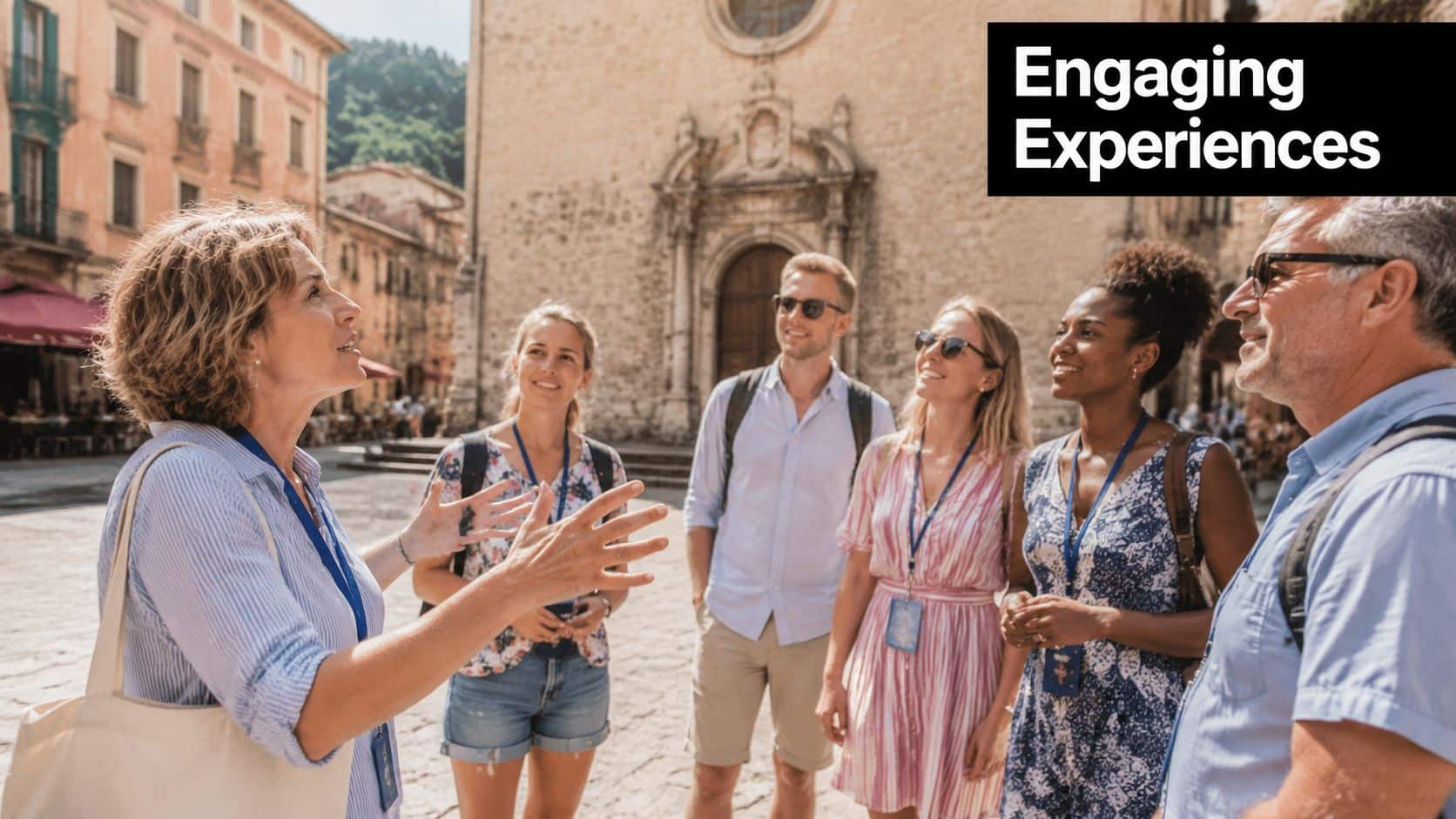
A strong guide is part storyteller, part host, part fixer, part producer. In Los Angeles, that means knowing when to lean into glamour in Beverly Hills, when to shift into film history in Hollywood, when to slow the pace for a family with young children, and when to keep a corporate group moving because their afternoon schedule matters. The work is visible and invisible at the same time.
The guest experience is the real product
On paper, two tours can visit the same places. Both might stop near Rodeo Drive, the Walk of Fame, Santa Monica Pier, and Griffith Observatory. Yet one feels rushed, generic, and transactional, while the other feels personalized.
The difference usually comes down to things guests don't see right away:
- Pacing: A great guide knows when a family needs a snack break before anyone asks.
- Context: A couple on a romantic getaway doesn't want the same rhythm as a team-building group.
- Delivery: Facts need shape, not just accuracy.
- Presence: Guests can tell when a guide is just performing versus truly hosting.
A premium tour should never feel like crowd control with commentary.
The best guides also know that people rarely remember every data point. They remember how the day felt. One guide makes Los Angeles seem scattered. Another makes it feel cinematic, layered, and surprisingly personal.
Great guides curate moments
That matters most in iconic destinations. First-time visitors arrive with big expectations. They want the postcard version of LA, but they also want the city behind the postcard. They want classic Hollywood, but also the little local detail that makes the story stick. They want beautiful photos, but they don't want to spend the day hunting for angles or parking.
A great guide turns all of that into one coherent experience. The city starts to make sense. The landmarks connect. The guest relaxes.
That's the standard.
The Core Skill That Separates Good from Great Storytelling
The single most important difference between a guide who's competent and one who's unforgettable is storytelling.
Industry training puts it plainly. A good tour guide must function as a “Master Storyteller” who translates objective facts into emotional narratives, creating wonder and connection instead of simple information delivery, as noted by ITMI tour guide training.
Facts don't move people. Stories do
A weak guide shares information in a straight line. Built in this year. Designed by this person. Famous for this event. Then on to the next stop.
A strong guide does something else. They choose the right detail, place it at the right moment, and connect it to a feeling the guest can recognize. That's how a place becomes memorable.
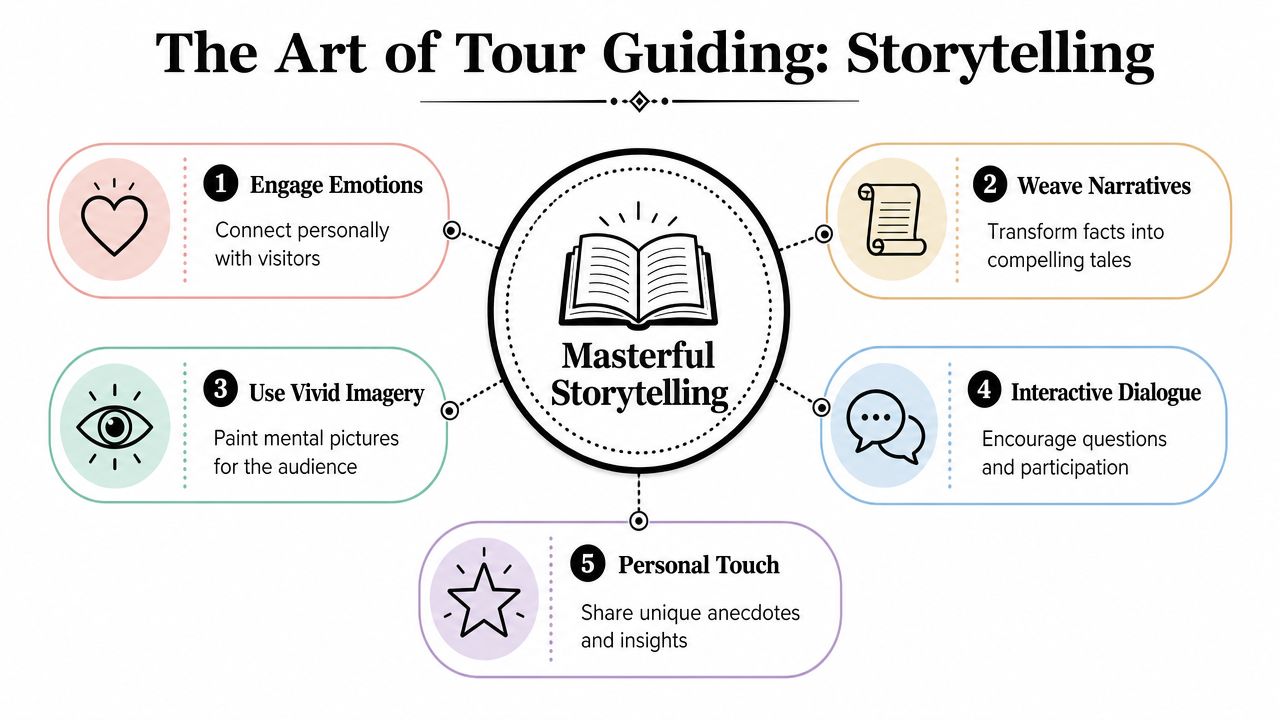
In practice, that means:
Lead with tension
Start with the part people can feel. Ambition. Reinvention. Vanity. Risk. Reinforce the facts after the emotional hook is set.Use researched detail selectively
The point isn't to dump everything you know. The point is to choose the detail that opens the door to the bigger story.Add a human bridge
Personal observations help when they're disciplined and relevant. Guests don't need a guide's life story. They need insight that sharpens what they're seeing.
Before moving further, it helps to see storytelling techniques in a visual format.
How that works in Los Angeles
Los Angeles rewards narrative thinking because the city is built on projection. Hollywood sells dreams. Beverly Hills sells polish. Venice sells contrast. Malibu sells escape. A guide has to translate those identities so guests don't just pass through them.
Here's the practical difference:
| Standard delivery | Better delivery |
|---|---|
| Recites a landmark's basic history | Connects the landmark to ambition, image, and the city's evolution |
| Lists celebrity facts | Explains why celebrity culture shaped the neighborhood |
| Talks continuously | Leaves space for questions, reactions, and observation |
| Uses the same script for everyone | Adjusts tone for families, couples, creators, or executives |
A photography-focused outing shows this especially well. On a well-designed Los Angeles photography tour, the guide isn't just pointing at murals or skyline views. They're explaining why the light works in one spot, why a certain backdrop says “classic LA” rather than “generic city,” and how to frame a shot so it feels like a story rather than a souvenir.
Practical rule: If guests are hearing facts but not feeling anything, the guide is underperforming.
The strongest storytellers also stay human. They don't sound polished to the point of being artificial. They read the room, adjust their pacing, and leave space for curiosity. That's why some tours end with guests saying they learned so much, while others end with guests saying they didn't want it to end. The second response is the one that matters.
Managing the Experience The Guide as Diplomat and Operator
A luxury private tour only feels relaxed when somebody is managing dozens of variables well. In Los Angeles, that means traffic flow, loading zones, weather shifts, group energy, timing at major attractions, bathroom access, mobility considerations, and the emotional rhythm of the day.
That's why the guide's job extends far beyond narration.
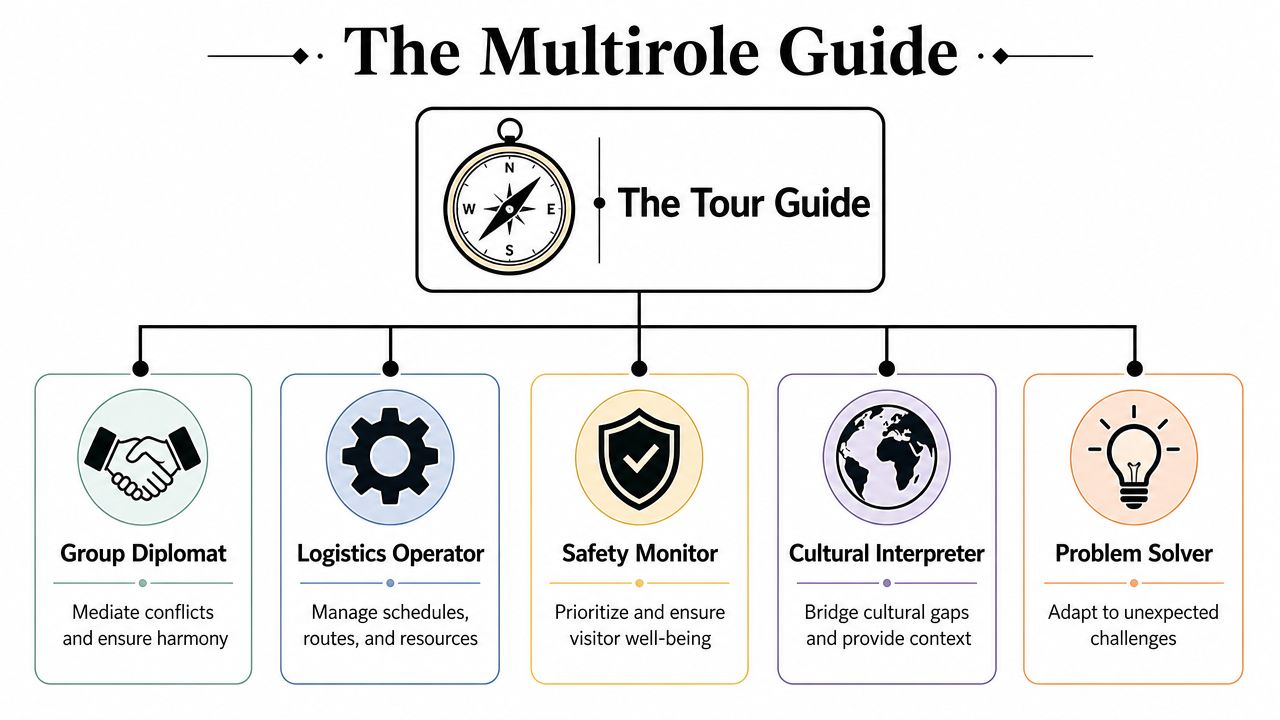
A respected industry perspective describes the top-tier guide as a “Group Diplomat” who anticipates needs, manages difficult personalities proactively, and uses “superconnector” skills like remembering names and interests so logistics feel invisible, according to Tourissimo's guide to tour guide qualities.
Luxury feels easy because someone is doing hard work
Guests usually notice this only when it's missing.
If a guide doesn't think ahead, the day starts to fray. A family gets hungry too late. A couple misses the best light at Griffith Observatory. A corporate group loses momentum because the route wasn't sequenced properly. A visitor who's overwhelmed by crowds in Hollywood doesn't get the space or pace adjustment they need.
The best guides operate almost like concierge-level producers. They're constantly evaluating:
- Route order: Which stop makes sense now, not just geographically but emotionally.
- Energy level: Is the group ready for a walk, a scenic break, or a reset in the vehicle.
- Comfort: Water, shade, seating, restroom timing, and whether anyone is fading.
- Group dynamics: Who wants more detail, who wants fewer words, who needs gentle inclusion.
Empathy is not soft. It's operational
This is one of the most overlooked parts of what makes a good tour guide.
Empathy often gets treated like a vague personality trait, but in premium touring it's a working tool. It helps a guide decide whether to speed up, slow down, offer options, redirect a conversation, or protect the group from one person's bad mood. It's how a guide keeps a private tour personal without becoming intrusive.
A few trade-offs matter here:
| What doesn't work | What works |
|---|---|
| Oversharing personal stories | Curated anecdotes tied directly to the place |
| Forcing cheerfulness | Reading the mood and matching the tone |
| Correcting guests too sharply | Guiding with tact and confidence |
| Sticking to the script no matter what | Adapting in real time |
The smoothest tours often involve dozens of tiny adjustments guests never notice.
There's also a practical limit to how long even a good experience can stay sharp. Preservation-minded guidance for tours recommends 90 minutes maximum, with two hours as the absolute upper threshold, because longer tours can reduce engagement and increase fatigue, as noted by National Trust for Historic Preservation guidance on good tour guiding.
In private Los Angeles touring, that principle matters even when the overall booking runs longer. The best guides build the day in chapters. They vary tempo, change scenery, and avoid letting any one stretch feel stale. That's what keeps a Hollywood, Beverly Hills, Santa Monica, and Venice day from turning into a blur.
Crafting the Perfect Los Angeles Tour In Action
A great guide proves their value on the ground, not in theory. Los Angeles is full of moments that can either feel effortless or frustrating depending on who's leading. The city looks glamorous in photos, but it's also spread out, layered, and full of practical friction. A skilled guide removes that friction while making the day feel spontaneous.
One of the clearest truths in the profession is that storytelling matters, but so does adaptability. Stand-out guides must be on-the-fly decision-makers who handle surprises with a cheerful, positive presence, as described by the Portobello Institute on excellent tour guide qualities.
How a guide shapes the day on the ground
Take a first-time visitor's dream itinerary. They want Beverly Hills elegance, Hollywood energy, ocean air in Santa Monica, the creative edge of Venice, and maybe a scenic Malibu finish. A weak guide tries to force all of that into a fixed script.
A strong guide reads the day as it unfolds.
Maybe the marine layer shifts the best coastline photo window. Maybe traffic near a major event changes the route. Maybe the family with children needs Santa Monica earlier while energy is high. Maybe a couple visiting for an anniversary wants a slower stop in Malibu and less time around the busiest sidewalks in Hollywood.
That is where curation shows up.
- For families: The guide simplifies transitions, keeps narration vivid but not heavy, and works in pauses before children hit a wall.
- For couples: The guide protects atmosphere, chooses scenic pacing, and avoids turning the day into a checklist.
- For corporate groups: The guide keeps timing precise, speaks with polish, and balances local color with schedule discipline.
- For creators and photographers: The guide knows angles, backdrop logic, and when to pivot for better light.
A well-built sightseeing day also benefits from smart planning tools. For visitors comparing bundled attraction options and trying to reduce guesswork, a practical resource is the Los Angeles Tour Pass, especially if they want to combine classic highlights with a more curated experience.
The difference guests actually feel
Most guests won't describe this in operational terms. They'll describe it in emotional ones. They'll say the day felt easy. They'll say they saw the city without feeling rushed. They'll say the guide knew exactly where to go and when. They'll say even iconic spots felt personal.
That same principle applies in other premium travel niches too. For example, if a group is organizing a wine-country outing in the Pacific Northwest, the planning logic behind transportation for Seattle wine tours is useful because it highlights the same reality. Great guest experiences depend on routing, timing, comfort, and letting travelers enjoy the day without managing logistics themselves.
The guest should feel free. The guide should be doing the calculating.
In Los Angeles, that might mean steering clear of a crowded drop-off, shifting the sequence between Griffith Observatory and Hollywood, finding a cleaner photo line in Beverly Hills, or knowing which stretch of Venice feels lively versus chaotic at a given hour. Those aren't flashy skills. They are the skills that turn sightseeing into a VIP experience.
What We Look For When Hiring a Private Tour Guide
Hiring for a premium tour company isn't about finding the person who can talk the most. It's about finding the person guests trust within minutes. Knowledge can be deepened. Delivery can be coached. Warmth, judgment, and situational awareness are harder to teach.
That's why resumes only tell part of the story.
Personality first, polish second
The strongest candidates usually share a few qualities. They're naturally observant. They listen well. They don't panic when plans change. They know how to be personable without making the day about themselves. They're proud of Los Angeles, but they don't flatten it into clichés.
We also look for range. A guide who's terrific with a couple celebrating a special weekend might not be the right fit for a corporate incentive group. Someone who shines on a lively Hollywood outing may need a different touch when hosting a multigenerational family visiting Beverly Hills, Santa Monica, and Malibu in one day.
A premium private guide also has to understand service. That means reading expectations quickly, communicating clearly, and knowing that small details shape trust. The guest shouldn't have to wonder what happens next.
Professional standards still matter
The role is more formal than many travelers realize. According to the U.S. Bureau of Labor Statistics overview of tour and travel guides, tour and travel guides typically need a high school diploma and receive on-the-job training. The same source notes that some jurisdictions require licensing, including TCP #27520 for licensed operators in Los Angeles, and projects 8 percent employment growth from 2024 to 2034.
That matters because good private touring isn't improvised hospitality. It's a profession with training, safety expectations, and operational standards behind it.
When travelers look for a private tour guide in Los Angeles, they should ask a few basic questions:
- Licensing: Is the operator properly licensed for the service being provided?
- Training: Are guides coached only on facts, or also on safety, pacing, and guest care?
- Fit: Can the company match the guide to the group type?
- Consistency: Is the experience dependent on luck, or built on standards?
The best companies don't hire performers and hope for the best. They select for judgment, train for consistency, and protect the guest experience at every touchpoint.
The Lasting Value of an Expert-Guided Experience
A great guide's value isn't that you hear more facts. It's that your time in Los Angeles becomes coherent, relaxed, and emotionally resonant. A city that can feel sprawling and contradictory starts to feel intentional. Hollywood, Beverly Hills, Santa Monica, Venice, Malibu, and Griffith Observatory stop being isolated stops on a map and start becoming part of one story.
That's why the question isn't just what makes a good tour guide. It's what kind of trip you want to remember.
Why the best tours stay with you
Guests rarely go home talking first about route efficiency, even though it matters. They talk about the moment LA clicked for them. The view that landed at exactly the right time. The neighborhood that suddenly made sense. The story that turned a famous corner into something human.
That comes from a guide who can do several jobs at once. Storyteller. Diplomat. Operator. Host. Local interpreter.
A memorable tour doesn't just show you the city. It changes your relationship to it.
In premium travel, that distinction is everything. You can absolutely self-drive, self-guide, and self-research. Plenty of visitors do. But there's a reason private touring remains so appealing for first-time visitors, families, couples, and executive travelers. It protects time, reduces friction, and upgrades the quality of attention you can give to the place itself.
What you're really booking
You're not only booking transport or commentary. You're booking judgment. You're booking local fluency. You're booking someone who knows when to move, when to pause, what to explain, what to leave unsaid, and how to make a complex city feel welcoming.
That's the difference between checking off landmarks and having a day that still feels vivid months later.
If you want that kind of experience in Los Angeles, Another Side Of Los Angeles Tours offers expertly guided private and small-group tours designed around comfort, storytelling, and smooth local execution. It's an excellent choice for first-time visitors, families, couples, and corporate groups who want to see LA with white-glove service and none of the guesswork.