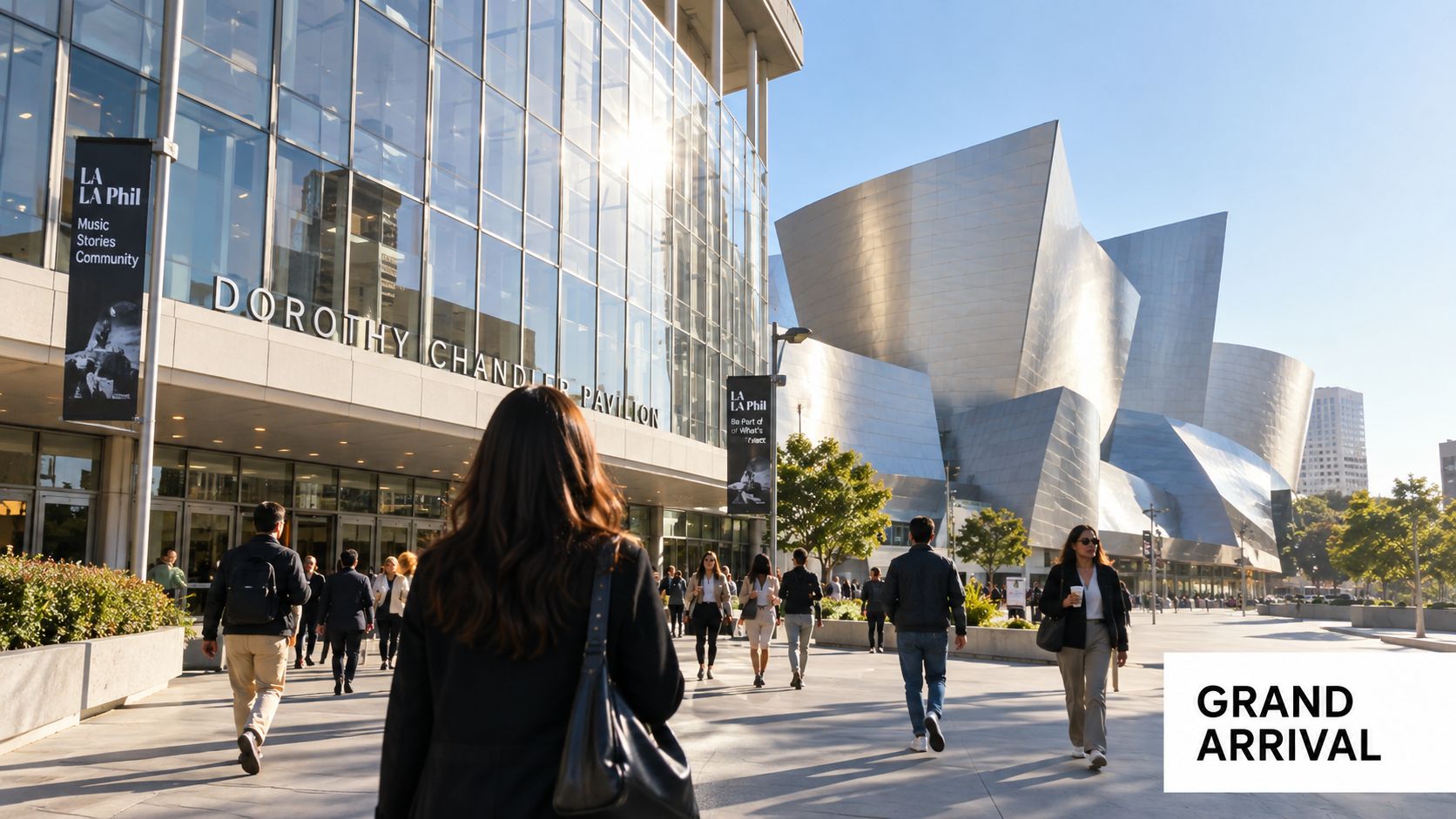
You've just stepped off the Metro, coffee in hand, and the afternoon light is catching the glass of the Dorothy Chandler Pavilion. Ahead, the Civic Fountains add a low, steady hum to the plaza while Grand Avenue moves around you with the energy of downtown Los Angeles. You know you've arrived at the Music Center, but the first question is less obvious: which building is yours tonight?
The Music Center Los Angeles is best understood as a walkable arts district, not a single theater. Four distinct venues sit within the larger Grand Avenue cluster, surrounded by restaurants, museums, transit connections, and public plazas. A first-time visitor who treats the campus as one address can easily enter the wrong side, underestimate the walk from a garage, or miss an easy pairing with another downtown attraction.
Before you choose a show, it helps to understand the building you're visiting, the audience atmosphere it creates, and the most efficient way to arrive. The Los Angeles transportation guide for tourists is useful if your evening is part of a broader sightseeing day, especially when you're combining downtown with Beverly Hills, Hollywood, Santa Monica, or Griffith Observatory.
By the end, you'll know how the campus is laid out, what each venue feels like, how to select a performance, how to arrive calmly, and how to turn a ticket into a polished Los Angeles evening. Consider the rest of this guide your concierge briefing for Grand Avenue.
Table of Contents
- Arriving at the Music Center Los Angeles for the First Time
- How the Music Center Campus Grew from 1964 to Today
- The Four Venues and What Makes Each One Special
- What Kind of Performances You Will Find Here
- Tickets, Parking, and Getting There Without the Stress
- Pairing a Performance with the Rest of Your LA Day
- Concierge Do's and Don'ts for a Memorable Night
Arriving at the Music Center Los Angeles for the First Time
You step off Metro, turn toward Grand Avenue, and see Walt Disney Concert Hall's bright, angular surfaces beside the formal Dorothy Chandler Pavilion. That first view tells you what matters: the Music Center is a cluster of venues, not one theater with interchangeable entrances.
Metro passengers arriving at Civic Center/Grand Park can walk toward Grand Avenue and reach the campus on foot. Pause on the plaza before going inside. The open space makes the relationship between buildings clear, and the walk between venues is part of the experience. Check the building name on your ticket, then follow the venue signs. Do not assume the most visible entrance serves every performance.
Read the campus before you enter
A concert at Walt Disney Concert Hall has a different arrival feel from a theatrical production at the Ahmanson Theatre. The Dorothy Chandler Pavilion feels ceremonial, while the smaller theaters bring the audience closer to the stage. Use that distinction when choosing among a symphony, opera, ballet, drama, or family performance.
The Grand Avenue arts cluster extends beyond the Music Center, with nearby cultural institutions and several transit connections. Metro A and E, B and D, and J Line access can simplify the trip, while rideshare and garage drop-off options serve visitors arriving by car. If your evening includes children, older relatives, or a corporate group, decide on the final approach before leaving your hotel. A few minutes of planning can prevent the classic downtown mistake of reaching the correct block but the wrong entrance.
For broader sightseeing plans, use this Los Angeles transportation guide for tourists to coordinate downtown with Beverly Hills, Hollywood, Santa Monica, or Griffith Observatory.
Concierge perspective: Make the plaza your orientation point. It gives you the clearest view of how the venues relate and saves time when you need to change direction.
The Music Center's public spaces also fit naturally into a private Los Angeles itinerary. Another Side Of Los Angeles Tours includes Walt Disney Concert Hall on its downtown sightseeing route, which can work well before a separate evening performance. Pairing the route with a show gives you context for Grand Avenue without requiring an unstructured solo exploration.
If you arrive early, stay outside long enough to identify your theater, then enter with a clear plan. That small shortcut makes the campus feel straightforward from the start.
How the Music Center Campus Grew from 1964 to Today
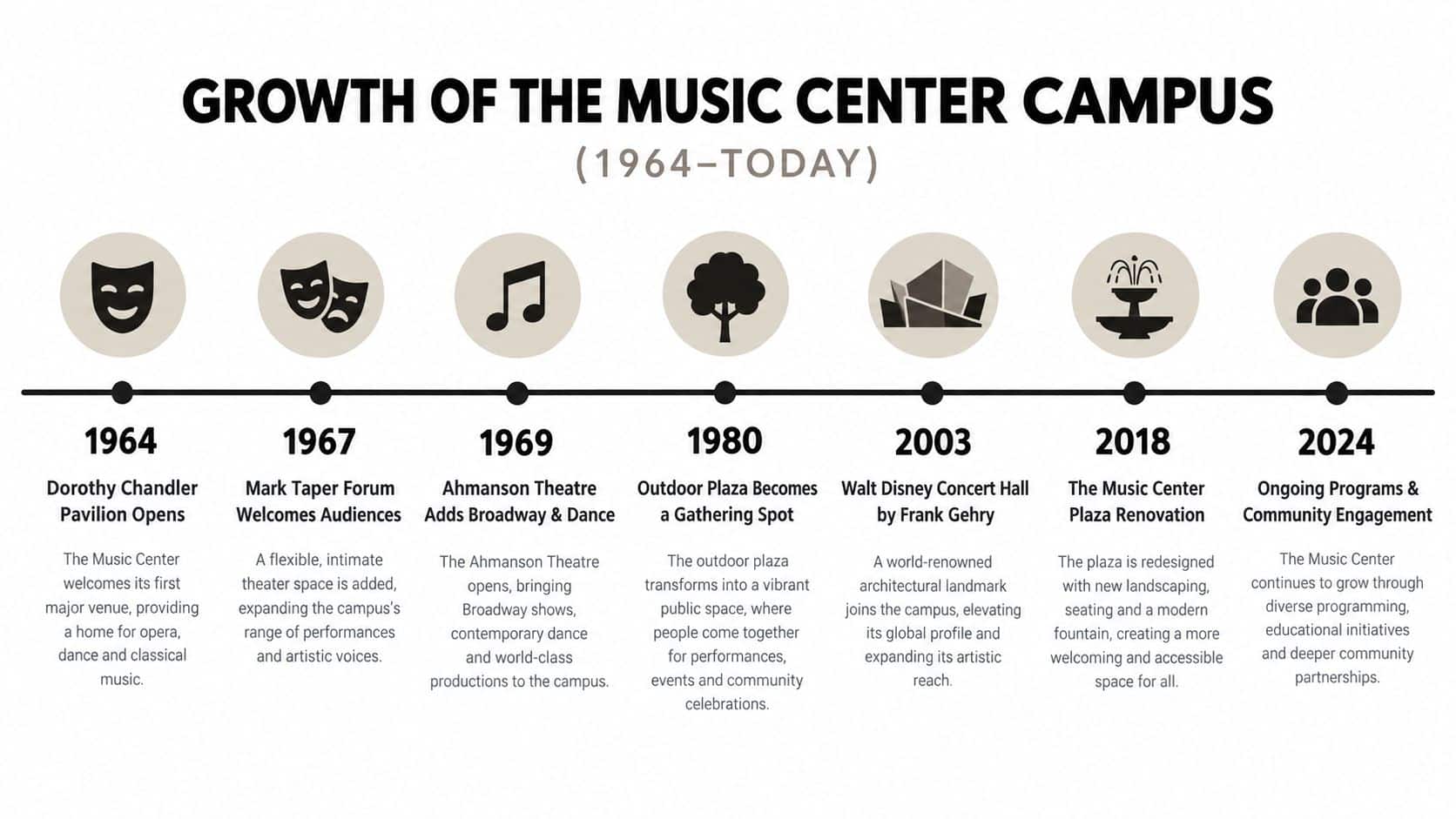
Arrive expecting more than one theater. The Music Center began as a civic arts project, then grew into a multi-venue destination on Grand Avenue, with distinct buildings gathered around shared public space. The original complex was dedicated on December 6, 1964, as a $33.5 million, three-theatre complex described as “A Living Memorial to Peace.” Its principal building was the Dorothy Chandler Pavilion. The Music Center history traces the shift from a formal mid-century arts complex to the contemporary performing arts campus visitors see today.
Dorothy Chandler supplied the project's private-public foundation. By opening day, she had raised nearly $19 million in private donations, while Los Angeles County supported the work through approximately $13.7 million in bonds, according to the Los Angeles Philharmonic account of Chandler's campaign. The first phase centered on the 3,197-seat Dorothy Chandler Pavilion. The Mark Taper Forum and Ahmanson Theatre followed in April 1967.
Four buildings, four intentions
The Dorothy Chandler Pavilion gave the campus its grand civic face. Its scale and formal presentation suit opera, ballet, and major concert events. The Mark Taper Forum brought a closer theatrical relationship between audience and performers, supporting ambitious drama in a more intimate room. The Ahmanson Theatre added a larger stage for substantial theatrical productions, including musical theater.
Walt Disney Concert Hall changed the campus's character when it opened in 2003. The site grew from seven acres to 11 acres, and Frank Gehry's expressive exterior created a new visual landmark on Grand Avenue. Inside, the hall was designed for orchestral listening rather than proscenium theater. The campus history records that architectural and programming shift without treating the buildings as interchangeable.
For a first visit, use the plaza to understand the layout before choosing a door. The result is four distinct rooms around one public gathering point. One feels ceremonial, another intimate, another theatrical, and another sculptural and acoustically focused. That difference should guide your plans: check the venue before buying, then pair the performance with nearby Grand Avenue stops rather than treating the Music Center as a single building.
The Four Venues and What Makes Each One Special
Choosing a venue is more useful than choosing a generic “Music Center event.” The Dorothy Chandler Pavilion is the grandest option, with a traditional proscenium presentation and seating spread across four levels. The Music Center's venue information lists Orchestra 1,442, Founders Circle 471, Loge 443, and Balcony 750, for a total of about 3,200 seats. See the Dorothy Chandler Pavilion venue details when comparing sections.
The Mark Taper Forum is the intimate choice for visitors who want the room to feel close and immediate. Its thrust-stage tradition places the audience around the action, making it especially appealing for serious drama and new theatrical work. It's the venue I'd choose for a focused, conversation-worthy night rather than a grand gala atmosphere.
The Ahmanson Theatre handles scale and flexibility. It's described as a 2,109-seat venue that can quickly convert to a 1,200-seat configuration, so the seating arrangement can change with the production. That makes it a strong pick for major theatrical productions, especially when the show's staging is as important as the script. The Ahmanson Theatre page explains the room's adaptable design.
Walt Disney Concert Hall is the specialist. Its auditorium holds 2,265 seats, and its vineyard-style arrangement brings the audience around the orchestra rather than placing everyone in long rows facing a distant stage. It's the natural choice for the LA Phil, orchestral repertoire, guest artists, and programs where sound quality is the main event.
| Venue | Capacity | Stage Style | Signature Use | Best For |
|---|---|---|---|---|
| Dorothy Chandler Pavilion | About 3,200 | Proscenium | Opera, ballet, major concert events | A formal, celebratory evening |
| Mark Taper Forum | Not specified here | Thrust-stage tradition | Intimate and ambitious drama | Theater lovers and couples |
| Ahmanson Theatre | 2,109, adaptable to 1,200 | Flexible theatrical configuration | Large-scale theatrical productions | Broadway-style nights and families |
| Walt Disney Concert Hall | 2,265 | Vineyard-style concert hall | LA Phil and orchestral programs | Music-focused visitors and architecture enthusiasts |
The Walt Disney Concert Hall and REDCAT venue information also identifies REDCAT as a flexible 200- to 270-seat theater with an additional 3,000-square-foot exhibition space. Choose it when you want experimental work or a smaller, contemporary arts setting.
What Kind of Performances You Will Find Here
The Music Center calendar rewards visitors who search by venue rather than browsing every listing. Start with your date, then filter by Dorothy Chandler Pavilion, Mark Taper Forum, Ahmanson Theatre, Walt Disney Concert Hall, or REDCAT. That simple move removes much of the noise and helps you understand whether you're looking at a flagship series, a limited engagement, or a one-off booking.
Walt Disney Concert Hall is the obvious destination for symphonic programming and LA Phil performances. The theaters support drama, musical theater, dance, opera, family productions, and contemporary work. Outdoor programming on the plaza can offer a more relaxed alternative, particularly when you want a cultural experience without committing to a full indoor performance.
Match the calendar to your trip
Visitors planning around a short stay should search for the exact month they'll be in Los Angeles, then check the venue and performance length before building dinner reservations. Families should look for productions described as family-friendly rather than assuming every daytime event is suitable for children. Couples may prefer a concert or evening drama, while corporate groups often benefit from a performance with a simple Grand Avenue dinner plan.
| Venue | Signature Programming | Typical Run |
|---|---|---|
| Dorothy Chandler Pavilion | Opera, ballet, and formal large-scale events | Season-based and limited engagements |
| Mark Taper Forum | New plays and intimate drama | Theater runs and special engagements |
| Ahmanson Theatre | Musical theater and major productions | Longer theatrical runs |
| Walt Disney Concert Hall | Orchestral concerts and guest artists | Concert seasons and individual programs |
| REDCAT | Contemporary performance and exhibitions | Shorter, flexible programming |
Free outdoor events and community programs can appear on the Jerry Moss Plaza, so check the official calendar rather than assuming every visit requires a paid ticket. If your evening includes a formal reception or a private event, resources for elegant gala arrangements in DTLA can help you think through the wider atmosphere, floral design, and guest experience around Grand Avenue.
Sold-out favorites deserve a different strategy. Save the performance page, check the official ticket channel periodically, and use available alerts when the site offers them. Don't rely on resale listings as your first move. Direct listings give you clearer venue information and a better chance of selecting seats that suit the production.
Tickets, Parking, and Getting There Without the Stress
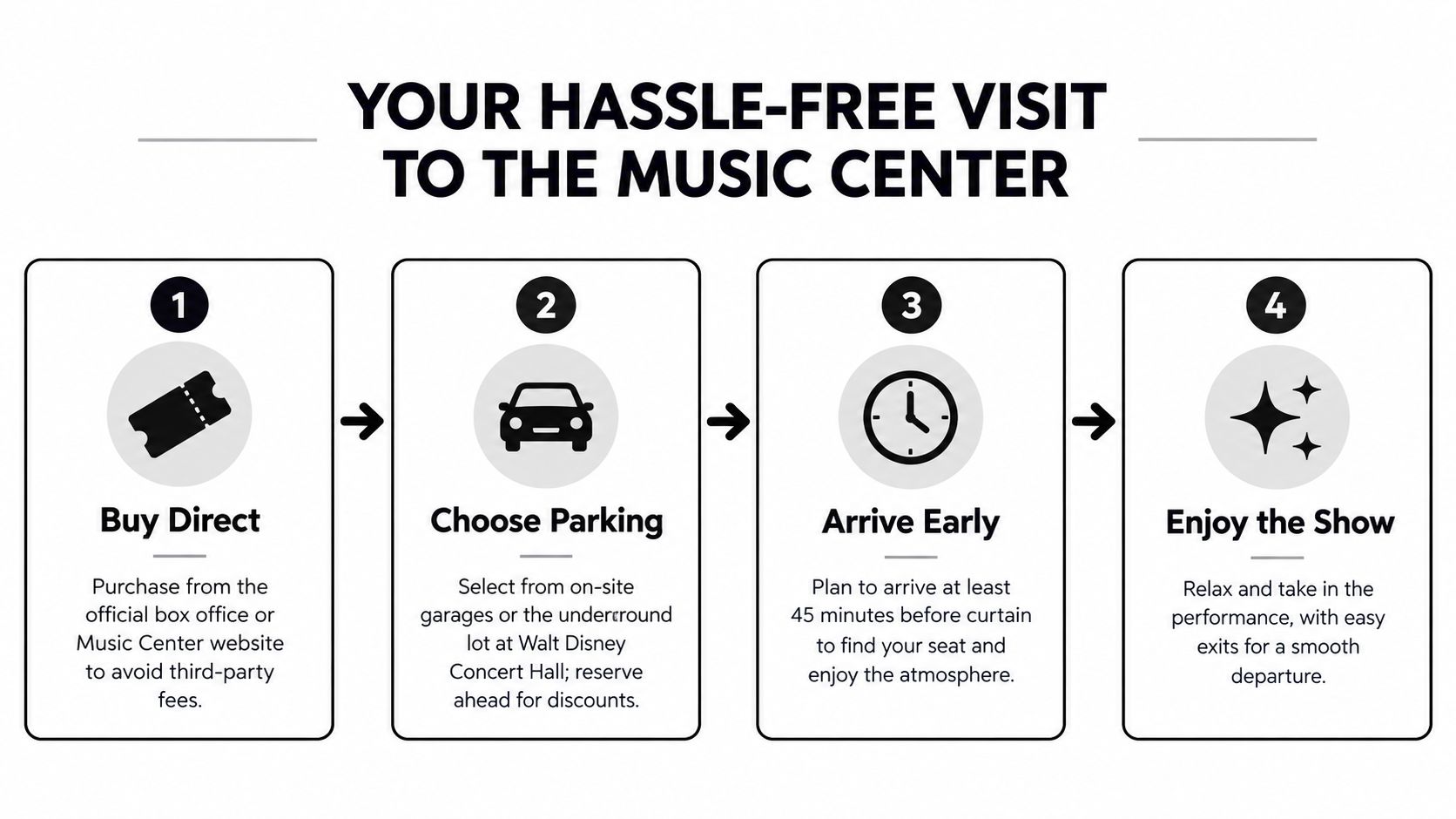
Buy through the official Music Center or venue box office whenever possible. You'll see the correct performance time, seating map, accessibility information, and venue entrance in one place, and you'll avoid the uncertainty that comes with unofficial listings. Print or save the ticket before leaving your hotel, especially if your group is moving between a tour, dinner, and the performance.
Parking works best when you decide before departure. The campus has on-site garages, and Walt Disney Concert Hall has an underground parking option. Compare the garage entrance with your venue before committing, because the shortest route for one building may not be the easiest route for another. If you're driving a luxury SUV, traveling with children, or assisting someone with limited mobility, convenience matters more than choosing the cheapest space.
Your arrival playbook
- Buy direct. Confirm the venue, start time, and entrance on the official listing.
- Choose your transport. Metro, a garage, and rideshare each work well when planned around the specific building.
- Allow a proper buffer. Arrive 45 minutes before curtain so you can pass security, find the right door, collect tickets if needed, and settle into your seat.
- Keep the exit simple. Know where your driver or vehicle will meet you before the performance ends.
Metro access includes the A and E lines, as well as the B and D lines and J Line connections highlighted in Grand Avenue transit guidance. Rideshare passengers should use the designated Grand Avenue drop-off guidance rather than stopping in an active traffic lane. If you're unfamiliar with downtown stations, hands-free audio navigation for LA venues may be useful for keeping directions accessible while you walk.
Accessibility should be part of the original booking conversation, not an afterthought at the door. Check the venue's current information for wheelchair-accessible entrances, ramps, seating, and assistive listening options, then tell the box office what your party needs. For visitors continuing to Hollywood afterward, keep the directions to Hollywood handy, especially if the show is one stop in a longer private itinerary.
Pairing a Performance with the Rest of Your LA Day
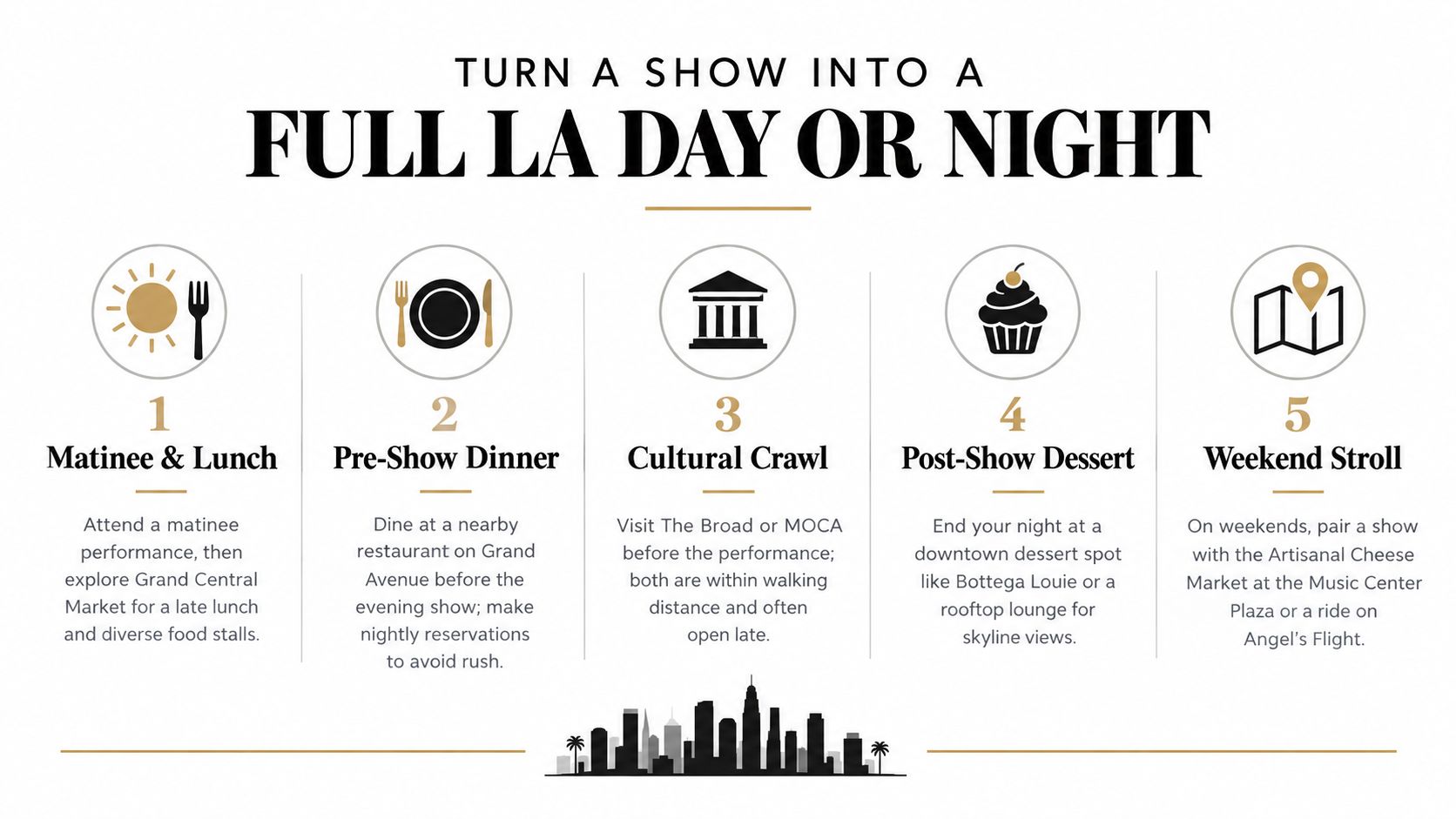
A Music Center ticket becomes much more satisfying when you build the surrounding day around its curtain time. A 2 p.m. matinee leaves room for a late lunch and a relaxed downtown walk afterward. An 8 p.m. evening performance works better as the anchor for dinner, the show, and one carefully chosen post-performance stop. Don't overload the schedule. Downtown is compact in this area, but security, seating, restaurant service, and traffic still need breathing room.
For a matinee, start with a gentle Grand Avenue visit before the theater, then head to Grand Central Market for a late lunch afterward. The market gives a family or corporate group flexibility because everyone can choose something different. Couples who prefer a more polished rhythm can make the performance the center of a longer downtown afternoon, with a museum visit before the curtain and dessert afterward.
Pairings I'd recommend
- Matinee and market lunch: See a daytime production, then explore Grand Central Market when the show ends.
- Grand Avenue dinner: Reserve a table before an evening performance and choose a restaurant close enough that a delayed course won't create a panic.
- Cultural crawl: Visit The Broad or MOCA before the show when their hours suit your itinerary, then walk to the Music Center.
- Post-show dessert: Finish with a downtown dessert stop or a rooftop lounge if your group wants skyline views rather than another full meal.
- Weekend wandering: Add a plaza visit or Angel's Flight when the performance schedule leaves room for an unhurried downtown stroll.
The smart luxury move is to reserve the restaurant first, then select the performance time around it. For a corporate group, keep everyone within the Grand Avenue cluster and arrange one coordinated pickup point. For visitors staying in Beverly Hills or Santa Monica, a private vehicle can protect the evening from parking decisions and allow the Music Center to fit into a broader Los Angeles day.
Concierge Do's and Don'ts for a Memorable Night
A polished Music Center visit depends on small choices made before you leave the hotel. Book dinner well before curtain, confirm the venue entrance, and decide whether the group is using Metro, a garage, or a rideshare. The campus is easy to enjoy once those decisions are settled, but it's not the place to improvise every detail with a party of six.
Do this before the performance
- Book dinner early. Leave enough time for a calm meal, payment, and the walk to your venue.
- Pre-plan parking. If you're driving, check the garage route and any current validation or event policies before departure.
- Choose seats for the room. Orchestra or mezzanine sections can be strong choices for sound and sightlines, while the ideal location depends on the venue and production.
- Dress smart-casual. A polished outfit fits most programs, but check the event description for galas, premieres, or special receptions.
- Arrive 45 minutes early. Use the buffer for security, restrooms, ticket questions, and finding your exact door.
- Silence your phone before the performance begins. It's a basic courtesy and protects the concentration of everyone around you.
Practical rule: Your ticket gets you into the building, but your arrival plan determines whether the evening feels effortless.
Avoid these common mistakes
Don't wait until show night to resolve a ticket problem at the box office. Don't bring an oversized bag if you can avoid it, and don't assume every entrance opens in exactly the same way at curtain time. If mobility is a concern, prioritize the garage and route that reduce walking rather than automatically choosing the lowest-cost option.
A full meal inside the theater is also a poor substitute for dining nearby. Use the venue as the centerpiece, not the entire itinerary. If you want a more customized arrival, dining, and sightseeing plan, Los Angeles concierge service can help coordinate the moving parts around your performance.
For first-time visitors, the winning formula is straightforward: choose the right venue, buy directly, arrive early, and keep the rest of the night intentionally simple. The Music Center rewards that approach with architecture, music, theater, and one of downtown's most enjoyable cultural settings.
Another Side Of Los Angeles Tours can pair a downtown visit to Walt Disney Concert Hall with private sightseeing across Hollywood, Beverly Hills, Santa Monica, Venice, or Griffith Observatory. Visit Another Side Of Los Angeles Tours to plan a custom, chauffeur-supported day or a small-group itinerary that leaves you relaxed before your Music Center performance.