The best Los Angeles historical landmarks are old enough to carry real stories, protected by an official designation, and open enough that you can stand in front of them. Five fit that test. El Pueblo and Olvera Street suit readers who want the city’s origins. The Chinese Theatre suits Hollywood fans, and Griffith Observatory suits anyone who wants a view with some history behind it. Hollyhock House suits architecture lovers, and Watts Towers suits visitors who care about art made against the odds.
The problem is scale. The City of Los Angeles alone has designated more than 1,200 Historic-Cultural Monuments, and the state and federal lists add more. Most of those are not worth a special trip. This article picks five that are, explains what each one is and how to visit it, and then breaks down how city, state and federal designations differ so you can read any plaque or list you come across.
Another Side Tours has guided visitors around Los Angeles since 2007, so the visiting notes below reflect how these places work in practice. Where one of our tours covers a landmark, we say so, with the real price and length.
1. El Pueblo de Los Angeles and Olvera Street
El Pueblo is where Los Angeles began, which makes it the best first stop among Los Angeles historical landmarks.
Key facts
The El Pueblo de Los Angeles Historic Monument preserves the oldest part of the city.
- Origin: the city traces its founding to 1781
- Oldest home: the Avila Adobe, the oldest standing residence in the city
- Main street: Olvera Street, a Mexican marketplace
- Next door: Union Station, which opened in 1939
Why it matters
Olvera Street is often called the birthplace of Los Angeles, and it shows the city’s multicultural roots long before the film industry arrived. The Avila Adobe is the one place where you can walk into pre-Hollywood Los Angeles.
Across the street, Union Station blends mission revival, art deco and streamline moderne styles. It still works as a transit hub, so you see a 1939 landmark in daily use instead of behind a rope.
Start here, and every other landmark on this list makes more sense.
How to visit it
Walking Olvera Street is free. The Avila Adobe keeps its own opening hours, so check them before you go. The Bradbury Building, finished in 1893, is a short ride away on Broadway. It is worth a look for its ornate ironwork and skylit atrium, though interior access is limited.
If you want context instead of a self-guided wander, our Ultimate Downtown Tour is a private, history-focused driving tour of downtown and its historic districts. It runs about four hours and costs $299 per guest, with a two-guest minimum. The Downtown Los Angeles Segway Tour takes about two hours at $199 per guest and is semi-private.
2. Grauman’s Chinese Theatre
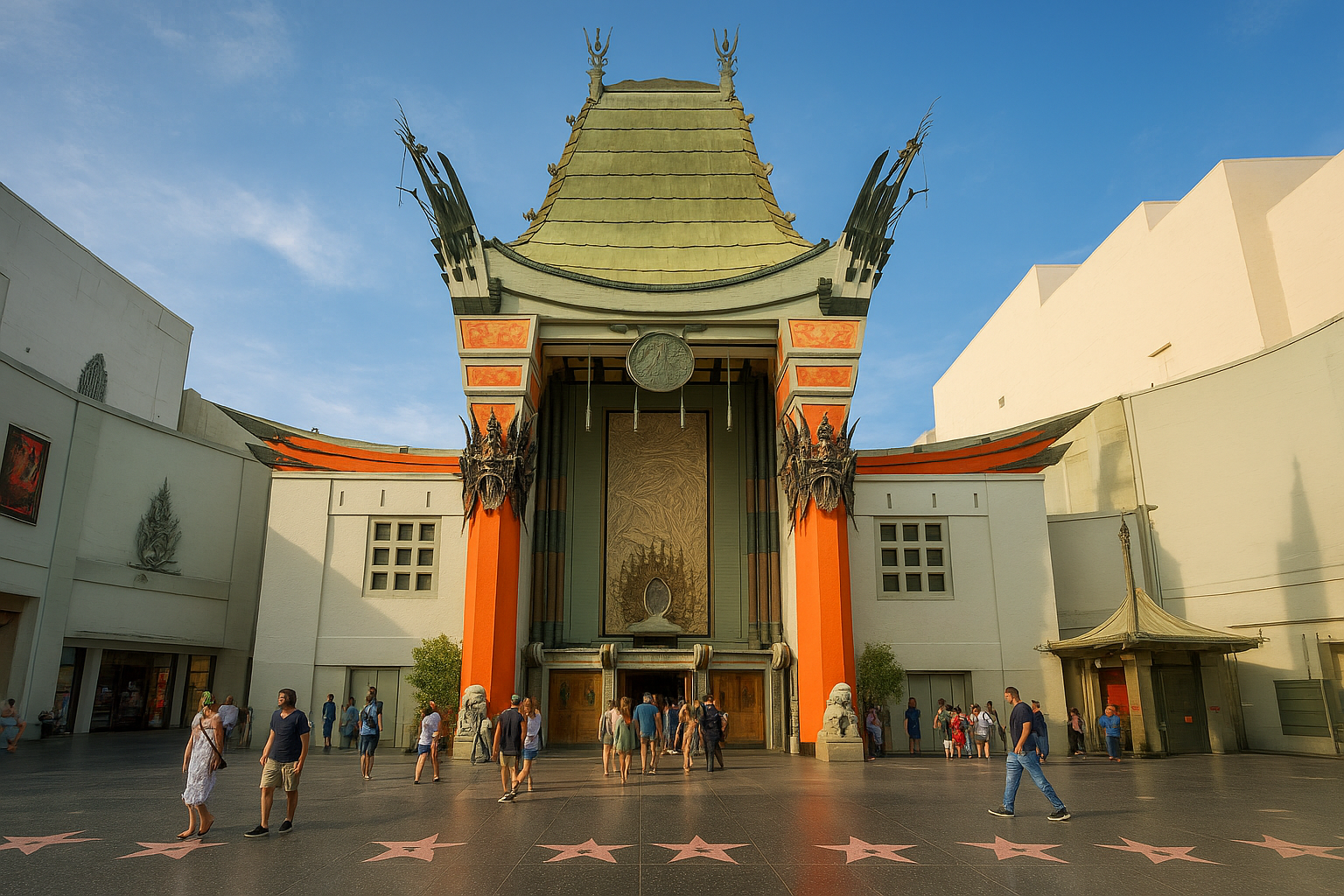
The Chinese Theatre is the clearest surviving symbol of Hollywood’s movie palace era.
Key facts
The theatre sits on Hollywood Boulevard, in the middle of the Walk of Fame.
- Opened: 1927
- Known for: celebrity handprints and footprints in the forecourt
- Neighbor: the El Capitan Theatre, opened in 1926
- Status: a Los Angeles Historic-Cultural Monument
Why it matters
Hollywood became the center of American film in the early 20th century, and its first film studio opened in 1911. The Chinese Theatre is where that industry put on its public face. It has hosted star-studded premieres for nearly a century, and the cement prints in its forecourt turned a movie house into a destination.
The El Capitan, a short walk away, still shows the grandeur of the period. Today it hosts Disney premieres and events, so the street still works as a stage.
Hollywood’s history is easiest to read on one block of Hollywood Boulevard.
How to visit it
You can see the forecourt for free at any hour, but midday crowds are thick and the prints are hard to photograph. Go early in the morning if you want room to look. Reading the prints without a guide only tells you who was famous, not why the street mattered.
Our Hollywood Walking Tour covers Grauman’s Chinese Theatre, the Walk of Fame and the El Capitan Theatre with a professional guide. It runs about 90 minutes and starts at $75 per guest, which makes it the lowest-priced way to get the story behind the block.
3. Griffith Observatory and the Hollywood Sign
Griffith Observatory is a 1930s landmark with the best free view of the city.
Key facts
The observatory and the sign both sit inside Griffith Park.
- Observatory opened: 1935, in the art deco style
- Location: Mount Hollywood
- Hollywood Sign: created in 1923 as an advertisement, on Mount Lee
- Status: both are Los Angeles Historic-Cultural Monuments
Why it matters
The observatory is a public observatory and a cultural icon at once. Its art deco form made it a favorite with filmmakers, and it gives you a clear read on how far Los Angeles spreads from one hilltop.
The Hollywood Sign has a stranger origin. It began as a real estate advertisement and became the symbol of the entertainment industry. The sign is protected, and you see it best from a distance.
The view explains the city’s sprawl better than any map can.
How to visit it
Parking near the observatory fills on busy days, so arrive early or use a ride share. General admission to the building is free, and the grounds reward a slow walk. Hiking toward the sign is possible, but the trail is exposed and hot in summer.
If you want the sign without the hike, our Los Angeles Tour is a semi-private, three-hour tour of Hollywood and Beverly Hills. It covers Mulholland Drive, the Hollywood Sign and Rodeo Drive for $149 per guest, with a two-guest minimum. It runs daily at 9:00 AM and 1:00 PM.
4. Hollyhock House
Hollyhock House is the best place in Los Angeles to see Frank Lloyd Wright’s early work up close.
Key facts
The house sits at 4800 Hollywood Blvd, in Barnsdall Art Park.
- Built: 1919 to 1921
- Client: oil heiress Aline Barnsdall
- Style: Mayan Revival, a textile-block design
- Status: a National Historic Landmark and a UNESCO World Heritage site since 2019
Why it matters
Wright named the house for the owner’s favorite flower, and a stylized hollyhock repeats through the design. The house is also where Wright tested ideas about indoor-outdoor living that Southern California architects kept using for decades.
Few Los Angeles landmarks hold national and international recognition at once. Hollyhock House is part of a UNESCO listing of Wright’s 20th-century buildings, which puts it in the same league as his best-known work elsewhere.
If you only visit one house, make it the one that Wright designed for Los Angeles light.
How to visit it
Interior visits are typically by timed ticket, so check the official schedule and book before you go. The surrounding park is easier to enter and has open views of the city. Because the address is on Hollywood Boulevard, you can pair it with the Chinese Theatre in a single Hollywood day.
Give yourself an hour for the house itself. The rooms are small and the details are fine, so a rushed visit misses the best parts. Read about the Mayan Revival style before you arrive and the textile-block patterns will make much more sense.
5. Watts Towers
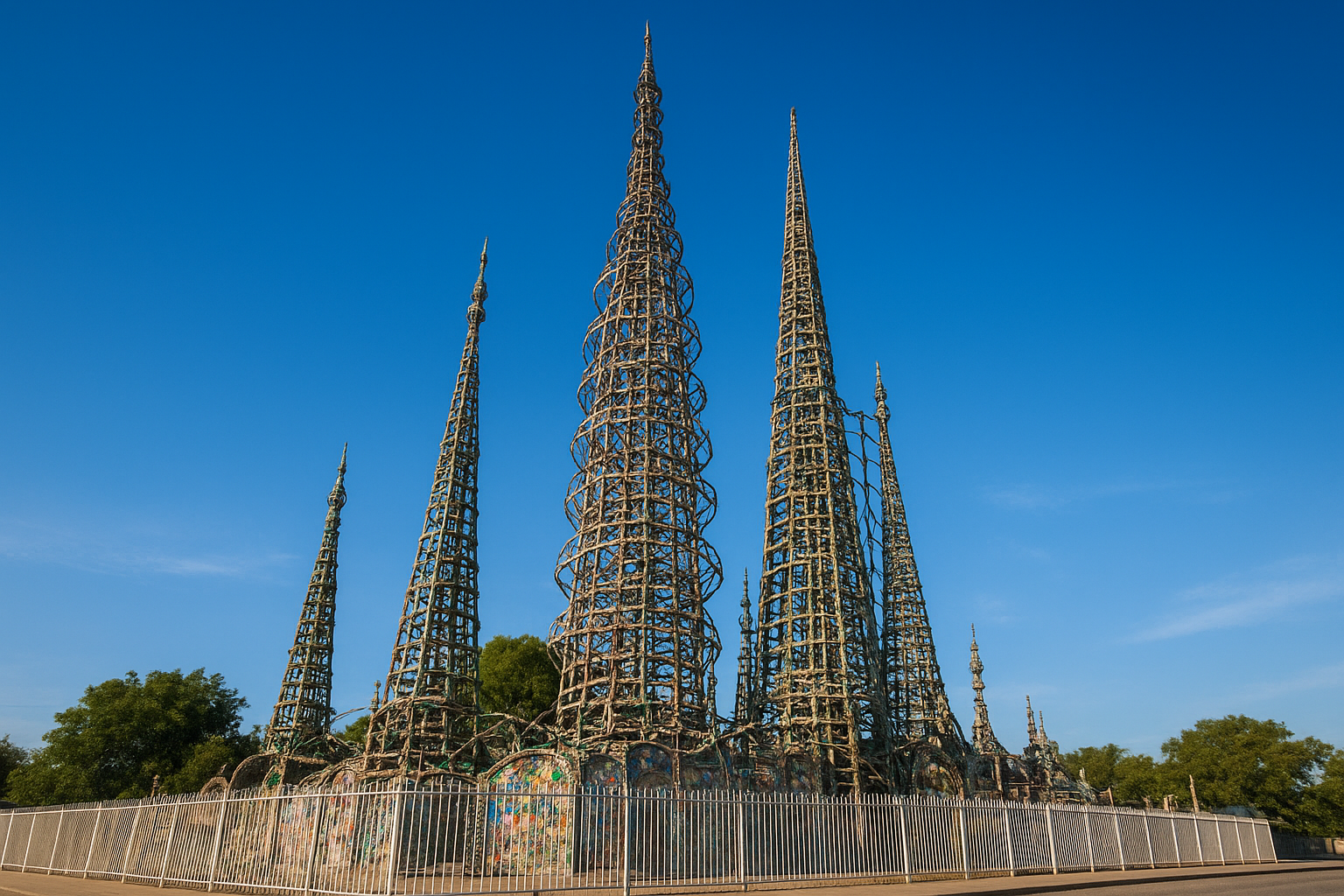
Watts Towers is the most remarkable folk-art landmark in Los Angeles, built by one man over three decades.
Key facts
Italian immigrant Simon Rodia built the towers in his own yard in Watts.
- Built: 1921 to 1954
- Scale: 17 interconnected sculptures, with the tallest rising nearly 100 feet
- Materials: steel rebar and mortar, covered in tile, glass and shells
- Status: a National Historic Landmark
Why it matters
Rodia was a construction worker, and he built the towers by himself, without machinery or scaffolding. That fact alone makes them one of the most unusual 20th-century monuments in the country. They also show that Los Angeles history is not only about studios and estates.
The towers carry a broader cultural story about immigrant labor and public art. Visitors who stay for the movie history and skip Watts see only half of the city’s heritage.
Watts Towers proves that a landmark does not need a famous address to be a great one.
How to visit it
Watts sits south of downtown, so plan a car or ride share. You can see the towers from the street. Guided tours of the grounds run on set days through the Watts Towers Arts Center next door, so check the schedule before you travel.
Treat it as a half-day stop on its own rather than squeezing it between Hollywood sights. The setting is residential, so keep a low profile, and bring water in warm months because the site has little shade.
How Los Angeles landmark designations work
Los Angeles landmarks are protected at three levels, city, state and federal, and one building can hold several designations at once.
The main designations compared
The City of Los Angeles runs the Historic-Cultural Monument program, and its newest monuments are approved by the Cultural Heritage Commission and City Council. The state and federal programs sit above it.
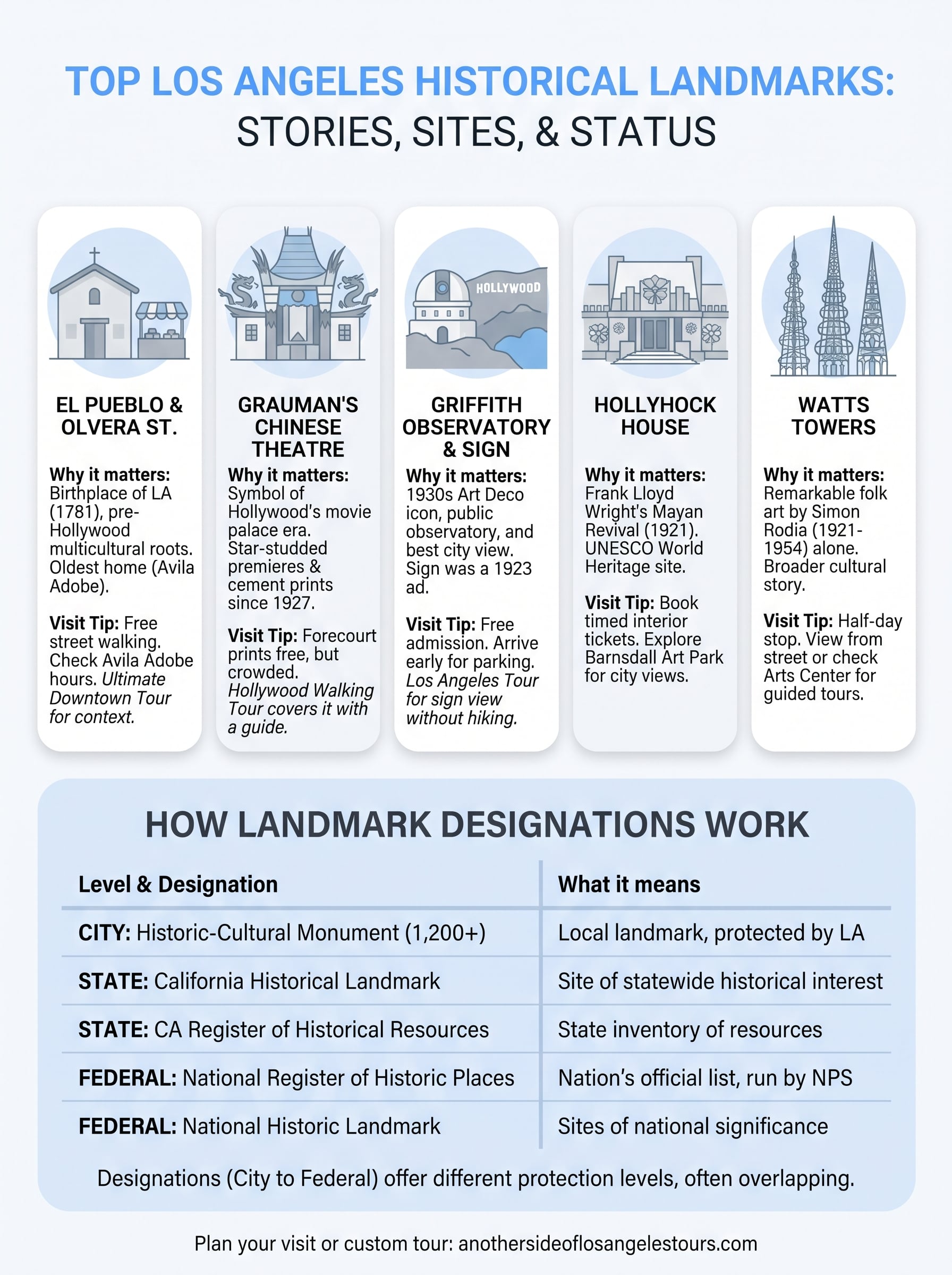
| Designation | Level | What it means |
|---|---|---|
| Historic-Cultural Monument | City of Los Angeles | Local landmark, with more than 1,200 designated |
| California Historical Landmark | State of California | Site of statewide historical interest, listed by county |
| California Register of Historical Resources | State of California | State inventory of significant historic resources |
| National Register of Historic Places | Federal | The nation’s official list of historic places, run by the National Park Service |
| National Historic Landmark | Federal | Sites of national significance |
Proposed projects involving designated properties are reviewed by the city’s Office of Historic Resources against the Secretary of the Interior’s Standards. That review is why protected buildings keep their original character.
A landmark’s label tells you who protects it, and how seriously.
How to check a property’s status
Use the city’s ZIMAS database to see whether an address has a historic designation or has been identified as eligible. The city’s historic landmark programs page explains the steps and links to the full Historic-Cultural Monument list.
- Enter the street address in ZIMAS.
- Read the historic preservation information for that parcel.
- Search HistoricPlacesLA for properties found eligible by SurveyLA or a Community Redevelopment Agency survey.
Where to start with LA’s past
Los Angeles historical landmarks reward you when you pick a few and learn why they matter. El Pueblo shows where the city began. The Chinese Theatre and Griffith Observatory show how it became Hollywood, and Hollyhock House and Watts Towers show how its builders and artists worked. The designation levels explain why some of these places are protected so closely.
If you want to see several of them without planning every transfer, we can help. Our guides know the history behind each stop, and we plan custom tours around what you most want to see. Talk to a tour expert about a custom route and we will build the day with you.