
Most touring advice starts with the biggest battery, the highest torque figure, or the longest manufacturer range claim. That's the wrong place to start. The best e-bike for touring is the one that still feels controlled, comfortable, and usefully charged after you add panniers, climb real hills, face a headwind, and ride farther than the showroom loop.
For a short coastal outing, a lighter trekking bike can be the smarter choice than a heavy SUV-style model. For loaded camping routes or sustained climbs, capacity and torque become decisive. I've ridden enough varied roads to know that a spec sheet can point you toward a good machine, but only route profile, cargo, assist mode, and charging access can tell you whether it's the right one.
Table of Contents
- Why Spec Sheets Lie About Touring Range
- The Five Criteria That Actually Matter for Touring
- Mid-Drive vs Hub Motors and Battery Configurations
- Matching E-Bike Specs to Your Touring Scenarios
- Top Touring E-Bike Recommendations by Use Case
- Essential Accessories and Maintenance for Touring Reliability
- Should You Rent or Buy Your Touring E-Bike
Why Spec Sheets Lie About Touring Range
A manufacturer's range claim usually describes an ideal ride, not your ride. It may assume a light rider, minimal cargo, flat pavement, mild weather, low assist, and consistent pedaling. Touring removes most of those assumptions at once.
A useful example comes from a 2026 editor-tested review of a 504 Wh battery. The bike delivered 56 miles in Eco mode but only 24 miles in Turbo, with a 180-pound rider and 400 feet of elevation gain reported in the test. The lesson isn't that the bike is poor. It's that assist mode and terrain can transform the same battery into two very different touring tools. Read the review details at Electric Bike Review's tested e-bike guide.
Practical rule: Treat advertised range as an upper boundary, not a daily itinerary.
Cargo changes the calculation
Weight affects more than climbing speed. An evidence-based touring guide estimates that energy use can rise by 10 to 20 percent for every additional 50 pounds of rider and cargo on flat ground, and by 40 to 80 percent or more on steep sustained climbs. The same guidance recommends a 15 to 25 percent safety margin for wind, detours, terrain, and cold weather. See the detailed planning guidance from Marsant SX on touring weight and battery range.
That makes a loaded coastal day and a loaded mountain day quite different. A rack carrying clothing and lunch may be manageable with a moderate battery on rolling pavement. Camping equipment, water, tools, and food demand a sturdier frame, stronger wheels, more usable capacity, and a motor that can climb without forcing you into maximum assistance all day.
Battery size still matters, just not alone
Battery capacity remains the clearest technical predictor of practical day range. Neutral cycling guidance places 500 to 625 Wh as the baseline for touring, while 750 Wh and dual-battery systems make more sense for loaded or hilly routes. Real-world touring estimates commonly place a 500 Wh battery around 35 to 50 miles, a 625 Wh battery around 45 to 65 miles, and a 750 Wh battery around 55 to 75 miles, depending on conditions. Those estimates come from eBike24's battery range guide.
Dual-battery systems around 1,500 Wh or more can stretch to roughly 130 to 160 km on hilly terrain and more than 200 km on flatter routes, but they add mass, cost, and charging complexity. The right question isn't “Which bike has the longest range?” It's “How much reserve do I need after my route, luggage, and preferred assistance are accounted for?”
The Five Criteria That Actually Matter for Touring
A genuine touring e-bike is more than a commuter with a rear rack. It needs to carry weight predictably, handle poor surfaces, protect the rider from fatigue, and preserve enough energy for the final climb. Use this checklist before you compare brands.
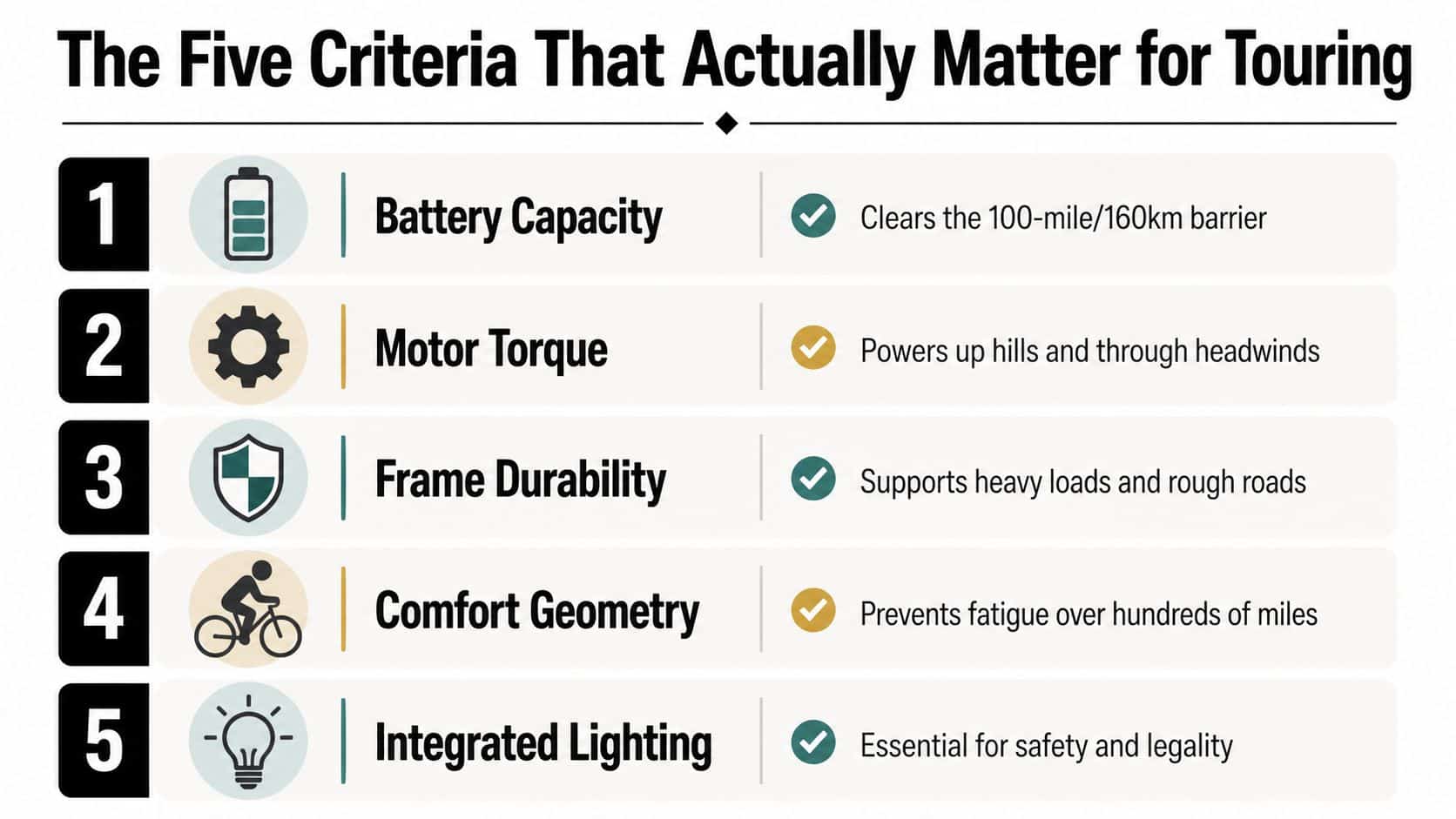
Battery capacity
Start with 500 to 625 Wh for conventional touring. Choose 750 Wh when your route is hilly, your luggage is substantial, or charging stops are uncertain. An expandable system, such as a 500 Wh base battery plus a 250 Wh extender, is especially useful because you can keep the bike lighter for local rides and add capacity for longer departures. The capacity guidance is supported by eBike24's touring range reference.
A small battery isn't automatically a bad choice. It becomes a problem when the listing hides the riding conditions behind a generous headline claim.
Motor torque
For serious touring, I look for mid-drive torque in the 70 to 85 Nm range. That's a useful sweet spot for climbs, headwinds, and luggage without automatically choosing the heaviest, most aggressive bike. An independent touring comparison placed a 70 Nm Bosch Performance motor between Bosch Performance at 65 Nm and Performance CX at 85 Nm. Read the touring e-bike comparison from Bike Magazin.
Torque matters most when the rider keeps pedaling efficiently through a hill. A large number can help, but gearing, rider position, tire choice, and total weight still decide how natural the climb feels.
Frame and cargo support
Look for an integrated rack, stable mounting points, strong wheels, full mudguard clearance, and a published cargo or gross-weight rating. A rack bolted onto a lightweight city frame isn't equivalent to a frame designed around luggage.
One touring-capable test bike reported a 27 kg rear rack limit and a 160 kg maximum gross weight, alongside a 600 Wh battery and 120 Nm maximum torque. Its real-world test produced more than 40 miles in Eco and Tour modes on a bumpy off-road route, while the manufacturer claimed 84 miles. The details are documented in road.cc's Moustache Xroad FS 6 review.
Bike weight and handling
A heavier bike may carry more, but it can be awkward on stairs, during transport, or when you need to maneuver it fully loaded. A lighter bike may feel livelier and use less energy on rolling terrain, yet lack the frame strength or battery reserve needed for expedition-style travel.
Judge weight together with wheelbase, tire width, stand-over access, and where the battery sits. A balanced bike is easier to control when panniers are full.
Comfort and visibility
Touring geometry should support a relaxed torso, natural wrist angle, and stable steering. Suspension can help on broken pavement and gravel, but tire volume and saddle setup often matter just as much. Integrated lights, mudguards, hydraulic braking, and a dependable kickstand are practical features, not decorative upgrades.
If a bike feels cramped or nervous unloaded, it won't become comfortable after a full day with luggage.
Mid-Drive vs Hub Motors and Battery Configurations
Mid-drive and hub-motor bikes can both tour successfully, but they solve different problems. A mid-drive places assistance through the bicycle's gearing, which generally makes it better suited to sustained climbing and changing terrain. A hub motor can be simpler and attractive for flatter routes, especially when a larger battery delivers useful reserve at a lower price point.
The motor decision should follow your route, not a popularity contest.
Motor Type and Battery Configuration Comparison
| Feature | Mid-Drive Systems | Hub Motor Systems |
|---|---|---|
| Torque behavior | Strong choice for climbing with luggage, with touring benchmarks around 70 to 85 Nm | Can work well on flatter routes, though the riding feel and hill performance vary by design |
| Hill climbing | Uses the bike's gears to keep the motor working efficiently on changing gradients | Often performs best when the route is flatter or the load is lighter |
| Serviceability | Dealer support matters because the motor, battery, display, and drivetrain may be integrated | Mechanical systems can be familiar to many bike shops, but electronics and proprietary parts still require support |
| Battery strategy | Commonly paired with expandable systems, including 500 Wh plus 250 Wh configurations | Value-oriented models often compensate with larger fixed batteries |
| Best use | Loaded touring, hilly routes, mixed surfaces, and riders who want a natural climbing response | Coastal pavement, urban-to-rural trips, flatter routes, and buyers prioritizing capacity per dollar |
| Main trade-off | Usually more complex and potentially heavier or costlier | Can feel less natural on steep climbs and may place more stress on the rear wheel when heavily loaded |
Recent touring guidance continues to highlight the Trek Allant+ 7 because it combines a Bosch Performance mid-drive, dealer support, expandable battery capacity, and integrated rack equipment. Value-focused alternatives such as the Aventon Level 3 use a hub motor and a larger battery strategy, which can make sense for riders who mostly stay on flatter roads. The contrast is useful because the decision isn't “best bike overall.” It's best motor system for your route and cargo. See the discussion in eBike GearLab's touring e-bike roundup.
Choosing your battery configuration
A removable battery is valuable when you'll sleep indoors and charge away from the bike. An extender is useful when most rides are moderate but occasional tours demand more reserve. Dual batteries are the serious option for long, hilly routes where charging access is uncertain, though you'll need to accept the additional weight and plan how to charge both packs.
For most riders, an expandable mid-drive system is the best compromise. It gives you a manageable everyday bike without closing the door on ambitious touring.
Matching E-Bike Specs to Your Touring Scenarios
The right specification depends on what you'll carry and where you'll ride. Don't buy a mountain-capable machine for a light coastal route unless you want its extra bulk. Likewise, don't choose a minimalist commuter for a multi-day trip just because its brochure shows a flattering range figure.
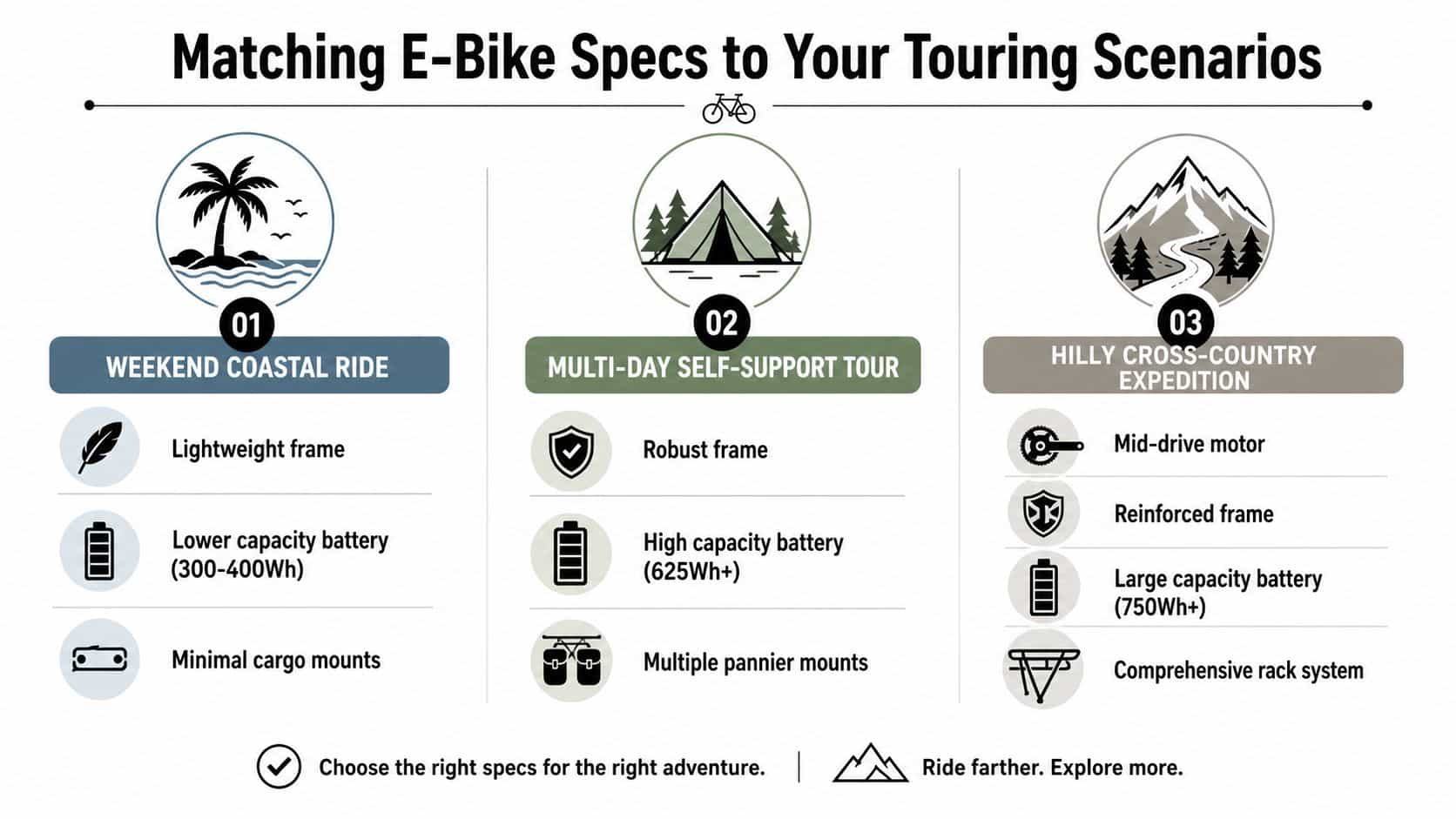
Weekend coastal rides
For a Malibu-style coastal day with minimal clothing, water, and a small repair kit, prioritize smooth handling, comfortable geometry, integrated lights, and easy charging. A 500 Wh battery is a sensible starting point, while 625 Wh gives more breathing room if your route includes repeated climbs or you prefer stronger assistance. A mid-drive around 70 Nm is plenty for most loaded coastal use.
Keep the rack system simple. You want room for a day bag or compact panniers, not a full expedition frame that makes the bike harder to transport.
Multi-day self-support tours
Camping gear changes everything. Choose at least 625 Wh, and consider 750 Wh if the route includes climbs, long gaps between charging opportunities, or heavy food and water loads. Multiple pannier mounts, a reinforced frame, strong wheels, full mudguards, and a published cargo rating matter more than a sleek silhouette.
Build your route around realistic energy use. The evidence-based touring guidance cited earlier recommends a 15 to 25 percent reserve for changing conditions, detours, wind, and cold weather, so don't plan to arrive at camp with the battery nearly empty.
Hilly cross-country routes
For sustained climbs, select a mid-drive with 70 to 85 Nm of torque, low gearing, and a 750 Wh battery or larger. A dual-battery setup around 1,500 Wh or more becomes attractive when the route is remote or mountainous. The extra capacity won't eliminate planning, but it can reduce the pressure to ride every climb in the most energy-hungry mode.
Route planning also needs legal awareness. In the U.S. federal classification system, Class 1 bikes assist only while pedaling and stop at 20 mph, Class 2 bikes can also use a throttle but stop at 20 mph, and Class 3 bikes assist only while pedaling up to 28 mph. The Bureau of Land Management e-bike FAQ explains the classifications and why access rules can differ across public lands and trails.
For visitors who'd rather experience Los Angeles without committing to a full purchase, the Beverly Hills and West Hollywood e-bike tour offers a guided way to learn the city's terrain, landmarks, and riding rhythm before planning a longer independent route.
Top Touring E-Bike Recommendations by Use Case
There isn't one universal winner, but there is a clear leader for serious all-round touring. My recommendations focus on the motor system, battery flexibility, cargo practicality, and route fit rather than a single headline range.
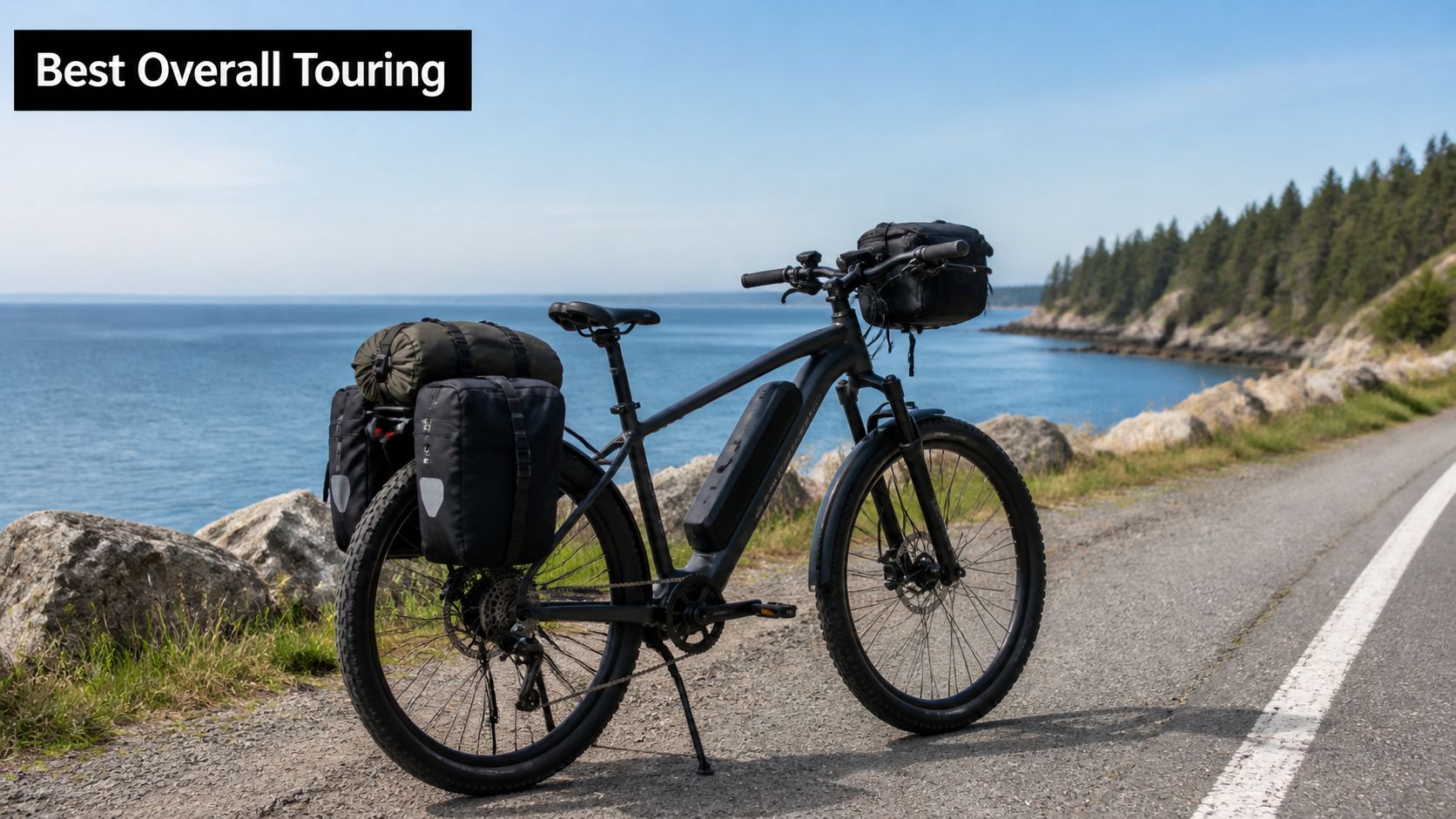
Best overall for serious touring
The Trek Allant+ 7 is my strongest general recommendation for riders who want one bike for commuting, weekend trips, and loaded touring. Its Bosch Performance mid-drive is listed at 75 Nm, and its battery configuration combines 500 Wh with a 250 Wh extender. An expert touring roundup lists a claimed range of about 60-plus miles, but the key advantage is the expandable system, dealer support, integrated rack, and predictable mid-drive climbing behavior. Those specifications appear in the Bike Magazin touring comparison.
It isn't the lightest choice, and riders who mainly travel flat bike paths may not need its full capability. For a touring buyer who wants dependable flexibility, it's the most balanced pick.
Best value for flatter routes
The Aventon Level 3 deserves consideration when budget matters and your routes are primarily paved, rolling, or coastal. Its hub-motor format and larger-battery approach can offer useful range without the complexity of a premium mid-drive system. It's not my first recommendation for heavily loaded mountain touring, but it can be a sensible value option for riders who want practical capacity and straightforward urban-to-rural use.
Check local service access, rack compatibility, total weight, and the manufacturer's cargo limits before committing. Those details determine whether the value survives beyond the first few rides.
Best for mixed terrain
For mixed pavement, gravel, rough roads, and sustained climbs, choose a mid-drive touring bike with strong gearing, wide stable tires, suspension where appropriate, integrated lighting, and at least 625 Wh of capacity. A model such as the Moustache Xroad FS 6 shows why the complete package matters. Its tested configuration included a 600 Wh battery, 120 Nm maximum torque, a 27 kg rear rack limit, and a 160 kg maximum gross weight, while its real-world range fell well below the manufacturer's claim on a rough route. The road.cc review of the Moustache Xroad FS 6 is useful precisely because it exposes that difference.
The trade-off is weight. You gain capability, but you'll notice it when lifting the bike or maneuvering it through tight spaces.
For more help comparing frame style, rack design, motor placement, and everyday practicality, consult these electric trekking bike buying tips before you shortlist models.
Best for lightweight weekend trips
A lighter trekking bike with a moderate battery is the right answer for riders carrying little and riding rolling roads. Look for comfort geometry, dependable lights, puncture-resistant tires, a useful rack, and enough capacity to finish the route with your reserve intact. Don't pay for dual batteries and expedition hardware if your actual touring means a day bag, lunch, and a planned café stop.
For a guided introduction to the city's hills, neighborhoods, and landmarks, Another Side Of Los Angeles Tours provides Los Angeles e-bike tours that can help first-time visitors understand how an e-bike feels before choosing equipment for a longer trip.
Essential Accessories and Maintenance for Touring Reliability
A touring e-bike fails at its weakest practical point. The motor may be excellent, but a loose rack, underinflated tire, neglected chain, or dead phone can end the day early. Pack for recovery, not just comfort.
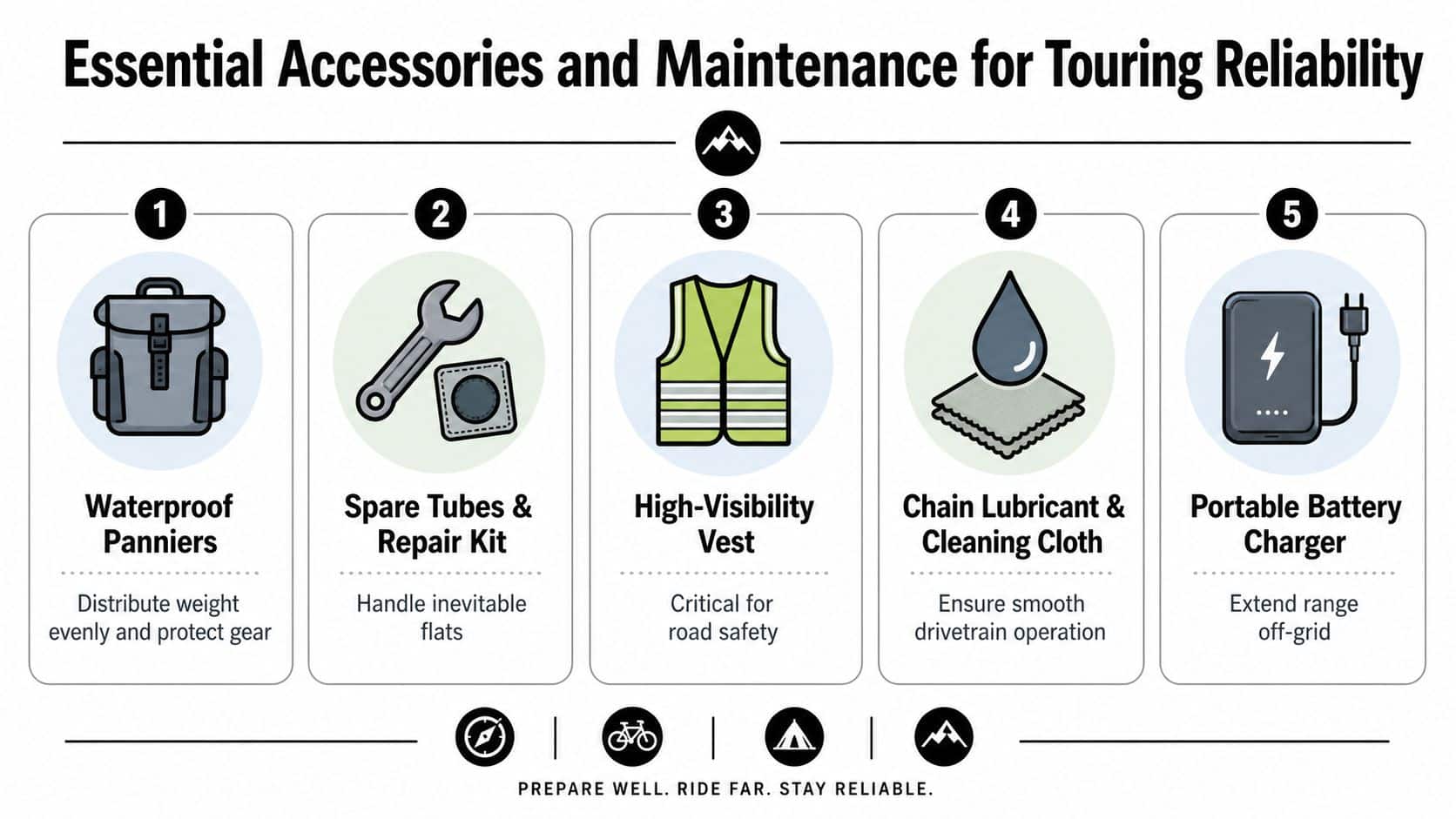
Pack the bike properly
- Waterproof panniers: Mount them symmetrically and keep dense items low so the bike remains stable through turns.
- Spare tubes and repair kit: Carry tubes that match your tire size, tire levers, a pump, patches, a multi-tool, and a chain tool.
- High-visibility vest: Use it on exposed roads, during poor weather, and whenever the route extends into lower-light conditions.
- Chain lubricant and cleaning cloth: Wipe grit from the chain before lubrication, especially after wet or dusty riding.
- Portable battery charger: Confirm that your accommodation, café, or planned stop permits charging before you rely on it.
A phone mount with charging capability is also worthwhile for navigation, but keep a paper or offline route backup. Electronics can fail at exactly the moment you need them.
Maintain before the ride
Inspect brake pads, tire sidewalls, spoke tension, rack bolts, pedals, and battery contacts before departure. Test every pannier attachment with the actual touring load. A ten-minute check at home is easier than diagnosing a loose rack beside a busy road.
Clean and lubricate the chain more often when you ride through rain, dust, or steep terrain. Store the battery according to the manufacturer's guidance, protect it from extreme temperatures, and avoid beginning a remote ride with a pack that hasn't charged properly.
A GPS tracker can add another layer of reassurance for a valuable touring bike. If you're comparing options, browse e-bike trackers and choose a device with a mounting position that won't interfere with the battery, rack, or service access.
Should You Rent or Buy Your Touring E-Bike
Buy when you'll tour regularly, have secure storage, and want a bike configured around your body and luggage. Ownership gives you consistent fit, familiar controls, your preferred saddle and pedals, and the ability to install racks, bags, lights, and tracking equipment exactly once.
Rent when you're testing the idea, traveling to a destination, or unsure whether you prefer a mid-drive or hub motor. A quality rental also lets you evaluate battery behavior, climbing feel, step-through access, and loaded handling before making an expensive commitment. Ask the operator about battery health, maintenance records, included accessories, legal classification, and what happens if the bike develops a fault.
Buying used can work when the frame is sound, the battery condition is documented, replacement parts are available, and a qualified shop can inspect the motor and brakes. Don't treat a low purchase price as a bargain if the battery, rack, or proprietary electronics are difficult to replace.
For visitors who want the experience without transport logistics or long-term maintenance, guided e-bike tours in Los Angeles provide a controlled introduction to riding around neighborhoods such as Beverly Hills, Hollywood, Santa Monica, Venice, Malibu, and Griffith Observatory.
Another Side Of Los Angeles Tours offers private and small-group electric bike experiences with local guides, safety instruction, and carefully planned routes through Beverly Hills, Hollywood, Santa Monica, and Venice. Visit Another Side Of Los Angeles Tours to choose a polished Los Angeles itinerary that lets you enjoy the ride without guessing about traffic, landmarks, or logistics.