You've just arrived in Los Angeles, the sun is bright, the traffic is already testing your patience, and your group is looking to you for more than a list of landmarks. At the Hollywood Sign overlook, one guest wants the perfect photograph, another wants film history, and someone else is wondering whether the next stop includes a restroom. The quality of the day depends on how smoothly you connect those needs.
That's the craft of tour guide communication. In Los Angeles, a guide must manage celebrity culture, multilingual guests, changing traffic, outdoor noise, family energy, and VIP expectations without making the experience feel managed. The right words, delivered at the right pace, turn Beverly Hills, Santa Monica, Venice, Malibu, and Hollywood into a coherent story rather than a hurried series of stops.
Table of Contents
- Why Tour Guide Communication Defines the Private Tour Experience
- Voice, Projection, and Pacing for Outdoor LA Stops
- Storytelling Structure That Makes LA Landmarks Memorable
- Reading the Room, Answering Questions, and Handling Difficult Guests
- Multilingual Phrasing and Accessibility Best Practices
- The Concierge Communication Checklist for Every Private Tour
Why Tour Guide Communication Defines the Private Tour Experience
At the Dolby Theatre, a strong guide might pause halfway through a sentence, lower the volume, and offer a brief aside about a 1953 premiere. The group stops checking phones. Guests lean forward, not because the fact is necessarily rare, but because the guide has created space for it to land.
That moment captures the difference between information delivery and concierge service. A private tour gives a guide room to notice who's engaged, who needs context, and who would rather photograph the architecture than hear another production anecdote. Research has long treated the guide as more than a one-way communicator, describing a shift toward someone who choreographs experiences and acts as a cultural link between visitors and host communities. The changing role of the tour guide helps explain why pace, framing, and group awareness matter as much as factual knowledge.
Consider two guides on Hollywood Boulevard. The first speaks at full volume, reciting dates while guests look toward the Walk of Fame stars. The second welcomes a Korean-speaking couple with a brief, personalized aside, checks whether the family wants more film context, then shifts from celebrity trivia to the architecture of the Chinese Theatre. The second guide hasn't necessarily said more. They've made the guests feel seen.
That distinction affects perceived value, recommendations, and gratuities. Visitors often remember whether a guide made the city accessible to them, not whether every fact was delivered. The same principle applies to visual content and digital storytelling. Teams that track carousel content performance understand that presentation changes how an audience receives information. A private guide works with the same principle in person.
For a practical overview of the qualities that support this kind of experience, see what makes a good tour guide. Every technique that follows rests on one foundation: communication turns an itinerary into an experience.
Voice, Projection, and Pacing for Outdoor LA Stops
Los Angeles rewards guides who can adjust their voice without sounding theatrical. Griffith Observatory has uphill walking, reflective surfaces, and changing wind. Rodeo Drive adds traffic, delivery vehicles, and passing conversations. A quiet Malibu canyon demands almost the opposite approach, with a softer delivery that protects the calm.
Start with breathing. Use low, diaphragmatic breaths rather than shallow chest breaths, especially before a longer explanation on the approach to Griffith Observatory. The goal isn't to shout farther. It's to maintain a steady, supported voice that stays intelligible when the group is spread along a path.
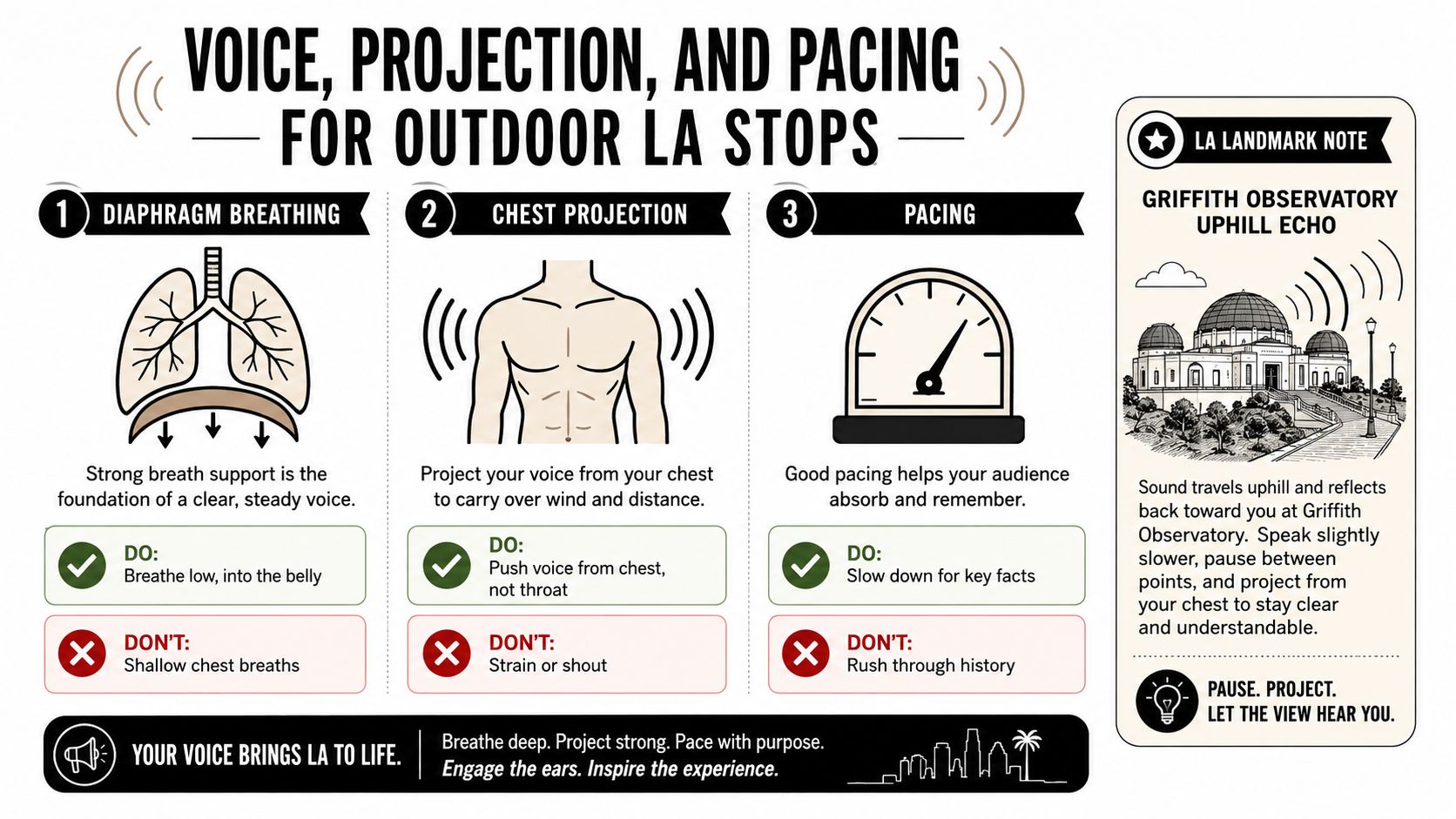
Project without shouting
At Rodeo Drive, project from the chest and keep the throat relaxed. A guide who strains to overcome traffic usually becomes harder to understand, not easier. Make a microphone check at every stop, even if the equipment worked perfectly during pickup.
A few habits make a noticeable difference:
- Lower the pitch for intimacy: At a Hollywood Sign overlook, a quieter, grounded tone encourages guests to look up and take in the view.
- Keep your face visible: Guests who rely on facial cues or lip-reading need a clear sightline.
- Avoid competing with noise: Wait for a bus, truck, or large group to pass rather than racing through a sentence.
- Use pauses deliberately: Leave two to three seconds between sentences so guests can take photographs without losing the thread.
Pacing also protects the itinerary. When a van circles back for a pickup, slow your cadence instead of filling the transition with rushed commentary. On a long canyon drive, vary emphasis and use sensory details. A monotone narration makes even beautiful scenery feel like dead time.
Guides can sharpen their delivery by reviewing voice-over script and editing tips, then adapting those principles for live conversation. Before each pickup, run a quick self-test: take one low breath, say the opening welcome at normal volume, check the microphone, identify the noisiest planned stop, and choose one place where you'll intentionally pause. That ritual takes moments and prevents the common mistakes, shouting over ambient noise, racing to stay on schedule, and flattening every stop into the same vocal register.
Storytelling Structure That Makes LA Landmarks Memorable
Facts become memorable when guests can place them inside a shape. A useful structure for Los Angeles landmarks is hook, context, surprise, and echo.
The hook earns attention. Context gives the guest enough orientation to understand the place. The surprise adds a detail they're unlikely to find in a guidebook summary. The echo returns the story to the guest, often through a question, sensory image, or personal connection.
A four-beat structure in practice
For the Hollywood Sign, a guide might say:
“The Hollywood Sign began as a real-estate stunt in 1923, created to draw attention to a new hillside development. Over time, the temporary message became an emblem of the entertainment industry, especially as Hollywood's cultural influence expanded through the 1970s. Look closely at the surface and you'll notice that the sign's paint and restoration history are part of its story, not just its appearance. What film, song, or childhood memory made this view feel familiar to you?”
The script uses a named era, a visual cue, and an invitation. It doesn't attempt to explain every chapter of the sign's history. One surprising detail per stop is usually more effective than a dense collection of trivia.
Santa Monica Pier needs a different emotional temperature. A concise version could sound like this:
“The pier is where the city meets the Pacific, so start by noticing the movement around you, families, performers, cyclists, and people watching the horizon. Its history connects recreation, transportation, and the changing character of Santa Monica. The unexpected detail is how quickly a place can shift from a local gathering point into a global image of California. Before we leave, choose one sound, color, or view from the pier that you'll remember when you think of Los Angeles.”
Use named characters when they clarify the story, sensory anchors when the setting is visually rich, and shorter sentences when the group is walking. At a memorial or a quiet Malibu canyon overlook, skip the full arc. Silence, a respectful observation, or a simple explanation may serve the moment better.
| Beat | Hollywood Sign Script | Santa Monica Pier Script |
|---|---|---|
| Hook | A hillside message begins as a real-estate attention-getter. | The pier brings families, performers, cyclists, and the Pacific into one view. |
| Context | The sign grows alongside Los Angeles entertainment culture. | The pier reflects recreation and the changing identity of Santa Monica. |
| Surprise | Its restoration and paint history add depth to the familiar image. | A local gathering point becomes a global California symbol. |
| Echo | Ask guests what memory the view brings back. | Invite guests to choose one sensory detail to remember. |
Reading the Room, Answering Questions, and Handling Difficult Guests
A rehearsed monologue treats every group as identical. A concierge-level guide watches the room and adjusts without making the adjustment visible.
On Hollywood Boulevard, scan before you start. Are guests looking at the stars beneath their feet, watching street performers, or facing you? At a celebrity-home viewpoint, are they asking follow-up questions, taking photographs, or drifting toward the edge of the group? Those signals tell you whether to shorten the next explanation, add context, or pause for a better viewing angle.
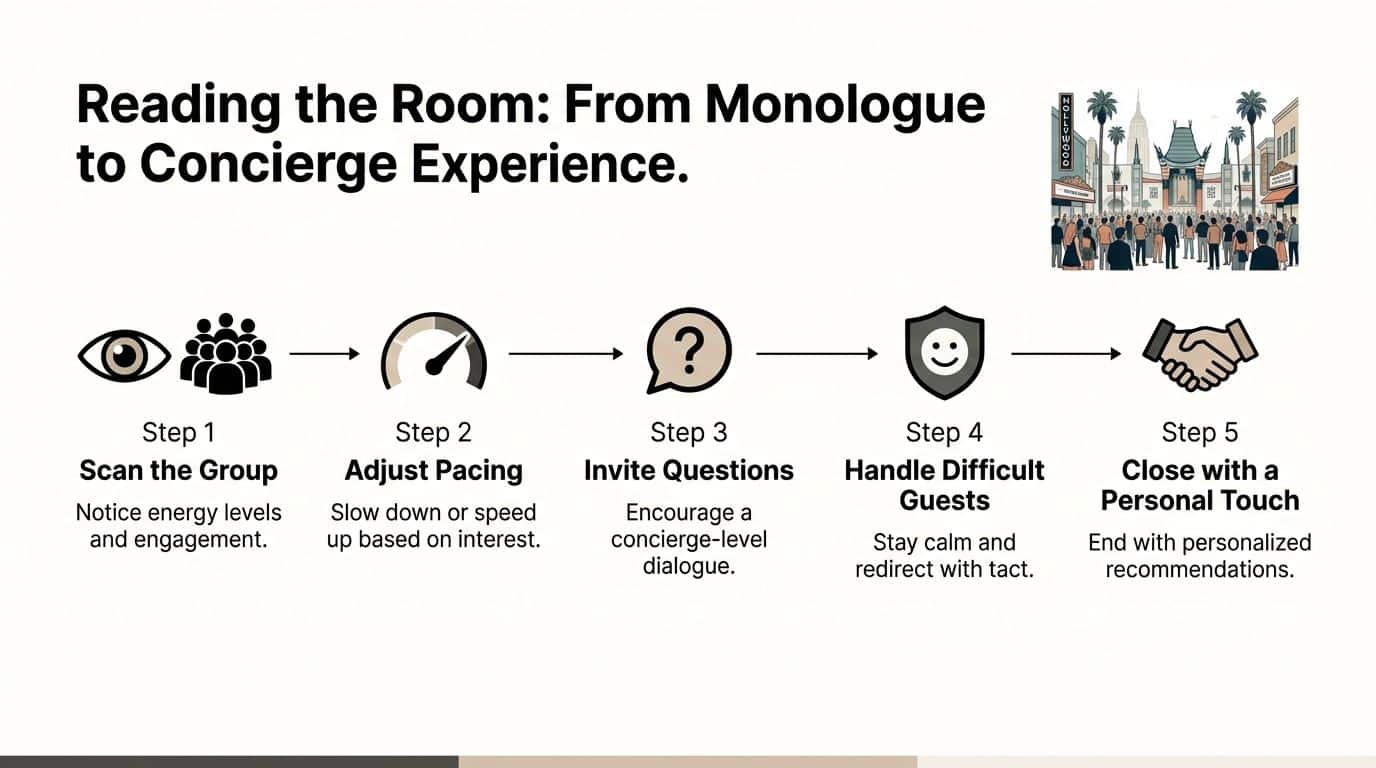
Keep questions useful
Invite questions after a complete thought rather than interrupting every sentence. If a guest takes the conversation toward a later stop, use a bridge such as, “Great question, let me fold that into the next stop.” This respects curiosity while protecting the shape of the experience.
For politically charged debates or spoilers about a filming location, stay neutral and redirect to what guests came to experience. A polished response might be, “That topic has several perspectives. I'll keep our focus on the site and return to the history that brought us here.”
Reading the room also means naming discomfort without amplifying it. A small-group guide can check whether the pace works, whether the sun is becoming tiring, or whether a family wants more time at a photo stop. Research on guide communication has found that visitors value welcoming behavior, orientation, stories, and directions together, rather than treating narration as a standalone performance. Research on communication skills at historical attractions supports that practical balance.
De-escalate without surrendering control
Use four moves:
- Lower your volume. A calm voice prevents a tense exchange from becoming public entertainment.
- Slow your pace. Give the guest room to finish and show that you heard the concern.
- Acknowledge the feeling. Say, “I understand why that feels disappointing.”
- Bridge back to the experience. Offer a clear alternative or explain the next useful step.
For a guest who complains that a filming location looks ordinary, try: “I understand the frustration. The camera angle and production design often create a different impression, so I'll show you the detail that makes this location recognizable.”
For a VIP who wants to dictate every turn, say: “We can absolutely prioritize your preferences. I recommend keeping the next stop because it protects the timing and gives you the strongest view, then we can adjust the route from there.”
Guides who want to refine this skill can review group dynamics management as part of their preparation. The aim isn't to win every exchange. It's to preserve trust, comfort, and momentum.
Multilingual Phrasing and Accessibility Best Practices
Premium communication begins before the vehicle arrives. Ask about language preferences, hearing needs, mobility, cognitive differences, and processing needs during booking, then use that information to shape the day rather than treating it as an exception.
Open with a greeting in the guest's primary language when you can do so accurately. Keep a laminated phrase card with useful expressions in Spanish, Mandarin, French, and German, including welcome language, directions, restroom guidance, and safety instructions. A guide who wants to strengthen practical Spanish can use giving directions Spanish phrases as a reference, then rehearse the phrases aloud before using them with guests.
Make complex places easy to follow
Plain language doesn't mean childish language. It means shorter sentences, defined terms, and explicit transitions.
Instead of saying, “We'll proceed along the perimeter before repositioning for the elevated vista,” say, “We'll walk around the building, then stop at the higher viewpoint.” For older guests, first-time visitors, and neurodivergent travelers, explain what happens next and allow time for the information to settle.
The same discipline helps multilingual guests. Avoid idioms, rapid jokes, and references that depend on cultural context. A bilingual hook can add warmth, but it should clarify rather than display the guide's vocabulary. For example, a brief explanation of a word connected to “star” can lead naturally into the Walk of Fame, provided the guide also explains the point in plain English.
Accessibility guidance recommends pacing a walking tour according to the slowest participant, speaking loudly enough to be heard without shouting, and keeping the group together. Accessible tourism guidance for walking tours turns those principles into an operational habit: pause at curbs, stairs, slopes, and uneven pavement, then confirm that everyone is ready before continuing.
Face the group when speaking so guests can read facial cues. Describe visual moments for low-vision companions, including the direction of a skyline view, the shape of a building, or the movement of the ocean. Address disabled guests directly rather than speaking through an assistant, a practice also emphasized in guidance for making tourist guiding accessible.
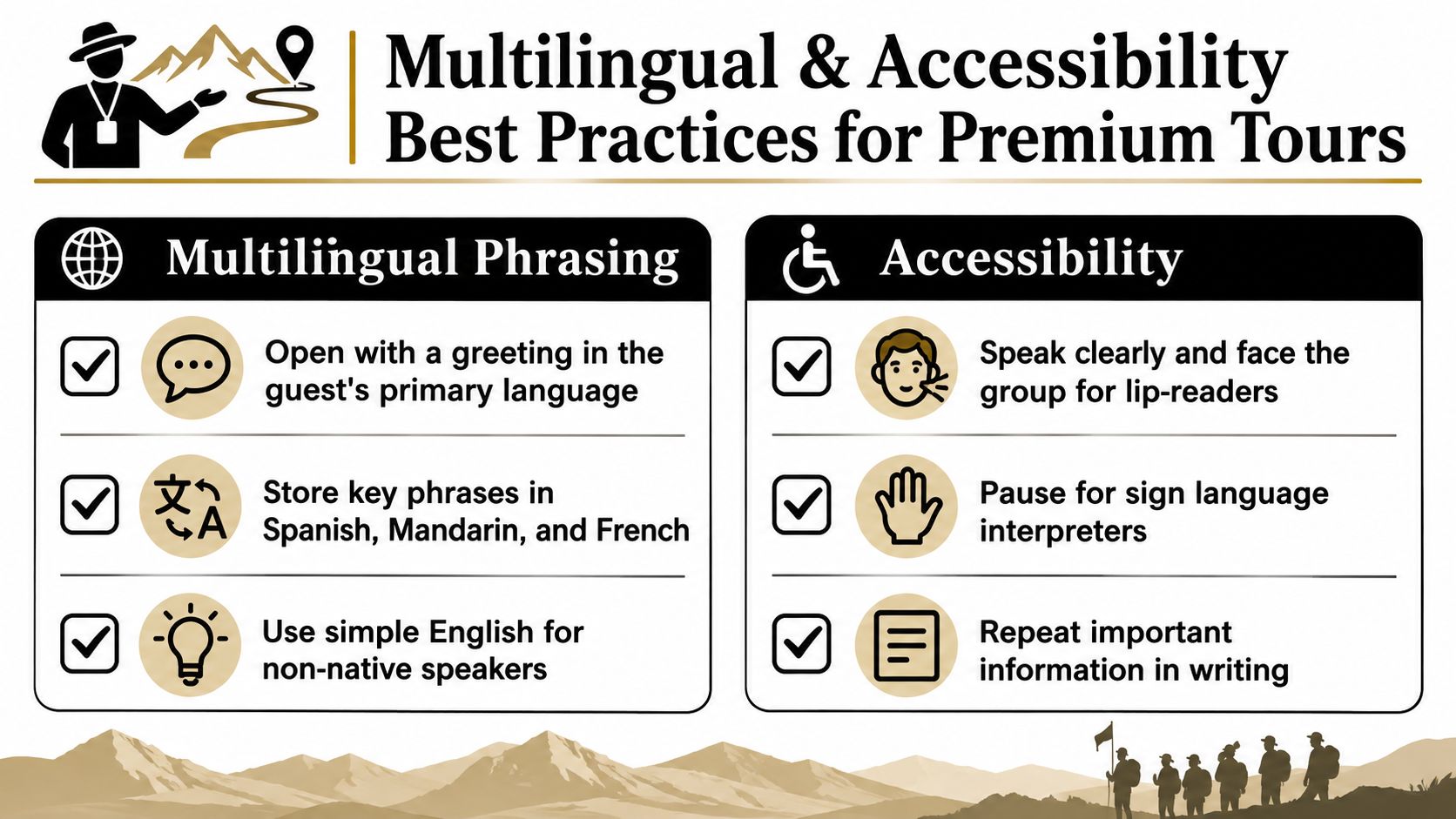
Microphone etiquette matters for guests who are hard of hearing. Keep the microphone near your mouth, avoid turning away during key information, pause for interpreters, and repeat important details in writing when appropriate. ISO 21902:2021 recommends tourism information that remains equivalent across channels and can be provided in formats such as audio, Braille, or other accessible options. The ISO accessibility standard reinforces a simple principle: access should be designed into communication, not added after a guest struggles.
Guests who need Spanish-language support can also consider Hollywood tours in Spanish when planning their Los Angeles visit.
The Concierge Communication Checklist for Every Private Tour
The most polished guides don't rely on charm alone. They prepare the communication environment, observe the group, and recover gracefully when Los Angeles introduces noise, traffic, heat, delays, or an unexpected change of plan.
Before pickup
Begin with the guest profile. Confirm names, language preferences, ages, mobility considerations, dietary or comfort concerns, photography priorities, and whether the group prefers celebrity culture, architecture, film history, shopping, coastal scenery, or a balanced mix.
Then prepare your voice and route:
- Review the guest profile: Know who wants a relaxed Beverly Hills drive and who hopes to spend time at the Hollywood Sign.
- Confirm language preferences: Decide which greetings, directions, and safety phrases you'll use.
- Check accessibility needs: Plan curb pauses, seating options, and alternatives for steep or crowded areas.
- Prepare key phrases: Keep plain-language wording ready for directions and transitions.
- Write opening and closing remarks: A confident welcome and a personal farewell make the day feel intentional.
Tourism guidance also recommends confirming timing, gathering a visitor profile, and preparing alternatives before the tour begins. That preparation is particularly valuable for private Los Angeles routes, where traffic can change the order of Beverly Hills, Griffith Observatory, Santa Monica, and Malibu stops.
During the experience
Open with a story rather than a schedule. At Greystone Mansion, use a guest's name naturally when you connect the architecture to their interests. At the Hollywood Sign, pause for photographs before adding the next piece of context. Check the group's energy regularly, not only when someone complains.
Keep the working checklist short:
- Monitor energy: Notice who's engaged, tired, or eager to move.
- Adjust volume and pace: Use supported projection outdoors and a quieter tone in reflective settings.
- Invite questions: Make room for curiosity without letting one topic take over.
- Use inclusive language: Explain what everyone can expect next.
- Handle friction tactfully: Lower your voice, acknowledge the concern, and offer a practical bridge.
A 12-week ESP tour-guide training study found that collaborative learning improved communicative strategies, with the experimental group outperforming the control group on oral-problem and listening-problem coping scales. The tour-guide training study supports training through role-play, peer interaction, listening drills, and scenario recovery rather than lecture-only instruction.
After the final stop
Recovery continues after the vehicle returns. Send a thoughtful thank-you, record preferences that could improve a future visit, invite specific feedback, and note which stories or stops created the strongest response.
A private tour feels premium when the guest notices considered phrasing, measured pacing, and visible care. Those signals matter at a crowded Hollywood stop, in a quiet Malibu canyon, and during a corporate itinerary where several personalities need to feel included.
A communication-focused operator such as Another Side Of Los Angeles Tours combines professionally trained local guides with private and small-group experiences across Hollywood, Beverly Hills, Santa Monica, Venice Beach, Malibu, and other signature LA settings. Its options include custom tours, step-on guide services, celebrity-home itineraries, hiking excursions, Segway and e-bike experiences, and VIP limo outings, giving guests a way to match the route and communication style to the occasion.
For a private Los Angeles day shaped around your pace, language preferences, family needs, or VIP priorities, visit Another Side Of Los Angeles Tours to explore curated routes and custom experiences. Share what you want to see, how you prefer to travel, and what would make the day feel effortless, then let the team build the conversation and itinerary around you.