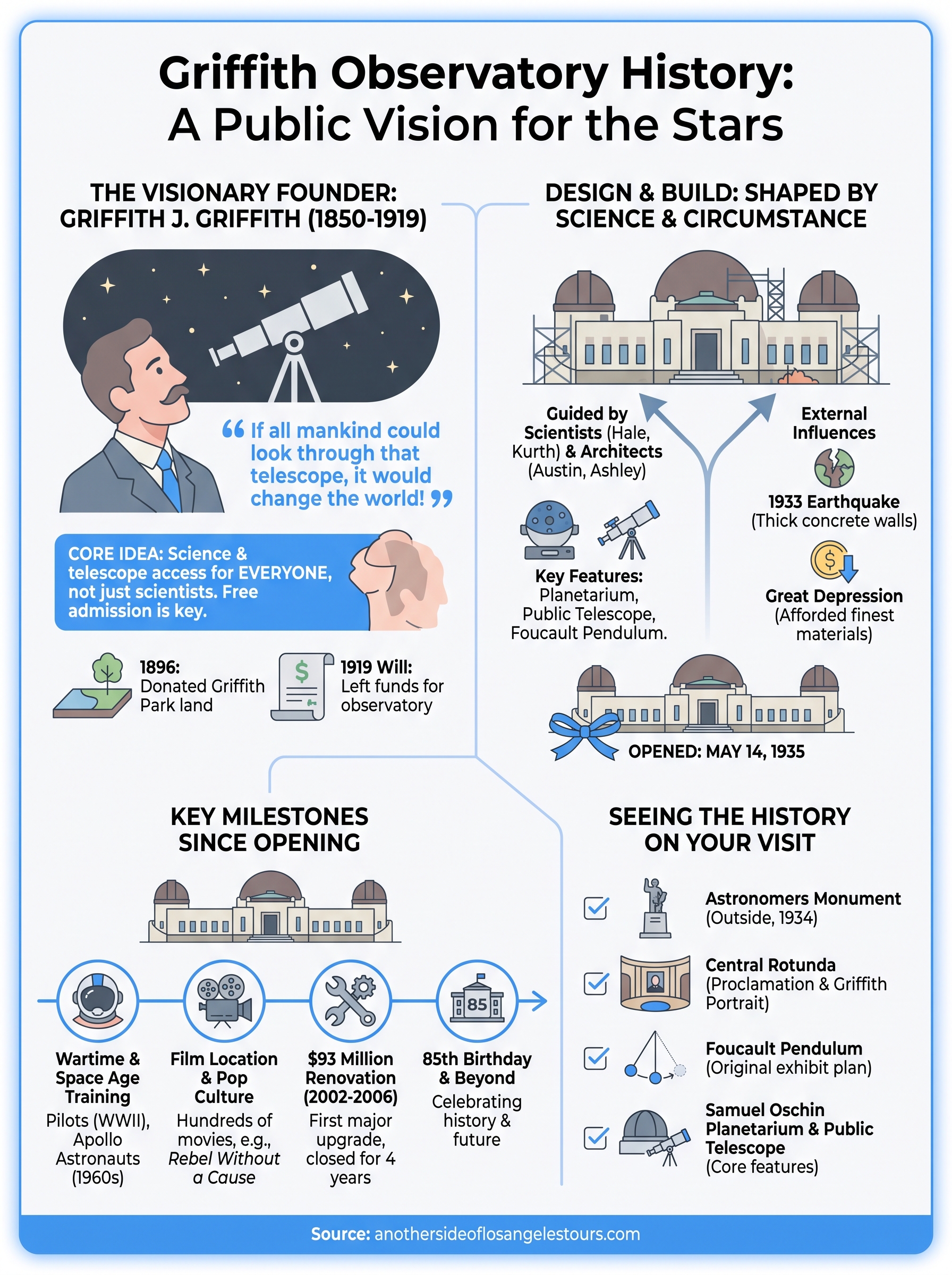
Griffith Observatory history starts with a Welsh-born mining and real estate millionaire, Griffith J. Griffith. He donated the land for Griffith Park in 1896, offered $100,000 for a public observatory in 1912, and left money for it in his 1919 will. The building was dedicated on May 14, 1935 and opened to the public the next day. Since then it has trained military pilots and Apollo astronauts, appeared in hundreds of films, and reopened in 2006 after a $93 million renovation.
An observatory is a building for viewing the sky. Most were built for researchers. Griffith’s was built for ordinary visitors, with a public telescope, science exhibits and a planetarium. That purpose explains almost everything about how it looks, how it was funded and why it is still one of the best-known landmarks in Los Angeles.
This article walks through the story in order. You will see why the history matters, who founded the observatory and why, how it was designed and built, which milestones followed, and how to spot that history when you visit. At Another Side Of Los Angeles Tours we have been creating experiences for visitors since 2007.
Why the history of Griffith Observatory matters
The history matters because the observatory was built on an unusual idea: anyone, not just scientists, should be able to look through a telescope and learn about the universe. Once you know that, the free admission, the building and the exhibits make sense.
A public observatory was a new idea
At the turn of the 20th century, a "public observatory" was a very new idea. Griffith did not leave the details to chance. He wrote precise specifications for what the building should include, and the planners followed them closely.
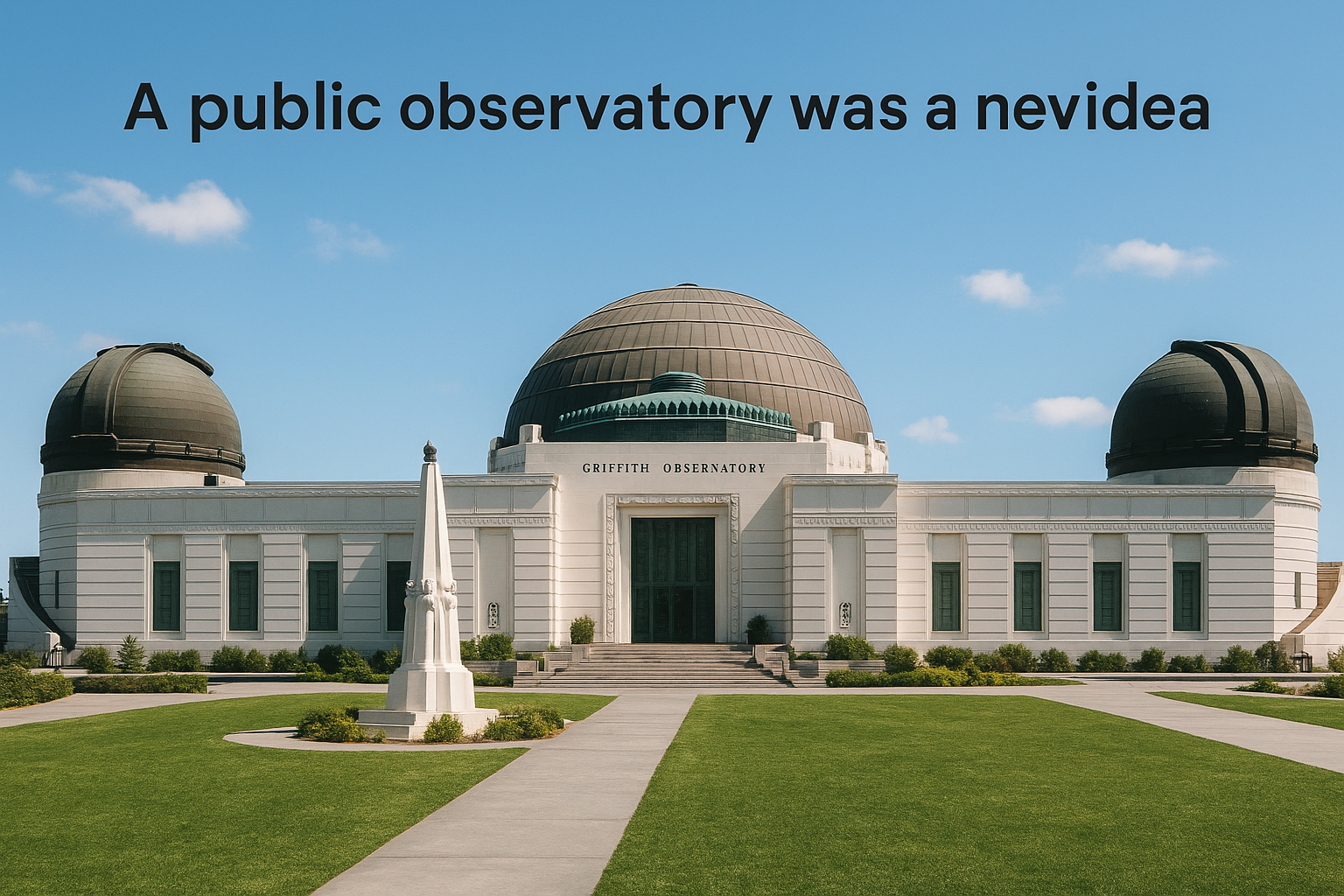
The result is a building with no equivalent in its time. Admission has been free since opening day in 1935. The City of Los Angeles describes it as the most-visited public observatory in the world.
The observatory exists because one man believed that looking at the sky should be open to everyone.
What the history explains when you visit
Many things you see on site have a reason behind them. Here are three that the history answers directly:
- Free access: Griffith’s plan called for free viewing through the telescope, and the building has been free to enter since 1935.
- Thick concrete walls: an earthquake in March 1933 pushed the architects away from a terra cotta exterior.
- A planetarium at the center: the planetarium was invented in 1923, after Griffith’s death, and replaced his original idea of a science film theater.
Who founded Griffith Observatory and why
Griffith J. Griffith founded it, first by giving the city the land and then by funding the building through his will. He wanted ordinary people to feel the awe he felt looking through a great telescope.
Griffith J. Griffith and the park
Griffith was born in Wales in 1850 and came to America as a teenager. He worked as a journalist and mining advisor, then made his fortune in Mexican silver mines and southern California real estate. In 1882 he bought what remained of Rancho Los Felis. He liked to be called "Colonel," though it is unclear he ever held a commission.
After seeing the great public parks of Europe, he decided Los Angeles needed one to become a great city. On December 16, 1896, he donated 3,015 acres to the city for a park in his name.
From Mount Wilson to a 1912 offer
Griffith was introduced to astronomy through the Southern California Academy of Sciences. Then he visited the research observatory at Mount Wilson, which opened in 1904. Looking through its 60-inch telescope, then the largest in the world, he reportedly said, "If all mankind could look through that telescope, it would change the world!"
On December 12, 1912, he offered the city $100,000 for an observatory on Mount Hollywood. His plan had three parts: a telescope open to free viewing, a Hall of Science, and a theater for educational films. Political debate stalled the project. In 1916, with his health failing, Griffith wrote a will with bequests and detailed specifications for the observatory. He died on July 6, 1919.
Griffith never saw his observatory. He died 16 years before it opened.
How Griffith Observatory was designed and built
The Griffith Trust, which managed money from his estate, began work in spring 1930, and the observatory was dedicated five years later. Leading scientists shaped the design, while an earthquake and the Great Depression shaped the building itself.
The team and the design
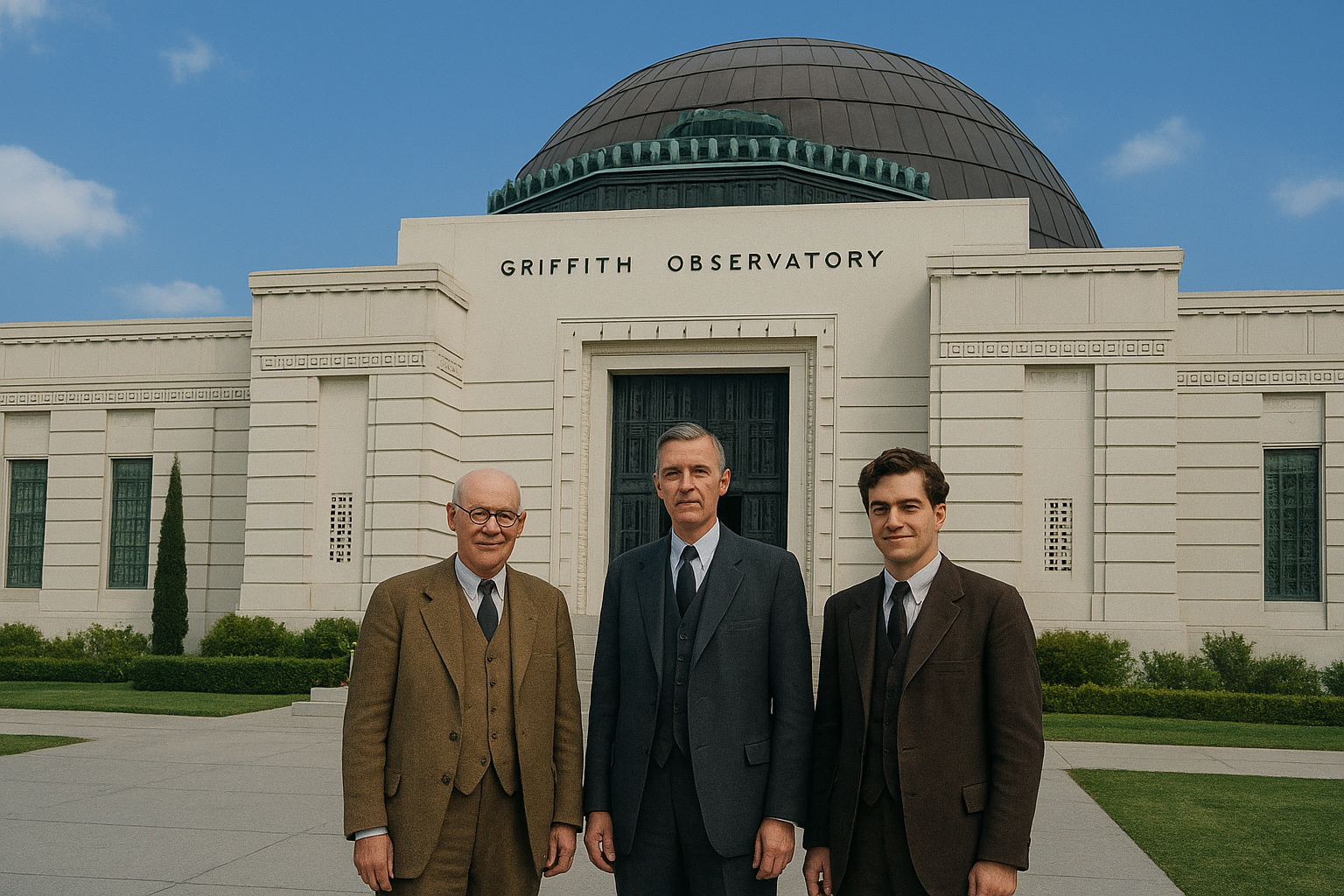
The Trust recruited George Ellery Hale, who had overseen the great telescopes at Yerkes, Mount Wilson and Palomar, to steer the design. Caltech physicist Edward Kurth drew up the plans, with amateur telescope-making pioneer Russell W. Porter as his aide. In May 1931, architects John C. Austin and Frederick M. Ashley were chosen to finalize the building plans.
The exhibit plans included a Foucault Pendulum, a 38-foot model of a section of the Moon by artist Roger Hayward, and a coelostat that fed three solar telescopes. The Trust picked a 12-inch Zeiss refracting telescope as the public instrument. It also designed a 75-foot-wide theater for a Zeiss planetarium projector. Griffith’s family agreed that the planetarium honored his intent better than the film theater. It was the third planetarium completed in the United States.
Construction and its surprises
Ground was broken on June 20, 1933, with the William Simpson Construction Company as builder. The March 1933 Long Beach earthquake led the architects to thicken the concrete walls. Depression-era prices let the Trust buy the finest interior materials of the day. A federal public works program employed six sculptors for the Astronomers Monument, dedicated in November 1934.
The project also lost people. Kurth was killed in a car accident in February 1934, and physicist Rudolph Langer took over supervision. Formal dedication came on May 14, 1935, when the Trust handed the building to the City of Los Angeles. The Department of Recreation and Parks has operated it ever since.
An earthquake and the Great Depression shaped the building as much as any astronomer did.
Key milestones since the 1935 opening
Since 1935 the observatory has served as a wartime classroom, a film location and a stage for celestial events, and it closed once for a major rebuild. These are the milestones that matter most.
From wartime training to the space age
| Year | Milestone |
|---|---|
| 1937 | Monthly Griffith Observer astronomy magazine begins |
| 1942 | Military pilots train in the planetarium to navigate by the stars |
| 1948 | Premiere of A Trip to the Moon, the first planetarium show about space travel |
| 1966-67 | Apollo astronauts train in the planetarium theater |
| 1973 | Laserium premieres and runs for 28 years, until January 2002 |
| 1974 | Dr. E.C. Krupp becomes director and serves 45+ years, the longest of any director |
| 1976 | Designated Los Angeles Historic-Cultural Monument No. 168 |
| 1985-86 | Halley’s Comet draws record crowds |
During World War II the observatory also closed on weekday evenings, from May 1942 to November 1946.
Renovation and the film connection
In January 2002 the observatory closed after 67 years of heavy use for its first major capital improvement. It reopened on November 2, 2006, after a $93 million makeover. It closed again on March 13, 2020 because of the coronavirus and celebrated its 85th birthday that May 14.
The film story started before the doors opened. The Phantom Empire was the first of hundreds of movies shot there, and the building plays itself in Rebel Without a Cause (1955). That answers the common question of which movie was filmed at Griffith Observatory. There is no single answer, but those two are the starting points.
The 2002 to 2006 renovation was the first major capital improvement to the building since it opened.
How to see the history on your visit
You can read the history in the building itself if you know where to look. A little preparation turns a quick photo stop into a visit with context.
What to look for
Use this short checklist:
- Astronomers Monument: the 1934 public art piece outside, restored in 1991 with a new bronze armillary sphere.
- Central Rotunda: inside, it holds the City Council proclamation accepting Griffith’s park gift, along with his portrait.
- Foucault Pendulum: part of the original exhibit plan, so ask a staff member where to find it.
- Samuel Oschin Planetarium: the theater descended from the 1935 planetarium, and one of the few in the world where every program is presented live.
- Public telescope: the Trust chose a Zeiss refractor in the 1930s for this role. Check the observatory’s official calendar for current viewing hours, since they change.
Visiting with a guide
If you want the story told on site, our Ultimate Kid Friendly Tour is a private family day with stops at the California Science Center, the La Brea Tar Pits and Griffith Observatory. It runs approximately 7 hours, costs $399 per guest with a two-guest minimum, and includes snacks, bottled water and transportation. Parties of four or more save $25 per guest.
Know three dates before you go, 1912, 1933 and 1935, and the building will read like a story.
The short version
Griffith Observatory is the result of one man’s conviction that science should be public. Griffith J. Griffith gave the land in 1896 and the money by will, and scientists, architects, an earthquake and the Depression shaped the rest. It opened in 1935, trained pilots and astronauts, starred in films and survived a major renovation.
If you want a guide who knows this story and the rest of Los Angeles, explore our private tours of Los Angeles.