
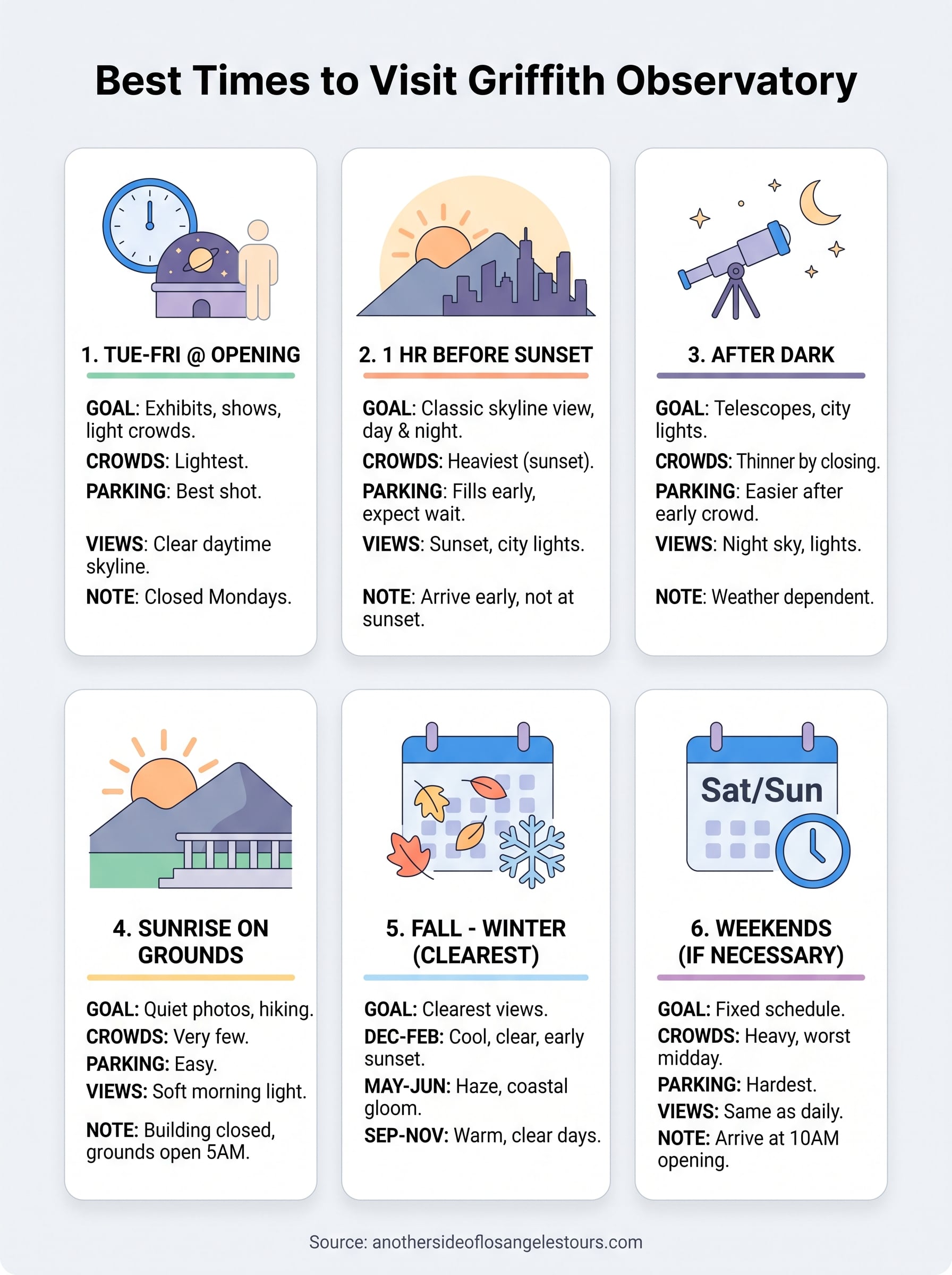
The best time to visit Griffith Observatory depends on what you came for. For exhibits and a calm building, go Tuesday through Friday right when the doors open. For the classic skyline view, arrive about an hour before sunset. For telescopes, stay after dark. For sunrise photos, the grounds open at 5:00 a.m. The clearest season runs from fall through winter, and the murkiest is the coastal haze of May and June.
Most advice on this question conflicts. One person swears by sunset, another says never go on a weekend, and almost nobody mentions that the building is closed on Mondays or that the parking lots fill long before the sky turns orange. This article ranks six visiting windows by goal. For each one you get the trade-offs in crowds, parking, and views, so you can pick a window and stop second-guessing.
We run guided tours across Los Angeles. Hours and show schedules change, so confirm them on the official Griffith Observatory visit page before you go.
1. Tuesday to Friday at opening
What you get
A weekday opening visit gives you the exhibits, the terraces, and the planetarium with the thinnest crowds you will find. The building opens at noon Tuesday through Friday and is closed on Mondays. Entry is free and you can just walk in. Only planetarium shows need a ticket.
- Crowds: lightest of the day, building toward sunset
- Parking: your best shot at a space in the paid lots near the building
- Views: a clear daytime look at downtown and the Hollywood Sign, but no telescope viewing
The building costs nothing to enter, and the only thing you pay for is a planetarium show.
Who it suits and how to plan it
This window suits first-timers who care about the exhibits, families with young kids, and anyone who wants to see a show. Book the show first. The planetarium has a single dome, so showtimes set the rhythm of your visit. Check the schedule on arrival, claim your seats, then explore. Show lineups rotate, so the best show is the one whose subject interests you and whose start time fits your plan.
Budget one to three hours inside. The Foucault pendulum, the Tesla Coil, the scale-model solar system, and the free film in the Leonard Nimoy theater fill a long afternoon. If you would rather skip the logistics, our Ultimate Kid Friendly Tour is a private family day of about 7 hours that combines Griffith Observatory with the California Science Center and the La Brea Tar Pits. It costs $399 per guest, includes transportation, snacks, and bottled water, and requires two guests minimum.
2. One hour before sunset
What you get
Sunset is the most popular time to visit, and for good reason. You see the city in daylight, in golden light, and then in lights, all from one spot. Sunset falls around 4:45 p.m. in late December and around 8:10 p.m. in late June, so the hour changes with the season. Arrive an hour before and you still have time to find parking and a spot at the terrace railing.
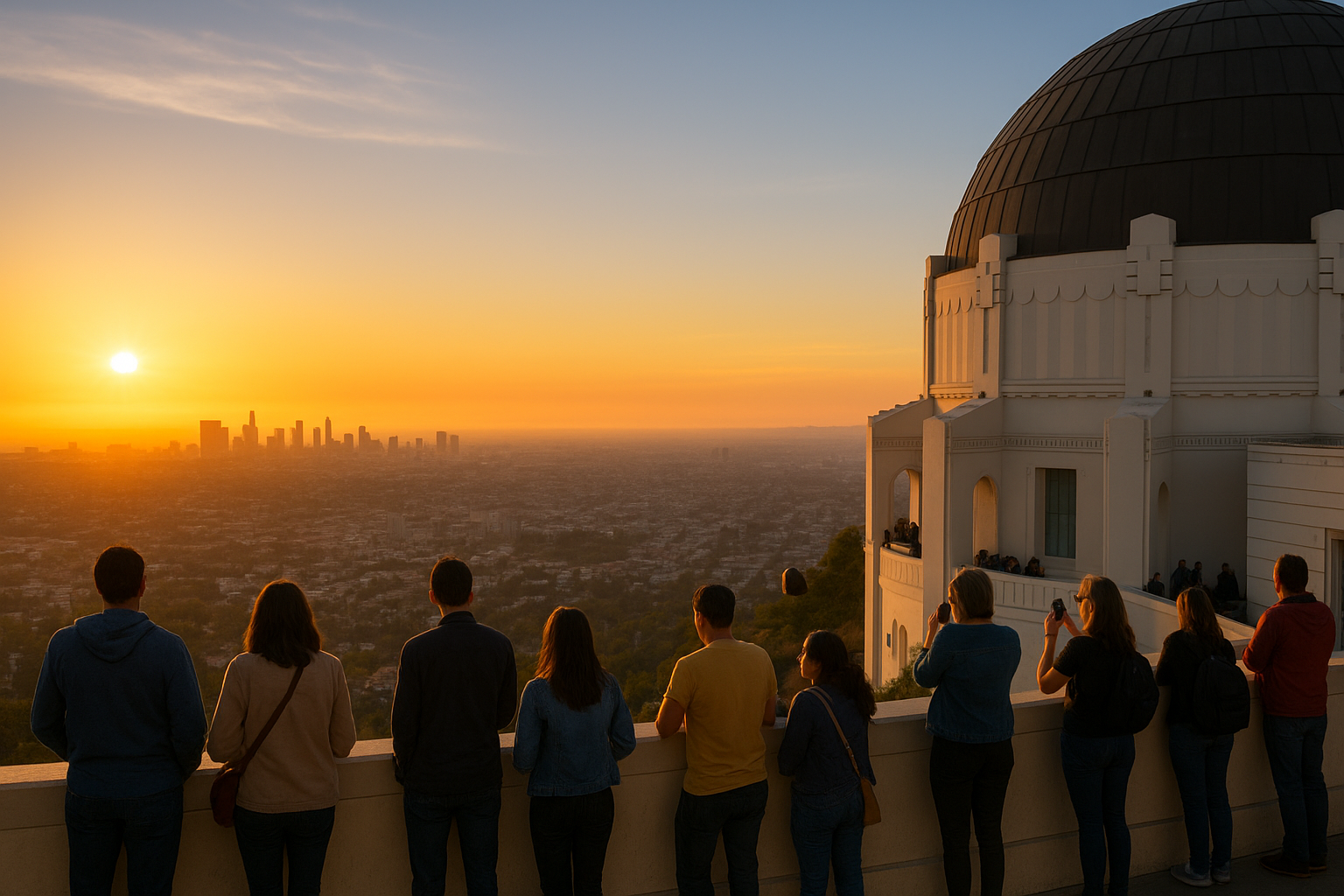
- Crowds: the heaviest of the day, worst on weekends, holidays, and summer evenings
- Parking: lots fill early, so expect a wait or a longer walk
- Views: downtown, the Hollywood Sign, and on clear evenings the coast
Arrive an hour before sunset, not at sunset, because by then the parking and the best railing spots are gone.
Who it suits and how to plan it
This slot suits couples, photographers, and anyone with one evening and a wish to see everything. It also answers the day-versus-night question. If you can only choose one, late afternoon into dusk gives you both.
Here is a worked example for late June. Arrive around 7:00 p.m., walk the terraces, and watch the sun drop near 8:10. Then go inside for the exhibits while the sky darkens, and join the telescope line around 9:00. You leave before the 10 p.m. close, about three hours after you arrived. In December, shift everything earlier and aim to arrive near 3:45 p.m. Lots crowded? The DASH Observatory shuttle runs from the Vermont/Sunset area and saves you the parking hunt.
3. After dark for telescopes and city lights
What you get
Telescope viewing happens after sunset, and it is one of the best free things at the observatory. Staff guides move the lines along, and the wait is usually shorter than it looks. The city lights from the terraces look completely different than they do by day. The building stays open until 10:00 p.m., and the grounds stay open until 10:30 p.m.
- Crowds: heavy at dusk, thinner by closing
- Parking: easier than at sunset once the early crowd leaves
- Views: skyline lights, plus the moon and planets when the sky is clear
If you want to look through a telescope, you have to come after sunset, and clouds can cancel the whole plan.
Who it suits and how to plan it
Night suits stargazers, date nights, and families with older kids. Check the sky forecast as well as the rain forecast, because thick cloud blocks every telescope. Moon phase matters too. A moon near first or last quarter shows the best surface detail along the shadow line, while a full moon is bright but flat and washes out fainter objects.
Dress in layers, since a hilltop gets cold fast after dark. As for safety, the area is busy until closing, so the usual city habits are enough: stay with your group and never leave valuables visible in the car. Winter is the easy season for this window, because dark arrives by 5:30 p.m. The observatory also hosts free public programs such as All Space Considered, so check its calendar for what is on during your dates.
4. Sunrise on the grounds
What you get
Griffith Park and the observatory grounds open at 5:00 a.m., hours before the building does. That makes sunrise the quietest way to see the Hollywood Sign and the downtown skyline. You can photograph both from the terraces without entering the building at all. Sunrise comes around 5:40 a.m. in June and around 6:55 a.m. in December.
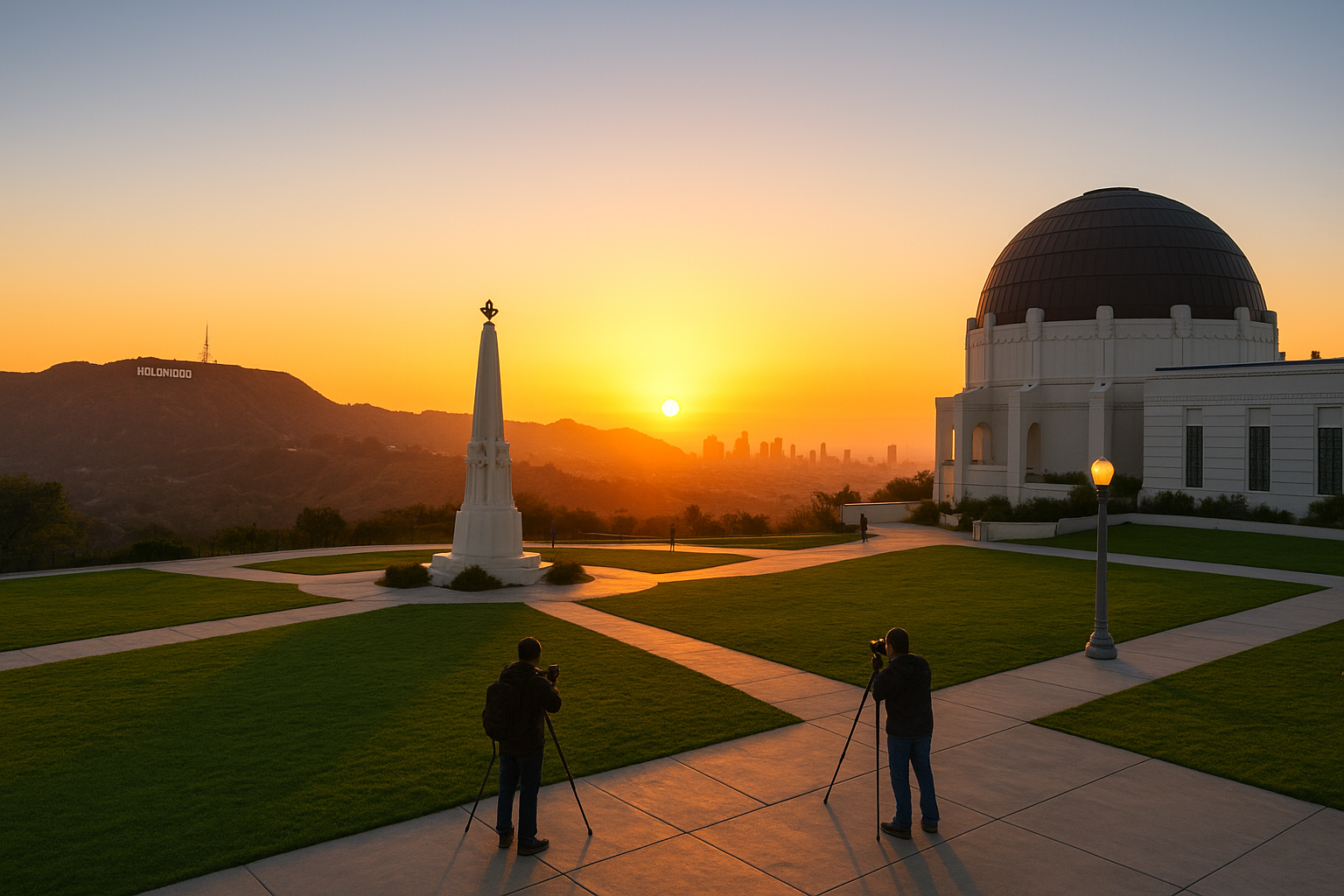
- Crowds: a handful of photographers and hikers
- Parking: easy compared with any other window
- Views: a soft light on the skyline, with no exhibits, shows, or telescopes
The grounds open about five hours before the building does, so you can go when it is closed.
Who it suits and how to plan it
Sunrise suits photographers, early risers, and hikers. If you hike up, count on 30 to 60 minutes of steady uphill from the lower trailheads. Popular routes start near the Greek Theatre or Fern Dell. Carry a flashlight, because the first part of the climb is dark in most seasons.
Sunrise is also your best answer to "can I go when it is closed?" Yes, you can use the grounds and terraces, but you cannot enter the building. If you want exhibits too, come back for a second visit at noon on a weekday. Many visitors do exactly that: sunrise for pictures, then a late breakfast in the neighborhood and a return trip once the doors open.
5. Fall through winter, the clearest season
What you get
The season matters almost as much as the hour. Air is generally clearest from fall through early spring, especially after rain has washed the haze out. Late spring and early summer bring the May Gray and June Gloom low cloud, which hits sunrise and sunset hardest near the coast. Summer adds haze and the biggest crowds.
| Season | Typical conditions | Verdict |
|---|---|---|
| Dec to Feb | Cool, clear after rain, sunset around 4:45 to 5:45 p.m. | Best for telescopes without a late night |
| Mar to Apr | Mild, often clear | Very good for any window |
| May to Jun | Low cloud and haze, especially near the coast | Arrive early so you can still see downtown |
| Jul to Aug | Warm, hazy, summer crowds | Go after dark or on a weekday |
| Sep to Nov | Warm, often clear days | Excellent for sunset |
If you can choose your month, pick fall or winter and book a weekday.
Who it suits and how to plan it
This pick suits anyone with a flexible calendar. Winter weekday evenings are the sweet spot, because early darkness means telescope time without staying late. Fall gives warmer evenings and strong sunsets. In autumn, dry offshore winds can scrub the air clean, but they also raise wildfire risk, so check current conditions.
If your dates are fixed in June, do not cancel. Arrive an hour or more before sunset and you should still see downtown with good visibility. Holiday weeks and school vacations are busy in any month, and special events in Griffith Park can back up the roads, so leave extra time. A table like this is a starting point, not a promise. Weather shifts from day to day.
6. Weekends and holidays, when that is your only option
What you get
Weekends are the busiest days, but they work if you plan around the crowd. The building opens at 10:00 a.m. on Saturday and Sunday, two hours earlier than on weekdays. That earlier opening gives you a quieter first hour, and the peak builds toward late afternoon and sunset.
- Crowds: heavy from midday through sunset
- Parking: the hardest of any window, so go early or skip driving
- Views: the same as on weekdays, with more people in every photo
On a weekend, arrive at 10:00 a.m. or after the sunset rush, and never in between.
Who it suits and how to plan it
Weekends suit visitors with a fixed schedule or a group that cannot take weekdays off. Arrive at the 10:00 a.m. opening, and book your planetarium show before you do anything else, because weekend shows fill. The second-best window is after the sunset crowd has thinned, when you can still reach the telescopes before closing.
Skip the parking fight when you can. The DASH Observatory shuttle runs from the Vermont/Sunset area, and hiking up avoids the road entirely. Rideshare works for drop-off, but pickups can be slow when traffic is restricted. Remember that Monday is not an option for the building, so a Sunday trip should not slip to the next day. If you are planning a holiday visit, add extra time for road congestion on the way up.
Pick your window and go
The best time to visit Griffith Observatory is the one that matches your goal. Go Tuesday through Friday at noon for exhibits and shows, an hour before sunset for the classic view, after dark for telescopes, and at 5:00 a.m. for quiet skyline photos. Fall and winter give the clearest air, and weekends work if you arrive at opening.
If you would rather have someone else handle parking, timing, and the stories behind the sights, our local expert guides can lead the way. Explore our private Los Angeles tours to build a day around the window you picked.