Little Tokyo doesn’t get the hype Hollywood or Venice Beach get, and that’s exactly why it’s worth your time. If you’re searching for things to do in Japantown Los Angeles, you’ve probably noticed most guides either skip it entirely or list the same three restaurants everyone already knows about. That’s not what you’ll find here.
This guide covers nine spots that actually capture what makes Little Tokyo special: the historic Japanese American National Museum, hole in the wall ramen counters, indie bookstores, and quiet gardens tucked behind busy storefronts. Whether you have two hours or a full afternoon, you’ll walk away with a plan instead of a vague sense of where to wander next.
We put this list together the way we build our own Hollywood and downtown LA walking tours, by walking the neighborhood, talking to shop owners, and skipping anything that felt like a tourist trap. You’ll get practical details on timing, cost, and what pairs well together, so you can string these stops into a route that fits your day instead of bouncing around Google Maps once you’re already there.
1. Wander the Japanese Village Plaza
Start here because everything else on this list sits within walking distance. The Japanese Village Plaza is a pedestrian mall running along Central Avenue, built in 1978 to look like a traditional Japanese street, complete with a wooden fire tower replica that’s become the unofficial photo spot of the neighborhood. It’s the anchor of Little Tokyo, and once you’ve got your bearings here, the rest of the neighborhood opens up fast.
What to expect
You’ll find roughly 30 shops and restaurants packed into a few tight blocks, ranging from mochi counters and ramen spots to import shops selling ceramics, stationery, and anime merchandise. The plaza has open-air walkways lined with lanterns, so it feels more like strolling through a small town square than a mall. Street performers and pop-up vendors show up on weekends, and the central fountain area is where most people pause to plan their next stop.
The Japanese Village Plaza is the one stop where you can eat, shop, and get oriented all in a single walk.
Who it’s for
This spot works for almost anyone, but it’s especially good for first-time visitors who want a low-commitment introduction before deciding where to spend the rest of their afternoon. Families appreciate the compact layout since kids can’t wander far, and photographers will want extra time near the fire tower and the traditional architecture, which ranks with the most Instagrammable places in LA in late afternoon light. If you’re short on time and can only pick one stop in Little Tokyo, make it this one.
Good to know
The plaza is free to walk through and open daily, though individual shop hours vary, with most opening around 10 or 11 a.m. and closing by 8 or 9 p.m. Parking is available in a structure off 2nd Street, but street parking fills up fast on weekends, so budget extra time or plan to arrive by public transit instead. Give yourself at least 45 minutes here if you want to browse shops rather than just pass through, and know that this is also the natural starting point if you’re pairing Little Tokyo with a broader itinerary of things to do in downtown LA that includes the Arts District or Grand Central Market.
2. Explore the Japanese American National Museum
Just a two-minute walk from the plaza, the Japanese American National Museum tells a story most visitors to Los Angeles never hear: the incarceration of Japanese Americans during World War II, and the community that rebuilt itself afterward right here in Little Tokyo. It’s housed partly in a restored 1925 Buddhist temple, which gives the whole visit a weight that a standard museum building wouldn’t.
What to expect
The permanent exhibit, "Common Ground: The Heart of Community," walks you through over 130 years of Japanese American history using photographs, personal artifacts, and a full-scale barrack from one of the incarceration camps. Rotating exhibits cover everything from contemporary Japanese American artists to pop culture history, so it’s worth checking what’s on display before you go. Plan for about 90 minutes if you want to read through the exhibits rather than speed-walk them.
This museum turns a neighborhood stroll into a real history lesson, and it’s the one stop here that lingers with you afterward.
Who it’s for
This one suits history buffs and anyone working through the top museums in Los Angeles who wants context behind the neighborhood they’re walking through, not just the shops and food. It’s a strong pick for families with older kids or teens, since the exhibits handle a difficult subject with clarity rather than sensationalism.
Good to know
Admission runs around $16 for adults, with discounts for students and seniors, and free entry on the third Thursday of most months. The museum is closed Mondays, so check the Japanese American National Museum’s hours before building it into your route.
3. Discover contemporary art at the Geffen Contemporary
Right across the street from the museum sits the Geffen Contemporary, MOCA’s warehouse-style annex that trades white-cube gallery walls for exposed pipes and raw industrial space. Frank Gehry converted the building from a former police garage back in 1983, and that rough, unfinished feel still shapes how the art gets shown here. It’s an easy add-on if you’re already spending your afternoon in Little Tokyo and want a change of pace from history and shopping.
What to expect
Expect large-scale installations, video work, and sculpture that need the kind of ceiling height and open floor plan a traditional gallery can’t offer. Shows rotate every few months, so you might catch a career retrospective one visit and an immersive multimedia piece the next. Budget 45 minutes to an hour, longer if a major exhibit is running.
The Geffen’s raw, warehouse feel makes even a quick visit feel like you stumbled into something bigger than a typical museum stop.
Who it’s for
This stop suits art lovers and anyone curious about contemporary work rather than historical exhibits, plus visitors who appreciate architecture that’s part of the experience, and it fits neatly alongside the city’s other cultural landmarks worth visiting. It’s less suited to young kids, since exhibits skew abstract and there’s not much hands-on interaction.
Good to know
A single ticket often covers both the Geffen and MOCA’s main Grand Avenue location if visited within a set window, so ask at the desk. Check MOCA’s current hours and admission before you go, since the space sometimes closes between exhibitions.
4. Find calm in the James Irvine Japanese Garden
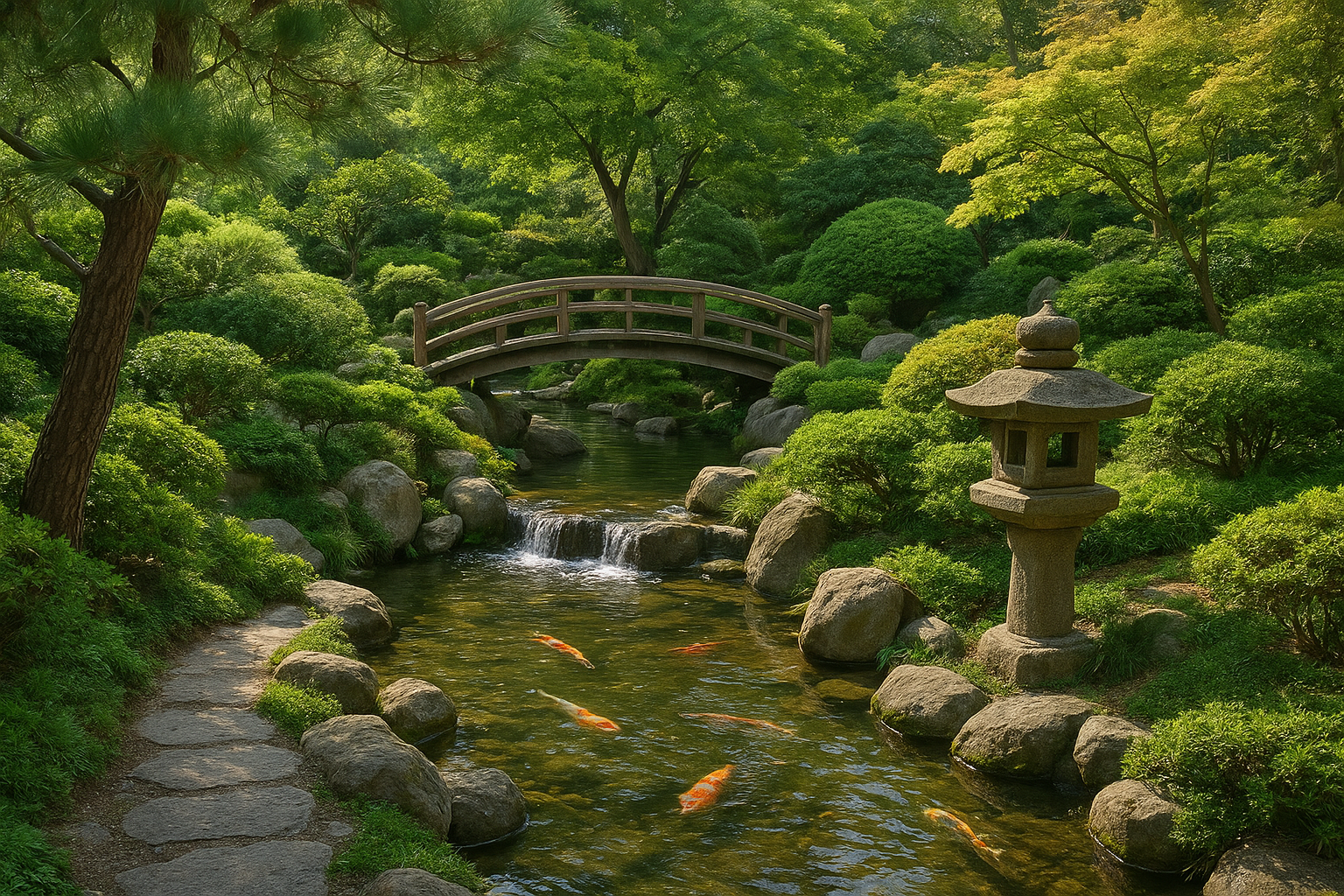
Tucked behind the Japanese American Cultural and Community Center, the James Irvine Japanese Garden is a sunken half-acre space most tourists walk right past, and one of the city’s true secret spots worth seeing. Locals call it Seiryu-en, or "Garden of the Clear Stream," and that name fits: a narrow stream runs the length of the garden, feeding small waterfalls and koi ponds as it winds toward the exit. After the crowds at the plaza and the density of two museums, this is where you slow down.
What to expect
A sloped path takes you down into the garden, past pine trees, stone lanterns, and a bridge crossing the stream at its narrowest point. The traffic noise from 1st Street fades almost completely once you’re a few steps in, which is part of the design. Fifteen to twenty minutes covers it comfortably, though there’s nothing stopping you from sitting on one of the benches longer.
A five-minute detour into this garden resets your energy for the rest of the day better than any coffee break.
Who it’s for
This stop suits quiet travelers who want a breather between busier attractions, plus anyone interested in traditional Japanese landscape design. Skip it if you’re tight on time and need to prioritize food or shopping instead.
Good to know
The garden sits within the JACCC building at 244 S. San Pedro Street and is free to enter during building hours, typically weekdays and select weekend events. Hours shift around scheduled performances at the adjacent Aratani Theatre, so check ahead if you’re planning a specific visit window.
5. Taste century-old mochi at Fugetsu-Do
A five-minute walk from the garden puts you in front of Fugetsu-Do, a mochi shop that’s been making sweets by hand since 1903. Four generations of the same family have run this storefront, and the current owner still uses recipes his great-grandfather brought over from Japan. It survived the incarceration era, a full building relocation, and over a century of changing tastes in the neighborhood around it, which says something about how good the mochi actually is.
What to expect
Glass cases line the front counter, stocked with strawberry mochi, red bean manju, and a rotating list of seasonal flavors that shift with the calendar. The shop is tiny, so you’ll likely queue on the sidewalk during weekend afternoons, but the line moves fast since most people know what they want before they reach the counter.
A century of unchanged recipes is rarer than almost anything else you’ll find in a city that reinvents itself every decade.
Who it’s for
This stop suits food-focused travelers who want a tangible piece of Little Tokyo history they can actually taste, not just read about on a plaque. It’s also a smart grab-and-go option if you’re pairing this list with a longer downtown LA walking tour and need a snack that travels well.
Good to know
Most pieces run $1 to $3, so a full bag rarely costs more than $15. The shop closes early, usually by 6 p.m., and shuts entirely on major holidays, so don’t save it for the end of a long day.
6. Slurp a bowl of ramen at a local noodle house
After mochi, you’ll want something heartier, and Little Tokyo delivers on that front better than almost any other pocket of downtown LA. Ramen houses cluster along 1st Street and inside Weller Court, each running their own broth for hours and building a following around a single signature bowl. You don’t need a reservation or a plan here, just an appetite and a willingness to wait if you show up during peak lunch hours.
What to expect
Most spots specialize in one style, whether that’s a rich tonkotsu pork broth, a lighter shoyu base, or a spicy miso bowl loaded with corn and butter. Counters are small, seating is tight, and the open kitchens mean you’ll watch your bowl get built a few feet away. Expect a 20 to 40 minute wait on weekend evenings, since several of these ramen shops cap out at 20 or 30 seats.
A great bowl of ramen in Little Tokyo tastes like it was built for regulars, not tourists, because it was.
Who it’s for
This stop suits hungry travelers who want a real meal rather than a snack, plus anyone who’d rather eat where locals actually line up, and it’s the same instinct behind our guided culinary tours of LA’s hidden eateries. Vegetarians have fewer options here, so check the menu boards posted outside before you commit to a wait.
Good to know
A bowl typically runs $12 to $18, cash or card depending on the shop. Lunch rush hits hard between noon and 1:30 p.m., so aim earlier or later if you want to skip the line entirely.
7. Shop for Japanese goods at Weller Court and beyond
Once you’ve eaten your fill, Weller Court rounds out the shopping side of Little Tokyo that the plaza doesn’t fully cover. This multi-level complex sits just across the street from the Japanese Village Plaza and mixes restaurants with specialty retail, anchored by a Kinokuniya Bookstore that stocks manga, art books, and stationery you won’t find at a typical US bookstore chain. Add in Bunkado, a decades-old gift shop selling kimono, tea sets, and ceramics, and you’ve got a shopping stretch that covers more ground than most visitors realize.
What to expect
Kinokuniya alone can eat up 30 minutes if you’re a reader, with entire sections devoted to Japanese language learning, design, and imported magazines. Bunkado leans more toward gifts and home goods, the kind of shop where you’ll find a $12 teacup next to a $200 ceremonial doll. Smaller stalls throughout the complex sell phone cases, snacks, and pop culture merchandise tied to whatever anime or game is trending that season.
Weller Court is where Little Tokyo’s shopping actually rewards slow browsing instead of a quick scan.
Who it’s for
This stretch suits gift shoppers and anyone building a souvenir list beyond the usual keychains and magnets. Bookworms and manga readers will want extra time here, while casual browsers can move through in under an hour.
Good to know
Most shops open by 10 a.m. and close around 8 or 9 p.m., though Kinokuniya tends to stay open a bit later on weekends. Parking validation is available at the Weller Court structure with a minimum purchase at participating stores.
8. Celebrate at the Nisei Week Japanese Festival
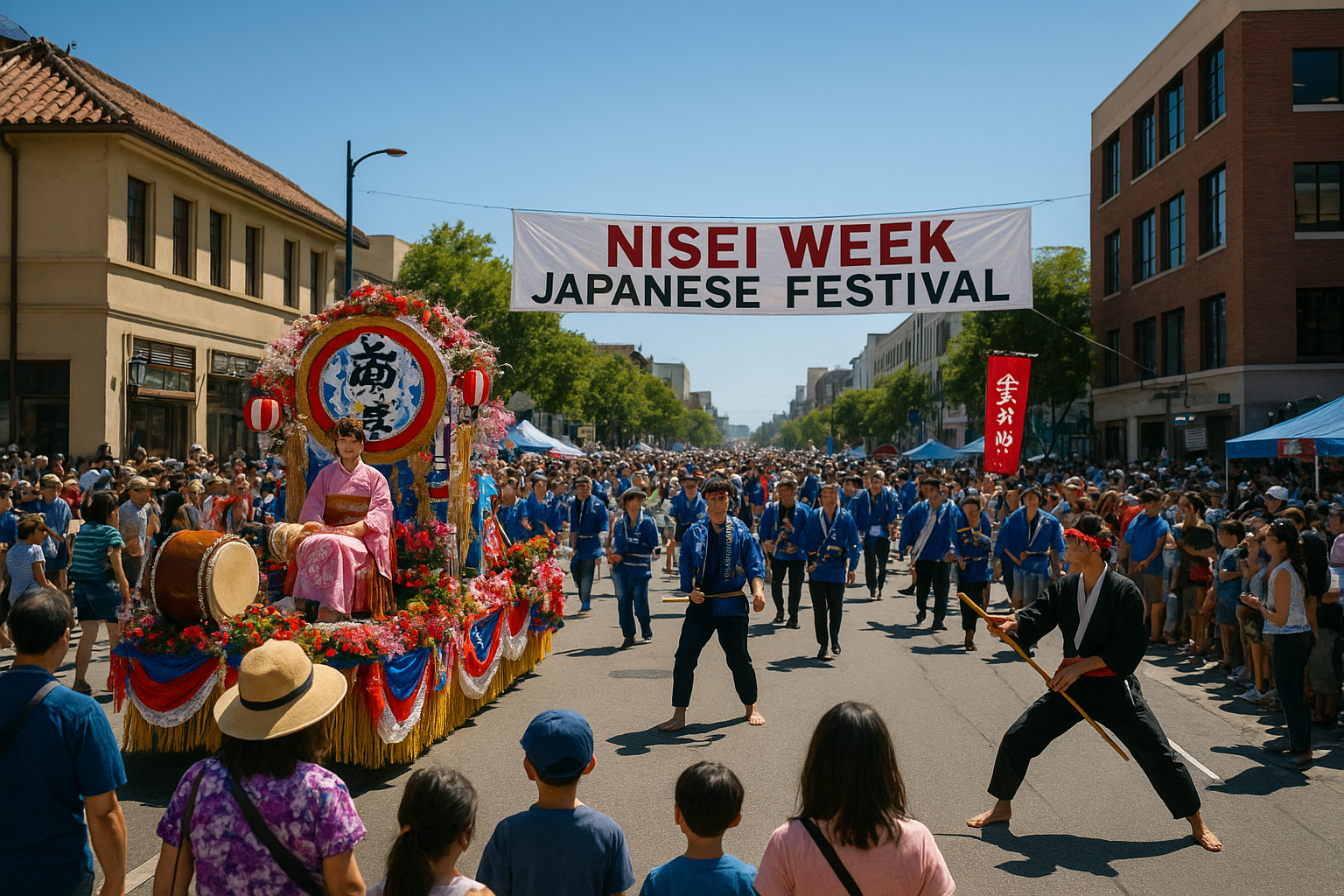
If your visit lines up with mid to late August, you’re in luck: that’s when Little Tokyo hosts the Nisei Week Japanese Festival, a tradition that’s run almost every year since 1934. It started as a way to bridge first-generation immigrants and their American-born children (the "Nisei"), and it’s grown into the largest Japanese American cultural festival in the country. Streets close, stages go up, and the whole neighborhood turns into one long block party for about a week.
What to expect
Expect a grand parade with taiko drummers, martial arts demonstrations, and a coronation for the festival’s court, plus carnival booths selling yakitori and shaved ice along 2nd Street. Ondo dancing fills the closing weekend, and anyone can join the circle even without practice. Most events are free, though the parade draws crowds early, so grab a curb spot 30 minutes ahead.
One week a year, Little Tokyo stops being a quiet detour and becomes the loudest, most alive block in downtown LA.
Who it’s for
This suits festival-goers and travelers who happen to be in town during the run dates and want an experience you can’t plan into a regular itinerary. Families do well here too, since daytime events skew kid-friendly before the evening crowds thicken.
Good to know
Dates shift slightly each year, so check the Little Tokyo Community Council’s Nisei Week schedule before booking travel around it. Parking gets scarce during peak days, so public transit is your best bet.
9. Sip cocktails and unwind at Little Tokyo’s night spots
Once the sun drops, Little Tokyo doesn’t roll up the sidewalks the way some other historic pockets of downtown LA do. A handful of izakaya bars and hidden speakeasies keep the neighborhood buzzing well past dinner, and this is where you cap off a day of temples, museums, and noodle counters with something looser. If you’re weighing things to do in Japantown Los Angeles after dark, this is the stretch that answers that question best, and it belongs on any list of nighttime things to do in Los Angeles.
What to expect
Several spots tucked along 2nd Street and inside the plaza pour Japanese whiskey, shochu, and sake flights alongside small plates like karaage and yakitori skewers. A few bars lean into the speakeasy angle with unmarked doors and reservation-only seating, so part of the fun is just finding the entrance. Expect low lighting, tight seating, and a crowd that skews toward locals who work nearby rather than tour groups.
The best nights in Little Tokyo start with dinner and end at a bar you almost walked past without noticing.
Who it’s for
This stop suits evening travelers who want to extend their visit past sunset instead of heading straight back to the hotel. It works well for couples looking for a quieter date-night stop, and for groups who’d rather sit and talk over drinks than keep walking.
Good to know
Cocktails typically run $14 to $18, and the speakeasy-style bars often require a reservation or a phone call ahead on weekends. Most spots stay open until midnight or 1 a.m., later than nearly anything else in this guide.
Planning your visit to Little Tokyo
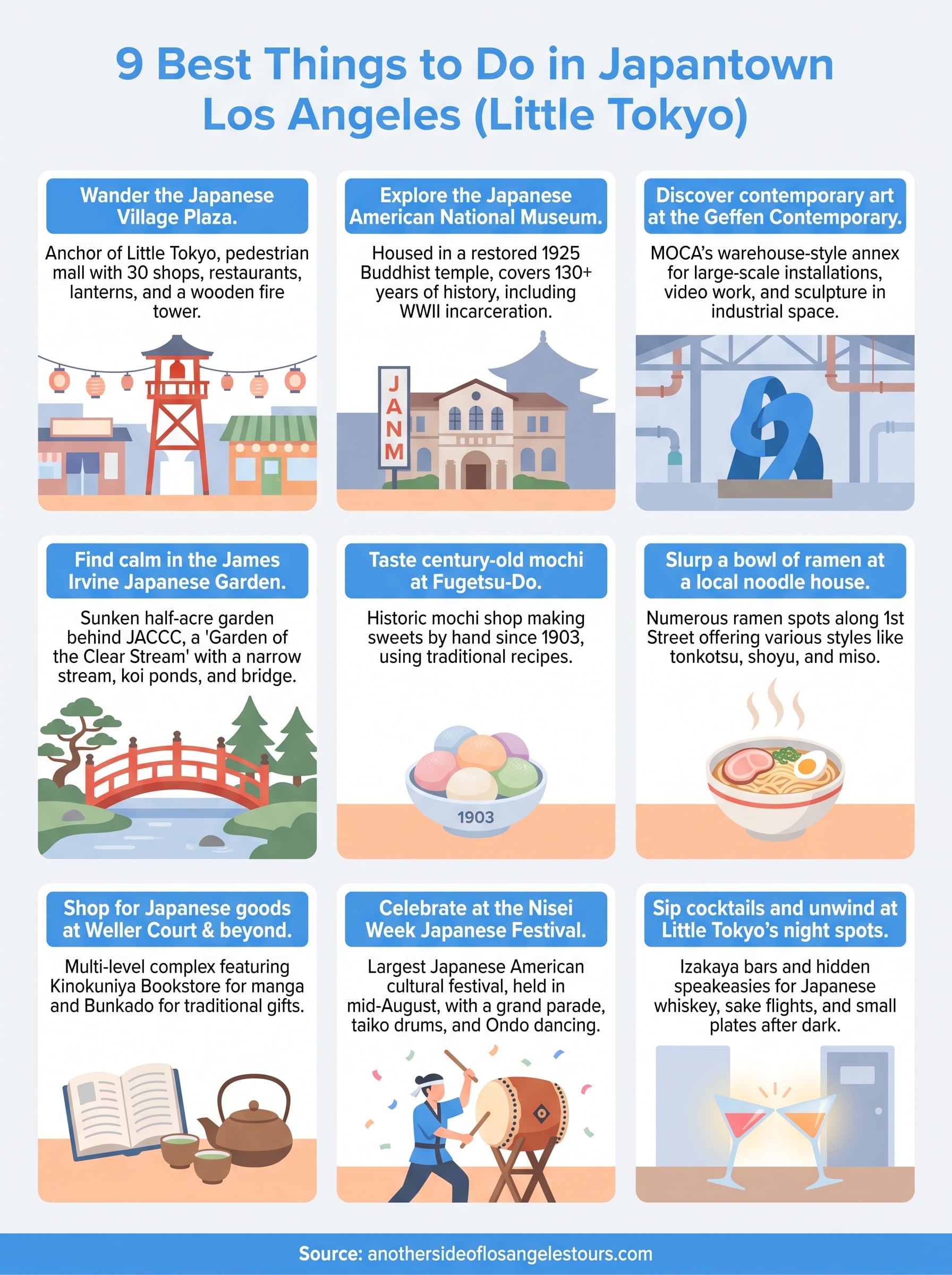
Nine stops, one compact neighborhood, and honestly more history and good food than most visitors expect from a few square blocks. Little Tokyo rewards a slow pace, so don’t try to cram all nine into a single rushed afternoon. Pick four or five that match what you actually want, whether that’s the museum and garden for a quieter day or ramen and night spots if you’re visiting with friends. Either way, you’ll leave with a better sense of Los Angeles than the postcard version most guides push.
If you’d rather have a local guide connect these dots for you, along with the rest of downtown LA’s hidden corners, that’s exactly what we do. Our guides grew up walking these streets and know which shop owner has a story worth hearing. Browse our daily sightseeing tours of Los Angeles and let someone else handle the planning for once.