A dozen guests step out of a cool, quiet vehicle onto Hollywood Boulevard, and the day changes instantly. One person wants the Walk of Fame, another is already looking for the best photo angle, a child is watching the traffic, and the corporate planner is checking whether the group will reach Griffith Observatory before golden hour. Nobody has done anything wrong, yet the group's energy can tilt within minutes.
That's the core work of group dynamics management. It isn't a corporate slogan or a forced icebreaker. It's the series of small decisions that determines whether a private Los Angeles tour feels effortless or becomes a string of avoidable frictions. A good leader notices who needs more context, who needs space, who's being left behind, and when the itinerary needs to breathe.
After guiding mixed groups through Beverly Hills, Hollywood, Santa Monica, Venice, and Malibu, I've learned that the same guests can create completely different memories depending on how the day is shaped from the beginning. The route matters, but so do the welcome, the pacing, the seating plan, the restroom stop, and the way a guide handles the first disagreement.
Table of Contents
- When the Group Chemistry Quietly Tilts
- First Fifteen Minutes That Set the Tone
- Right-Sizing the Group for the Experience
- Facilitation as a Craft, Not a Pep Talk
- Reading and Resolving Conflict in Real Time
- Pacing, Energy, and Re-Engagement Tactics
- Logistics, Access, and Accessibility in Los Angeles
When the Group Chemistry Quietly Tilts
At a rooftop viewpoint above Los Angeles, I once watched a private group divide before anyone had taken a photograph. A few guests wanted an unhurried view across Beverly Hills and the city basin. Two younger travelers were eager to move on to the next location, while a family member had started asking about shade and water. The most vocal guests weren't necessarily the most uncomfortable, so following the loudest voices would have produced the wrong decision.
I gathered everyone close enough to hear, acknowledged the time available, and offered a choice: a few more quiet minutes at the viewpoint, followed by a shorter stop later, or a quick photograph now and more time at the coast. The group chose together. That small reset restored a sense of control without turning the moment into a formal meeting.
Practical rule: When the mood shifts, name the choice in front of the group before someone turns it into a personal complaint.
LA tours expose group chemistry quickly. A paparazzi-heavy drive through Beverly Hills can make some guests animated and others self-conscious. The Walk of Fame attracts multilingual families with different levels of interest in celebrity history. A sunset pull-off in Malibu can feel transcendent for one couple and too late for a tired child. Corporate groups add another layer, because colleagues may be carrying workplace roles into what should feel like a shared experience.
The leader's job isn't to make every person feel the same emotion. It's to create enough structure that different personalities can enjoy the same day. That means setting expectations early, watching for silent disengagement, and making adjustments before frustration becomes visible to everyone.
Research into group dynamics has long treated interaction patterns, shared norms, leadership, and communication structure as central to group outcomes. Kurt Lewin established the world's first Research Center for Group Dynamics at the Massachusetts Institute of Technology in 1945, helping move small-group behavior from informal observation toward experimental study of change, leadership, and coordination pressures. The later team-size meta-analysis synthesized 156 primary studies covering 19,114 teams and found a small but significant relationship between team size and task performance, while also connecting team size with counterproductive work behaviors and team attitudes in its review of team size and performance.
First Fifteen Minutes That Set the Tone
The opening should feel warm, specific, and lightly structured. Guests don't need a speech. They need to know who's looking after the day, what will happen first, and how their preferences can shape the experience.
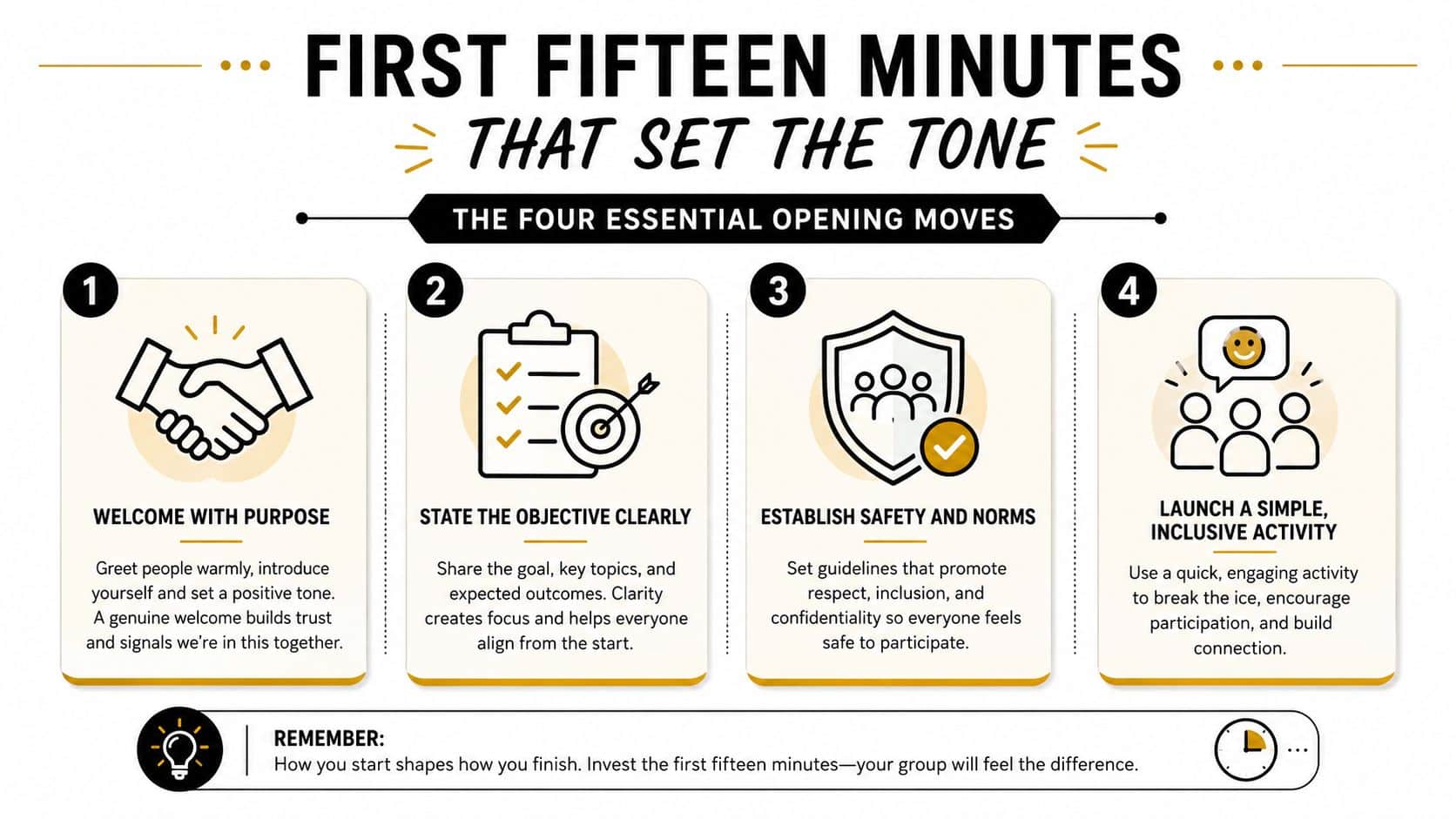
Welcome with purpose
Meet the group before the route begins, whether that's in a Beverly Hills hotel lobby, outside a Santa Monica conference room, or beside a private vehicle near Hollywood. Use one specific observation that makes the welcome feel personal: “You've chosen a beautiful coastal day for Malibu,” or “I know several of you are here for your first look at the Hollywood Sign.”
Then explain your role in plain language. “I'll keep an eye on timing, comfort, and the route. If you want more photographs, a quieter stop, or a change of pace, tell me early.”
Listen for needs without putting anyone on the spot
Use a quick round rather than an elaborate introduction. Ask each person for a name, a preferred interest, and one practical consideration, such as walking comfort, dietary needs, language preference, or whether they're traveling with children.
Keep it moving. A family might reveal that the grandparents want architecture while the children want the coast. A corporate group might show that some colleagues want an active challenge and others prefer conversation. You're collecting signals, not conducting an interview.
State the objective clearly
Give the day a simple shape. “We'll combine iconic Los Angeles landmarks with a few quieter viewpoints, and we'll keep enough flexibility for photographs and breaks.” For a corporate outing, define the shared purpose without making the tour feel like a workshop: “The aim is to spend time together away from the meeting room, with a route that creates natural conversation.”
A transparent agenda reduces uncertainty. It also makes later adjustments easier because guests understand what can move and what can't.
Establish one repeatable gathering signal
Choose a phrase, hand signal, or visible meeting point and use it consistently. At Griffith Observatory, I might say, “When I raise my hand, please come within hearing distance.” On a busy Hollywood sidewalk, I'll identify a landmark rather than relying on a vague instruction to “meet back here.”
Finish with a simple inclusive prompt, such as asking guests to choose one place they're most curious about. It gives quieter members an opening without forcing performance.
Right-Sizing the Group for the Experience
Bigger groups aren't automatically better. A larger party can bring more shared knowledge and social energy, but it also creates more coordination, more waiting, and more chances for individual contributions to disappear.
A meta-analytic study based on 208 studies and 21,435 participants found a null overall relationship between team size and task performance, with results changing according to task complexity and coordination demands in the Academy of Management Proceedings abstract. Complex work can benefit from additional perspectives, while high coordination requirements paired with low task complexity can make a larger group less effective.
That distinction translates directly to touring. A private limo experience depends on intimacy and quick movement, while a corporate scavenger hunt may need enough people to create variety. The right question isn't “How many can we fit?” It's “How many can participate without losing the feeling of being looked after?”
| Tour Type | Recommended Cap | Why |
|---|---|---|
| Private limo experience | 6 | Keeps conversation natural and makes photo, seating, and timing decisions easy. |
| E-bike tour | 8 | Allows safety guidance, route visibility, and a manageable riding rhythm. |
| Segway experience | 8 | Gives the guide room to monitor confidence, spacing, and street awareness. |
| Hollywood walking tour | 10 | Preserves audibility on busy sidewalks while allowing different interests. |
| Scavenger hunt | 12 | Supports playful subgrouping without making instructions hard to repeat. |
| Custom corporate outing | 16 | Can work when the itinerary alternates active moments, meals, and smaller conversations. |
These are planning caps, not universal laws. A family with toddlers, older travelers, and guests using mobility aids may need a smaller working group than a highly mobile party. A corporate group can stretch its size when transport, meals, meeting points, and activity instructions are designed in advance.
Smaller groups also reduce social loafing because each person's contribution is easier to see, particularly when that contribution feels unique rather than redundant as described in this group-dynamics lecture. For planners comparing formats, the guide to top team-building activities in Los Angeles can help connect group size with the type of shared task being planned.
Facilitation as a Craft, Not a Pep Talk
A facilitator doesn't just keep people cheerful. A facilitator gives the group enough structure to move through forming, storming, norming, and performing without allowing normal friction to become a lasting fracture.
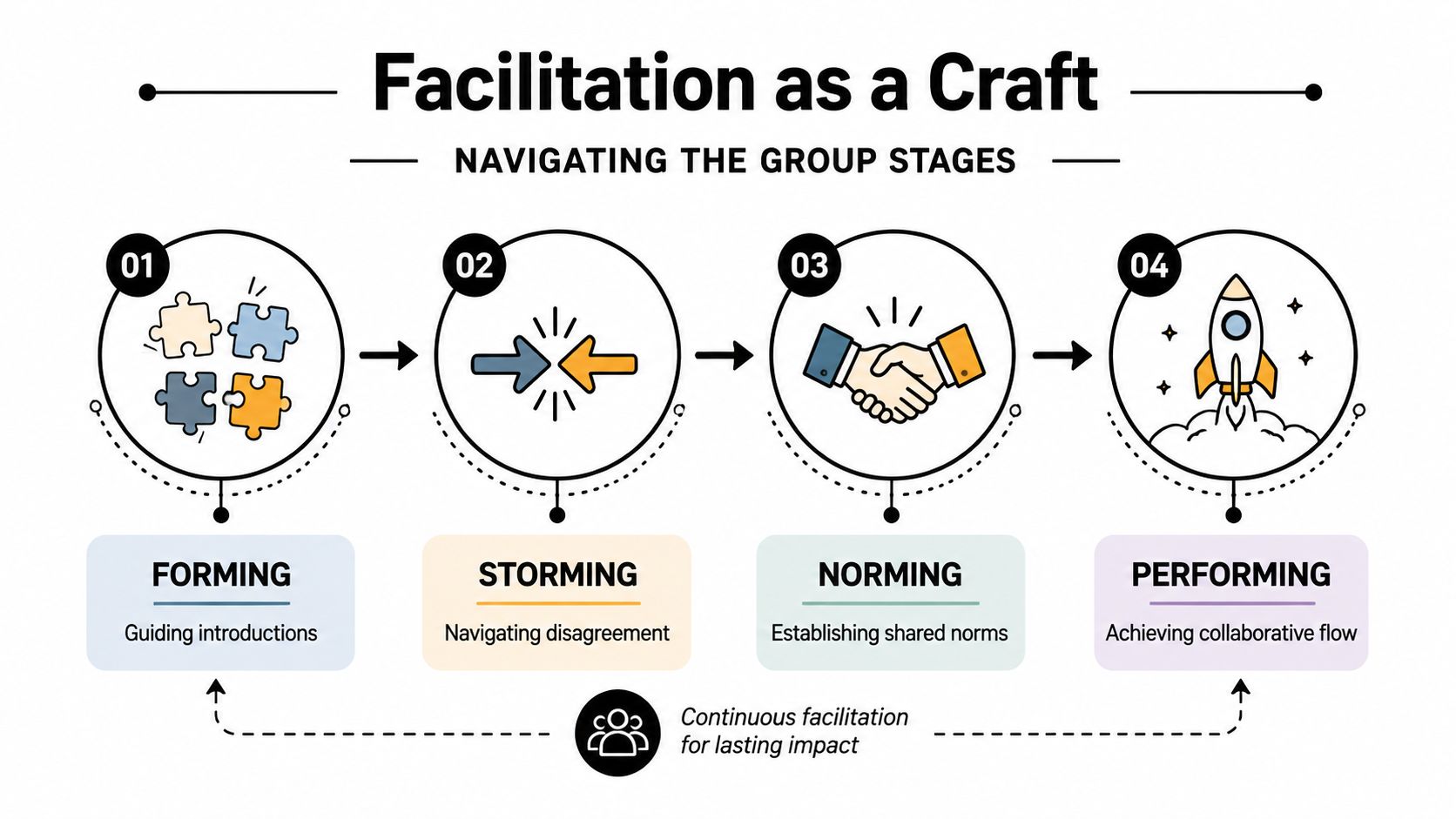
Forming
At hotel check-in or the first vehicle pickup, people are polite and observant. Give them low-pressure ways to participate. Introduce names when appropriate, clarify the route, and avoid asking a shy guest to perform for the group.
Storming
The first disagreement often appears during a choice. One guest wants the Hollywood Sign hike, another wants more time for Beverly Hills, or a corporate team debates whether to take a competitive activity seriously. Don't rush to erase the difference. Ask what each option protects, such as comfort, time, curiosity, or team connection.
Norming
Once guests understand how decisions work, participation becomes easier. Establish practical norms, such as letting people finish a thought, keeping the group within sight, and voicing a concern before it becomes urgent.
Performing
At a sunset gathering near Griffith Observatory or during a coastal drive, the group may begin to flow naturally. The facilitator can step back, but still watches the edges. A quiet table at brunch, a sudden side conversation, or someone checking a phone repeatedly can signal that the rhythm needs attention.
Three techniques work especially well:
- Turn-taking: Ask a broad question, then invite a quieter person by name only if you've already established comfort.
- Two-touch acknowledgment: Confirm the contribution, then connect it to the group's next action. “That's a useful point about the schedule. We'll protect the coast stop and shorten the next pause.”
- Redirecting: In a corporate setting, say, “Both priorities matter. Let's separate the route decision from the broader preference, choose the route now, and revisit the optional stop once we're moving.”
Good facilitation is part of what makes a good tour guide. It's observant, practiced, and nearly invisible when done well.
A short visual summary can help guides and planners remember the sequence:
Training also matters. A meta-analysis of team training found positive relationships between training interventions and cognitive outcomes, affective outcomes, teamwork processes, and performance, with results moderated by training content, membership stability, and team size in the available empirical review. Practice the behaviors a group needs, rather than delivering a generic motivational talk.
Reading and Resolving Conflict in Real Time
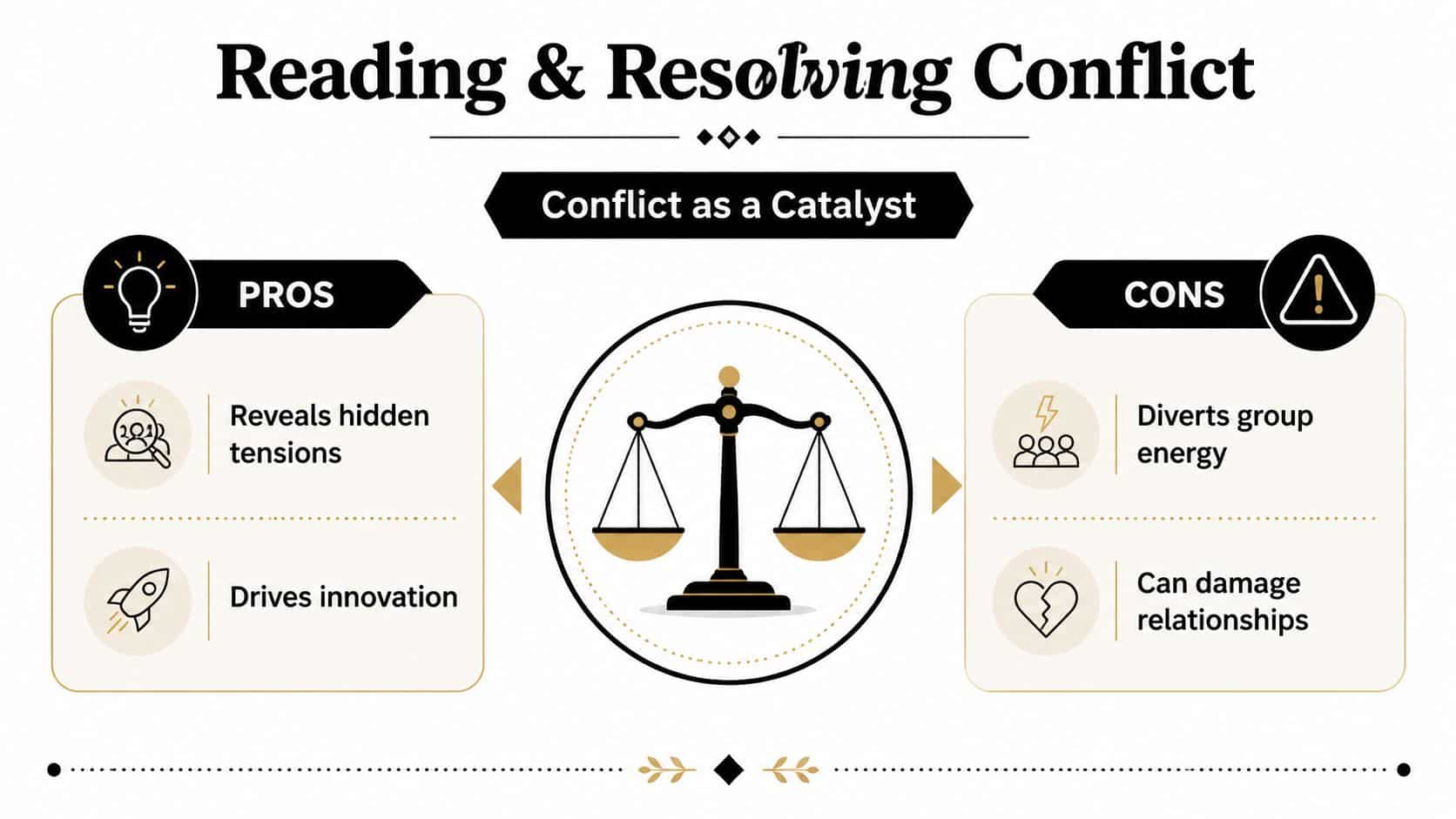
Conflict isn't automatically a failure. Untimed and unmanaged conflict is the problem.
On a corporate outing, two executives once disagreed sharply about whether the team should spend more time on an active challenge or move directly to a private meal. Their disagreement had a real task component, but the public setting added status and relationship pressure. If I had asked them to “just compromise,” both would have felt unheard.
Identify the type before choosing the response
Task conflict concerns what the group should do. On a tour, guests may disagree about visiting Rodeo Drive or heading straight to Santa Monica.
Process conflict concerns how the group should do it. One person may want a fixed schedule, while another keeps requesting spontaneous stops.
Relationship conflict becomes personal. Eye-rolling, sarcasm, dismissive interruptions, or repeated references to someone's behavior signal that the issue has moved beyond the itinerary.
Research on team conflict describes a productive profile as low but increasing process conflict, low relationship conflict, and moderate task conflict at the midpoint of work, supported by trust, open discussion, and early conflict training in this review of conflict profiles. The lesson for guides is practical: don't suppress every difference, but don't let a scheduling question become a character judgment.
Use the 30-second bridge
When a van turns tense, I use a short bridge:
- Name the shared aim: “Everyone wants the afternoon to feel enjoyable and worth the time.”
- Separate the issues: “We have a route choice and a pacing concern.”
- Offer a bounded decision: “We'll take the coastal route now, keep the next stop brief, and preserve the meal timing.”
- Invite one practical need: “What would make that plan comfortable for you?”
The bridge works because it lowers the temperature without pretending the disagreement didn't happen. With a frustrated family member, the language might be gentler: “You're right that the pace has been brisk. Let's pause for water, then I'll explain the next two stops so you can decide how much walking feels right.”
Never force public resolution when the issue is personal. Move one guest aside, listen without promising an impossible outcome, and protect the rest of the group from becoming an audience. Resources focused on helping teams foster healthier workplace dynamics can also support corporate planners who need a deeper framework beyond the tour itself.
Handled with care, a tense moment can become a turning point. Guests often remember that the guide noticed what was happening and restored dignity to everyone involved.
Pacing, Energy, and Re-Engagement Tactics
A successful LA day has a rhythm. Greystone Mansion rewards quiet observation and slower conversation. Venice suits a brisker, more playful pace, with street life, murals, and people-watching. Griffith Observatory benefits from a dramatic pause, especially when the sky begins to change color.
Read energy through behavior rather than asking the group to announce its mood. Short answers, delayed exits from the vehicle, repeated phone checks, and guests drifting to the back usually mean the current format has run too long.
Change the sensory pattern
After a long stretch of celebrity-home narration, pivot to a story about how Los Angeles neighborhoods developed, then let the group look outward for a few minutes. A surprise stop can help, but it should be purposeful. A quiet overlook, a coffee pause, or a brief view of the ocean can reset attention more effectively than adding another landmark.
A pair-share works well in a sleepy corporate van. Ask guests to turn to someone they haven't spoken with and exchange one place they'd return to in Los Angeles. Keep it optional and brief, then invite a few observations rather than collecting every answer.
Content creators respond to a clear photo cue. At the coast, I might say, “You'll have a clean visual moment here, and we'll regroup by the vehicle after the last photograph.” That gives people permission to create without turning the stop into an uncontrolled delay.
Match pace to the people in front of you
Families need snack, shade, and restroom planning before fatigue becomes behavior. Older guests may prefer fewer transitions and more comfortable seating. Travelers with mobility considerations need routes assessed for surface, distance, and stopping points rather than being offered vague reassurance.
Celebrity-home routes are often more comfortable when planned around the group's attention and neighborhood conditions, not just a list of addresses. At Malibu, protect the sunset window, but keep a weather and traffic alternative ready. Premium pacing means guests feel that the day has room for them.
Logistics, Access, and Accessibility in Los Angeles
Logistics shape group dynamics before guests recognize them as logistics. A difficult parking search near a Hollywood Sign trailhead, an unexpectedly long walk, or a missing restroom stop can turn a relaxed group into a defensive one. When the practical details work, guests experience the result as calm hospitality.
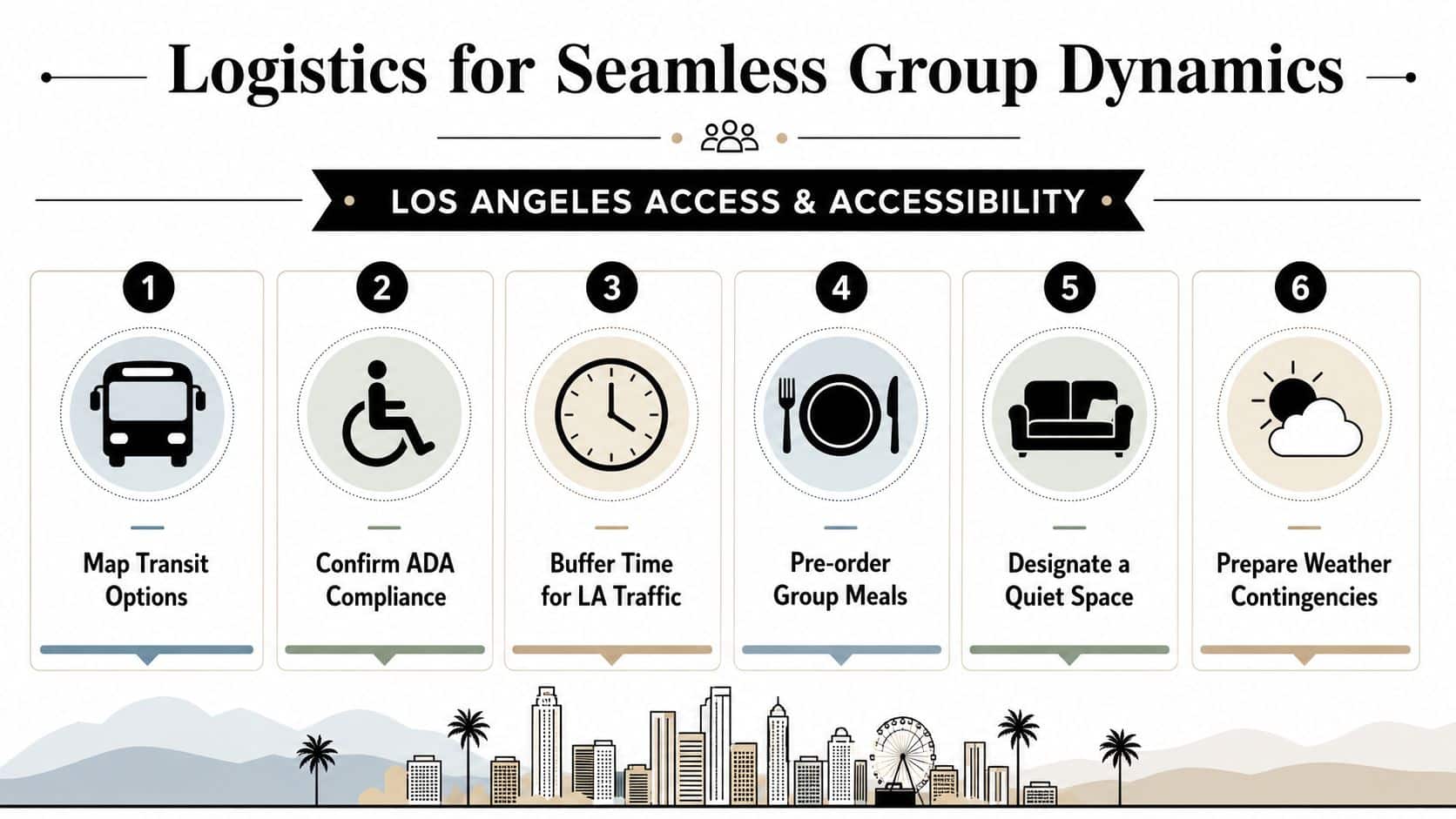
Plan access before the itinerary
Hollywood, Beverly Hills, Santa Monica, Venice, Malibu, and Griffith Park each create different movement challenges. Sidewalk congestion around the Walk of Fame affects how a guide gathers a multilingual family. Rodeo Drive requires a clear meeting point because guests may spread across storefronts. Venice rewards walking, but the route should include a realistic place to pause.
For Griffith Observatory and Hollywood Sign areas, confirm current access conditions, parking expectations, walking surfaces, and any timed-entry requirements before promising a particular sequence. Mulholland viewpoints can offer memorable photographs, yet vehicle access and safe stopping space vary by location. Along Pacific Coast Highway, restroom planning matters because attractive pull-offs don't always provide facilities.
Climate-controlled transportation also changes the emotional temperature of a summer afternoon. A vehicle gives families, couples, and corporate groups a place to recover between stops, adjust layers, store purchases, and regroup without standing in traffic or heat.
Treat accessibility as route design
Accessibility isn't a courtesy added at the end of planning. It's part of the route itself. Ask specific, respectful questions before departure:
- Mobility: Can guests manage steps, uneven pavement, slopes, or a longer walk between vehicle and viewpoint?
- Equipment: Is there a mobility aid that needs secure storage or additional vehicle space?
- Sensory comfort: Would a traveler benefit from quieter transitions, advance notice of crowds, or a less compressed schedule?
- Communication: Which language preferences, visual explanations, or written details will make instructions easier to follow?
- Meals: Are allergies, religious requirements, or dietary preferences already documented with the restaurant?
Neurodivergent travelers may appreciate a clear sequence, quieter alternatives, and permission to step away without explanation. Multilingual groups benefit from short instructions, visual meeting points, and confirmation that everyone has understood the next move. Inclusive language also helps. Say “the person joining us” rather than assuming family roles, and ask before making personal details part of group conversation.
A practical guide to tour accessibility for mobility challenges can help planners turn broad intentions into specific questions about vehicles, routes, and walking conditions.
Use a pre-tour operations check
The day before departure, review the experience from the guests' point of view:
- Route: Confirm the order of Beverly Hills, Hollywood, the coast, and Griffith Park stops against the group's interests and mobility needs.
- Timing: Build breathing room around traffic, photographs, meals, and restroom breaks instead of treating every transfer as exact.
- Vehicle: Verify climate control, seating, storage, step access, and the meeting location.
- Reservations: Recheck timed entries, restaurant capacity, studio arrangements, and any site-specific restrictions.
- Weather: Prepare a coastal alternative, shade plan, layers, water, and a shortened walking option.
- Communication: Send one concise message covering pickup details, footwear, sun protection, accessibility arrangements, and the gathering signal.
- Staffing: Make sure every guide knows the group profile, language needs, dietary details, and the decision-maker for corporate events.
A company such as Another Side Of Los Angeles Tours handles this kind of work through private and small-group itineraries, custom corporate outings, step-on guide services, climate-controlled transportation, and routes across the city's major neighborhoods. Its licensing, insurance, local route knowledge, and experience with corporate team-building and scavenger hunts are operational details that guests may never discuss, but they feel the benefit when the day stays smooth.
That's the heart of group dynamics management in hospitality. Guests don't need to analyze the gathering signal, the seating plan, or the route buffer. They should feel welcomed, included, safe, and free to enjoy the Hollywood stories, Beverly Hills architecture, Santa Monica light, Venice character, Malibu horizon, or Griffith Observatory view in front of them.
For private Los Angeles tours, Another Side Of Los Angeles Tours creates customized experiences across Hollywood, Beverly Hills, Santa Monica, Venice, Malibu, and Griffith Park, with professional guides and planning built around your group's pace and access needs. Visit Another Side Of Los Angeles Tours to plan a polished day that turns careful group dynamics management into a defining LA memory.