You've arrived on Hollywood Boulevard with a phone full of celebrity names, a camera ready, and the expectation that the Walk of Fame will be a compact plaza. Instead, your favorite stars may be separated by blocks of sidewalk, busy intersections, theaters, restaurants, and stretches that look deceptively similar. A map of Hollywood stars is useful, but only when it helps you build a route, not merely locate one name.
The Walk of Fame was launched in 1960 and had grown to 2,853 stars by June 2026, with stars embedded along Hollywood Boulevard and Vine Street. It attracts about 10 million visitors annually, so a little planning makes the difference between a polished Hollywood outing and a tiring search through crowds. (Hollywood Walk of Fame overview)
Table of Contents
- Why Most Hollywood Star Maps Leave Visitors Lost
- The Three Types of Hollywood Star Maps Explained
- Navigating the Walk of Fame Block by Block
- Creating Your Own Custom Hollywood Star Map
- Sample Walking Routes for Every Schedule
- When to DIY and When to Book a Private Tour
- The Ethics of Celebrity Home Maps and Modern Alternatives
Why Most Hollywood Star Maps Leave Visitors Lost
A first-time visitor often starts at the TCL Chinese Theatre, searches for a favorite actor, takes a photograph, and then opens a map for the next name. The second star is farther east than expected. The third is across a major intersection. Before long, the afternoon has become a sequence of reversals, phone checks, and hurried sidewalk detours.
The problem isn't that online locators lack information. The official directory can help you search for individual stars, including their addresses and entertainment categories, but a search result isn't an itinerary. (Official Walk of Fame directory) A map may tell you where one star sits without telling you whether it makes sense to walk there before or after the Dolby Theatre, Vine Street, or your lunch reservation.
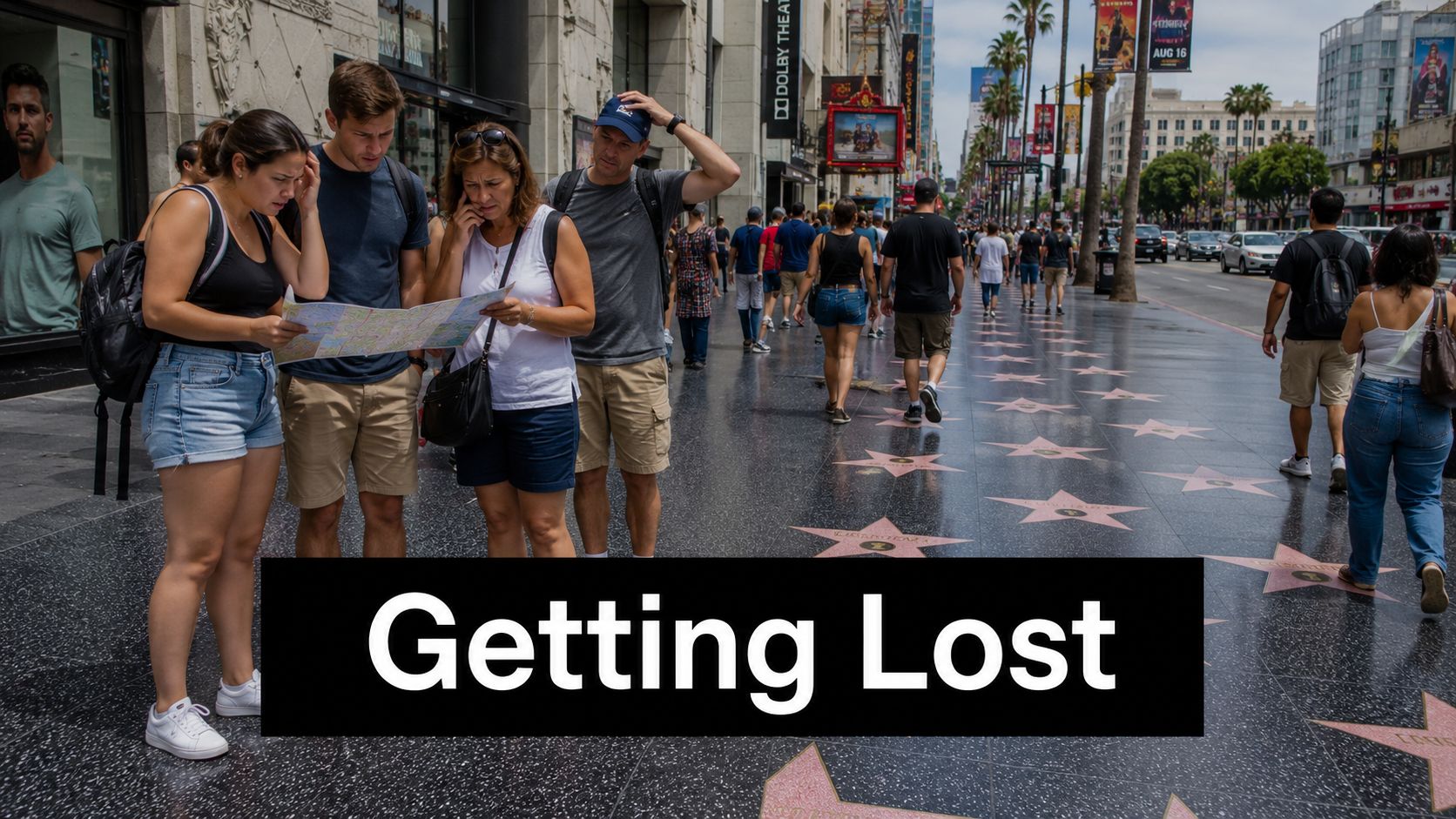
The real challenge is route design
The Walk of Fame isn't one continuous pedestrian plaza. It covers roughly 15 blocks of Hollywood Boulevard and 3 blocks of Vine Street, with official coverage from La Brea Avenue to Gower Street on Hollywood Boulevard and from Sunset Boulevard to Yucca Street on Vine Street. (Hollywood Partnership Walk of Fame guide)
That two-corridor layout changes how you should plan. Alphabetical celebrity lists are poor walking plans. A thoughtful route groups stars by street segment, places the busiest landmarks at sensible points in the outing, and avoids sending you back over the same blocks.
Practical rule: Search for your must-see stars first, then arrange them geographically. Never plan the Walk of Fame in alphabetical order.
A private guide earns its place. A local knows which stars can be combined with the Chinese Theatre, Dolby Theatre, Hollywood & Vine, or a comfortable café stop. A family with children may need a shorter loop, while a corporate group may prefer a polished Hollywood visit combined with Beverly Hills or Santa Monica rather than an unstructured sidewalk search.
The Three Types of Hollywood Star Maps Explained
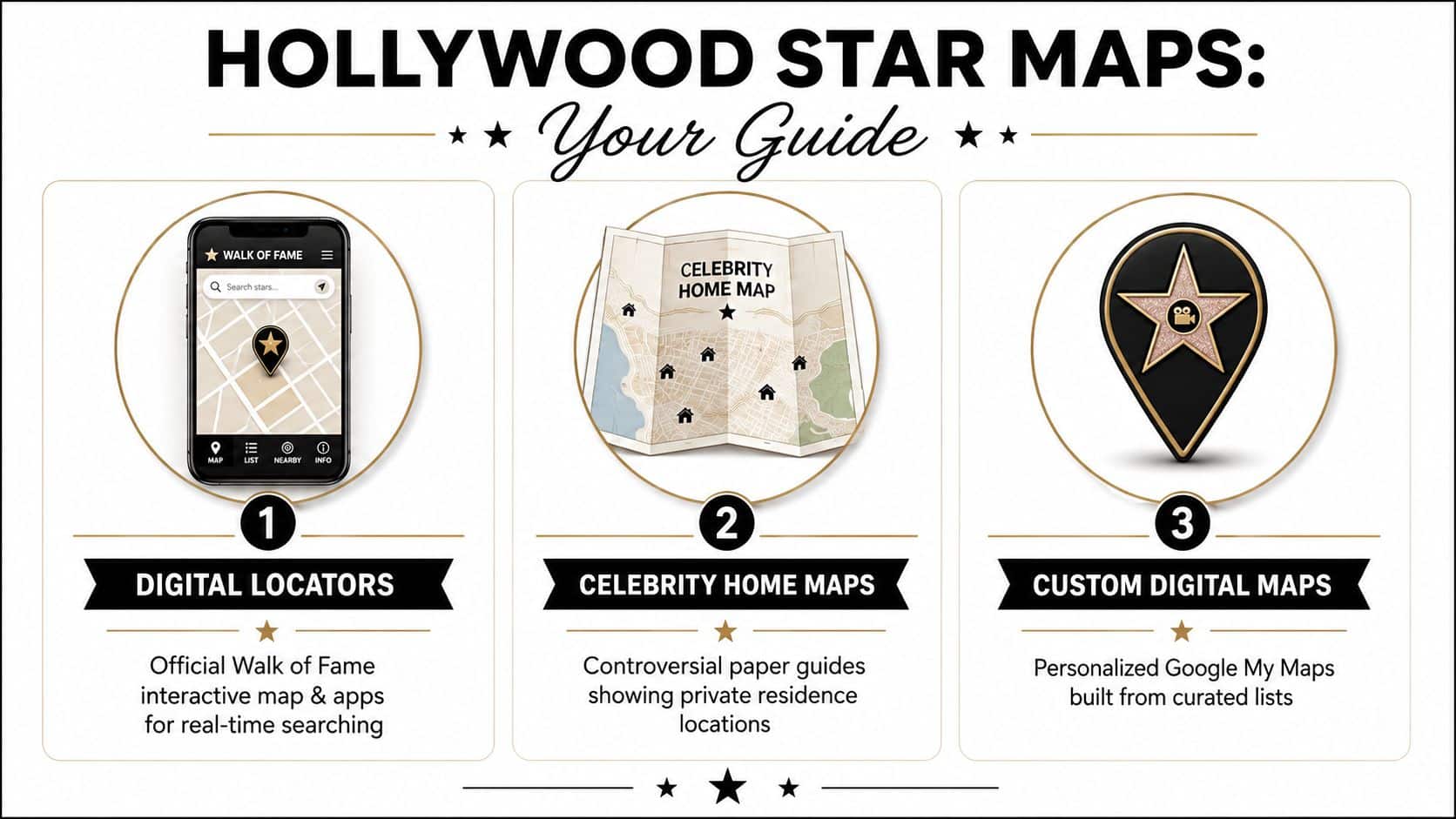
When visitors search map Hollywood stars, they usually find three map products, each built for a different travel goal. Choose the format before downloading an app or buying a paper guide, then shape it around your route rather than collecting scattered pins.
Digital Walk of Fame locators
The official interactive directory is the strongest starting point for a particular performer, musician, recording artist, television personality, or other honoree. It provides star-level details, including address and category, so you can create a focused search list. (Official Walk of Fame map and directory)
Its limitation is logistical. A locator answers “Where is this star?” but rarely answers “What should I see next?” Third-party apps can add GPS directions or filters, yet verify each location against the official directory before leaving. For an efficient outing, group your targets by nearby blocks and follow one corridor before crossing to another.
Celebrity home maps
Paper celebrity-home maps remain associated with Hollywood and Beverly Hills. They suit visitors interested in celebrity history, but they can blur public landmarks with private residences. Details may be dated or difficult to verify, and the format rarely explains how to view homes respectfully. Use one for historical context, not as the backbone of a walking itinerary.
Studio and filming-location maps
Filming-location maps serve movie enthusiasts seeking studios, theaters, production sites, and recognizable Los Angeles streets. They may feature Warner Bros., Paramount, historic cinemas, and public locations seen on screen. These maps are less useful for photographing a specific Walk of Fame star, but they work well for couples, content creators, and film-focused visitors.
Free digital locators suit independent travelers with flexible schedules. A paid custom map or private experience makes more sense when a family needs a child-friendly route, a couple wants a relaxed cinematic day, or a corporate group needs transportation and timing handled professionally. The right map should reduce backtracking across Hollywood Boulevard, not just display more celebrity names.
Navigating the Walk of Fame Block by Block
A star hunt becomes inefficient quickly if you treat Hollywood as one compact attraction. Hollywood Boulevard stretches from Gower Street to La Brea Avenue, while Vine Street runs from Sunset Boulevard to Yucca Street. Use the official Walk of Fame general FAQs to confirm details before setting out, then plan by corridor rather than by celebrity.
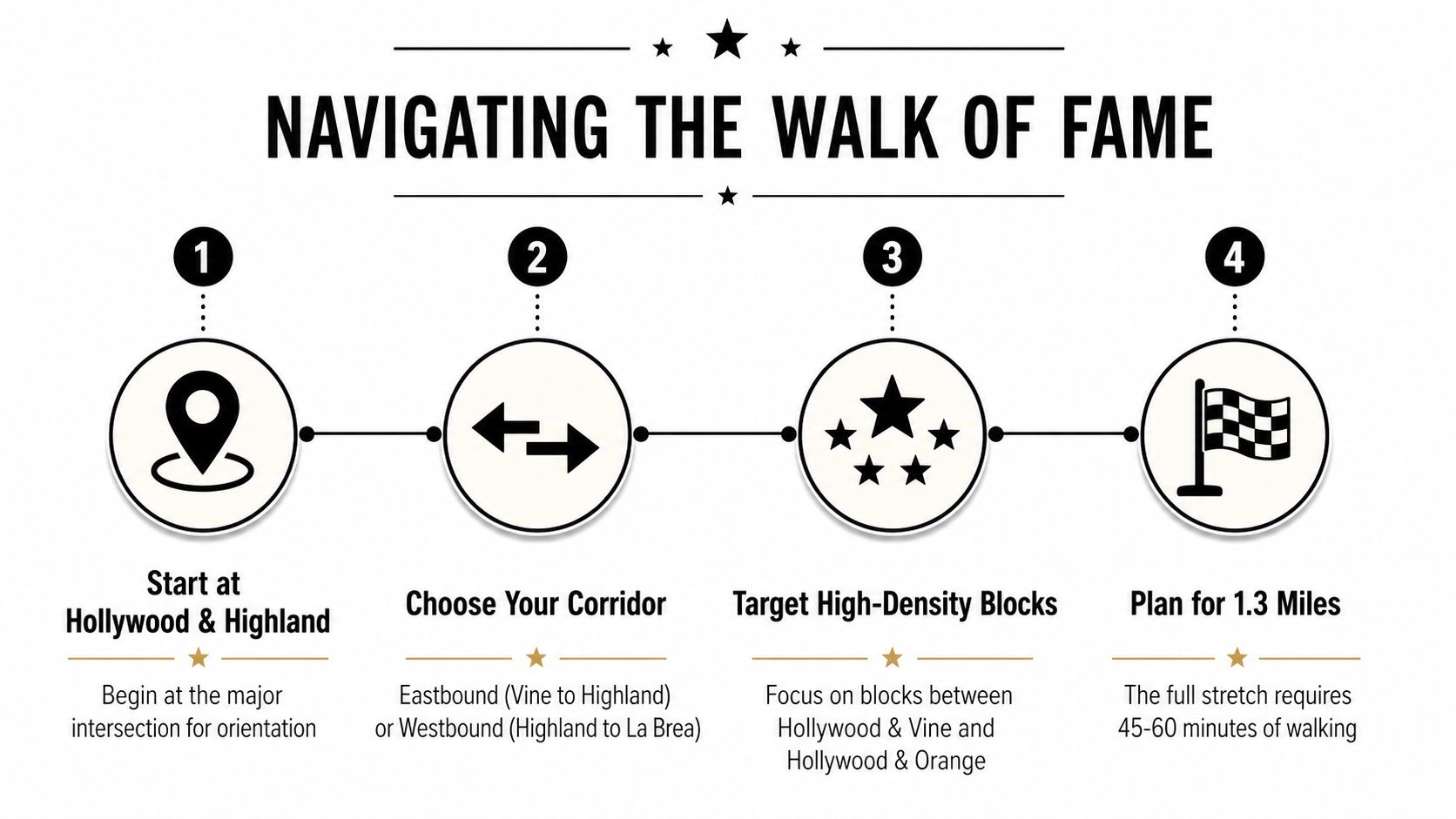
Hollywood & Vine is the clearest orientation point. The TCL Chinese Theatre and Dolby Theatre area gives you another reliable anchor. Together, these landmarks divide the outing into manageable sections and reduce the temptation to zigzag between scattered pins.
Build the route around corridors
Choose Hollywood Boulevard, Vine Street, or a planned combination before you leave. The Walk covers 1.3 miles on Hollywood Boulevard and 0.4 miles on Vine Street, so an efficient itinerary follows one corridor first and crosses only when the next group of stars justifies it. (Hollywood Walk of Fame map and list)
Use this field plan:
- Choose an anchor: Start near Hollywood & Highland, the Chinese Theatre, Dolby Theatre, or Hollywood & Vine.
- Group nearby stars: Arrange names in street order, not celebrity order.
- Mark checkpoints: Use the Chinese Theatre, Dolby Theatre, and Hollywood & Vine to keep families and groups oriented.
- Allow for pauses: Photos, performers, shops, and crosswalks all add time.
The blocks around Hollywood/Vine and the major theaters feel concentrated because visitor attractions sit close together. Quieter stretches suit visitors seeking a particular category or fewer distractions, but they demand careful, pin-by-pin planning. If your group has limited time, start with the anchor that places the highest-priority stars closest together.
Make the walk more comfortable
Keep the sun behind you when practical, and follow your phone's live location instead of a static screenshot. Check the route before leaving, especially for guests with mobility concerns. Favor established sidewalks, controlled crossings, and entrances with clear access. Crowds, events, and fatigue can change the day's pace, which is one reason a private guide can adjust the sequence on the spot.
For historical context beyond star names, explore this historic Hollywood Blvd wall art, a visual reminder of how much the boulevard has changed. Pair the Walk with practical recommendations for what to see near the Hollywood Walk of Fame when building the rest of your itinerary.
Watch the route in action before you go:
Creating Your Own Custom Hollywood Star Map
A custom Google My Map is the most useful DIY option for travelers who already know whose stars they want to find. It turns an open-ended attraction into a personal itinerary, particularly for families searching for Disney-related names, superhero performers, favorite musicians, or classic film figures.
Start with the official directory
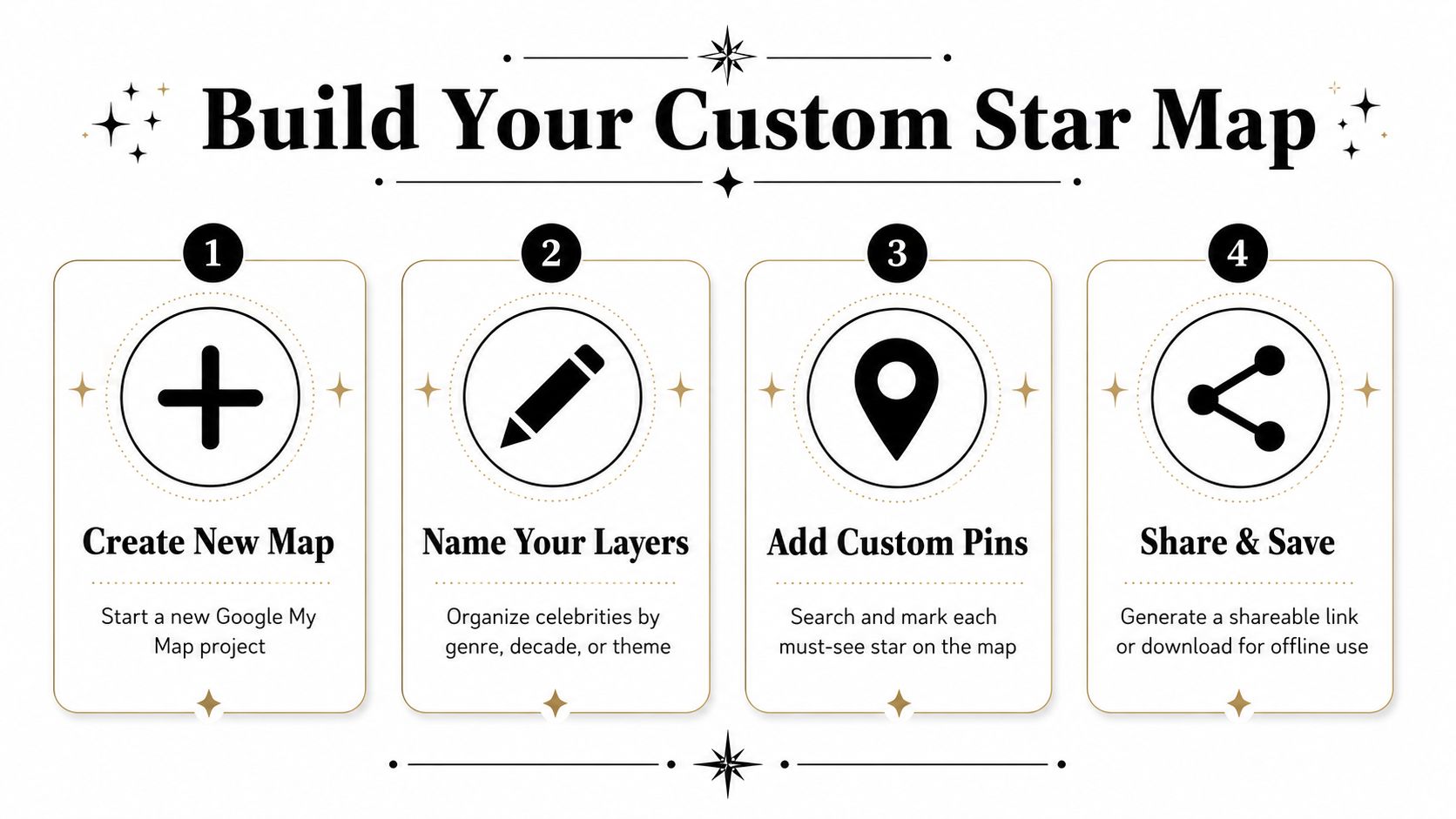
Open the official Walk of Fame directory and search each must-see name. Record the displayed address and category, then create a new Google My Maps project with a clear title such as “Hollywood Family Star Walk” or “Classic Film Afternoon.”
Create layers that reflect how you'll use the map.
- Classic Hollywood: Group golden-age actors and historic entertainers together.
- Modern musicians: Separate singers, recording artists, and bands if music is the focus.
- Favorite directors: Add directors, producers, or writers for a film-history route.
- Practical stops: Include parking garages, coffee shops, restrooms, and a planned lunch location.
The practical layer matters more than many visitors expect. A star map that ignores comfort stops may look impressive on a screen but become frustrating on the sidewalk, especially for children, older travelers, or guests with mobility concerns.
Add pins, then remove the clutter
Place a custom pin for each confirmed star and use colors or icons to distinguish categories. Don't add every interesting name you find. Mark the stars your group wants to photograph, then arrange them in a walking sequence that minimizes backtracking.
Share the map with travel companions through its link so everyone can see the same route. Save a usable version before leaving the hotel, because a group shouldn't depend on one person's phone battery or cellular connection.
Concierge advice: Give each traveler one role. Let one person navigate, another watch the children, and another handle photos. The walk feels far more relaxed when nobody is doing everything.
A custom map is still a planning tool, not a substitute for local judgment. It won't tell you which blocks feel crowded at a particular moment, how long a photo stop will take, or when your group should abandon a detour for a comfortable ride.
Sample Walking Routes for Every Schedule
The best itinerary groups stars by proximity and purpose. It doesn't chase every possible name, and it never sends you east, west, and back again because a list was arranged alphabetically.
| Route Name | Duration | Distance | Stars Covered | Key Highlights |
|---|---|---|---|---|
| Hollywood Core Highlights | 60 minutes | Core blocks near Hollywood/Vine and the theater district | Selected must-see stars in the central cluster | Hollywood & Vine, TCL Chinese Theatre, Dolby Theatre |
| Boulevard and Theatre Loop | 2 hours | Central Hollywood Boulevard with a longer east-west walk | A broader custom selection from your official directory | Photo stops, theater exteriors, Hollywood Boulevard landmarks |
| Deep-Dive Hollywood Day | 3 hours | Extended corridor route with side-street options | Large themed list, selected for your interests | Historic theaters, side streets, meal break, slower exploration |
The 60-minute highlights route
Start at Hollywood & Vine and walk toward the theater district, finishing around the TCL Chinese Theatre or Dolby Theatre. Choose a compact list of priority stars in advance, and treat every additional name as optional. This route works well for families, travelers connecting Hollywood with Griffith Observatory, and visitors who want photographs without committing to a long sidewalk session.
The 2-hour boulevard route
Begin near Hollywood & Highland, move through the Chinese Theatre and Dolby Theatre area, then continue toward Hollywood & Vine. Use the official addresses to select stars that sit along the same east-west path. Build in photo pauses at the theater district and a short refreshment break rather than adding a distant star that forces a reversal.
The 3-hour deep dive
Start at Hollywood & Vine, work west through the central boulevard, and include selected side streets or historic theater exteriors where appropriate. Finish with lunch in Hollywood or connect by vehicle to Beverly Hills, Santa Monica, or Griffith Observatory. This is the right format for film enthusiasts and content creators who want atmosphere, architecture, and stories alongside star photographs.
For paper-map users, print the official directory results and mark your route with a pen. Keep the list in walking order, not alphabetical order, and write the starting landmark at the top so the group can recover quickly after a detour.
When to DIY and When to Book a Private Tour
DIY navigation works well for a solo traveler who wants one specific musician, a couple comfortable with spontaneous detours, or a repeat visitor who already understands Hollywood's layout. A custom map gives you control, and it lets you skip anything that doesn't interest you.
A private tour is the better decision when your priority is time efficiency and comfort. Families don't have to manage every crossing and restroom question alone. First-time visitors can combine Hollywood with Beverly Hills, Santa Monica, Venice, or Griffith Observatory without trying to coordinate separate routes. Corporate groups can keep everyone moving together instead of scattering around a busy sidewalk.
A professional guide also provides the context a pin can't deliver. They can explain why a landmark matters, adjust the itinerary around crowd conditions, handle parking and transportation, and replace a less comfortable walking segment with a scenic drive. That's particularly valuable in Los Angeles, where neighborhoods and major attractions are spread apart.
Another Side Of Los Angeles Tours offers private and small-group experiences covering Hollywood, Beverly Hills, Santa Monica, and Venice, with climate-controlled transportation, custom itineraries, and options that combine the Walk of Fame with celebrity landmarks and other city highlights. Details are available through its private Los Angeles tour guide service.
The choice comes down to your priorities. Choose DIY for independence and a narrow interest. Choose a private experience when your group values a calm pace, reliable logistics, and a day that connects several iconic Los Angeles neighborhoods without wasted travel.
The Ethics of Celebrity Home Maps and Modern Alternatives
Celebrity residences are private homes, not attractions. Sharing or following home addresses raises privacy and safety concerns, while listings can be outdated or impossible to verify. A responsible itinerary stays with places celebrities have chosen to make public.
Build your route around the Walk of Fame, public filming locations, award-show venues, celebrity-owned businesses, and recognizable districts such as Beverly Hills and West Hollywood. These stops let visitors enjoy restaurants, gyms, shopping streets, and architectural landmarks without turning a private residence into a sightseeing target.
The rule is straightforward: look for public-facing celebrity history, not hidden residential access. For respectful context, pair guidance on seeing celebrity homes in Los Angeles with a public-landmark itinerary. A local guide can explain boundaries that a static map cannot, while arranging the route around walking time, traffic, and your group's pace.
Another Side Of Los Angeles Tours can build a private day around the Walk of Fame, Beverly Hills, Santa Monica, Venice, Griffith Observatory, or other signature stops. Another Side Of Los Angeles Tours offers climate-controlled transportation and itineraries customized to your interests and schedule.