Driving through Beverly Hills or the Hollywood Hills, it’s hard not to wonder who lives behind those massive gates and manicured hedges. If you’ve been searching for how to see celebrity homes in LA, you’re far from alone, it’s one of the most popular things visitors want to do here. The good news: there are several solid ways to make it happen, from guided tours to self-guided driving routes.
But not every option gives you the same experience. Some tours pack you onto a crowded bus with a megaphone narrator. Others hand you a printed map and wish you luck. At Another Side Tours, we’ve spent years showing visitors Los Angeles through private and semi-private guided experiences, celebrity homes included, with local guides who actually know the stories behind the addresses.
This guide breaks down your options: professional tours, driving routes, neighborhood tips, and the practical details that’ll help you plan a celebrity home visit that’s actually worth your time. Whether you book a tour or go solo, you’ll know exactly what to expect before you go.
What to expect when you look for celebrity homes
Before you figure out how to see celebrity homes in LA, you need an honest picture of what you’re actually getting into. Los Angeles has been home to movie stars, musicians, and entertainment executives for over a century, and the neighborhoods people talk about are real. But the experience of visiting them looks different from what most first-timers picture, and knowing that upfront saves you a lot of frustration.
The reality: gates, hedges, and public streets
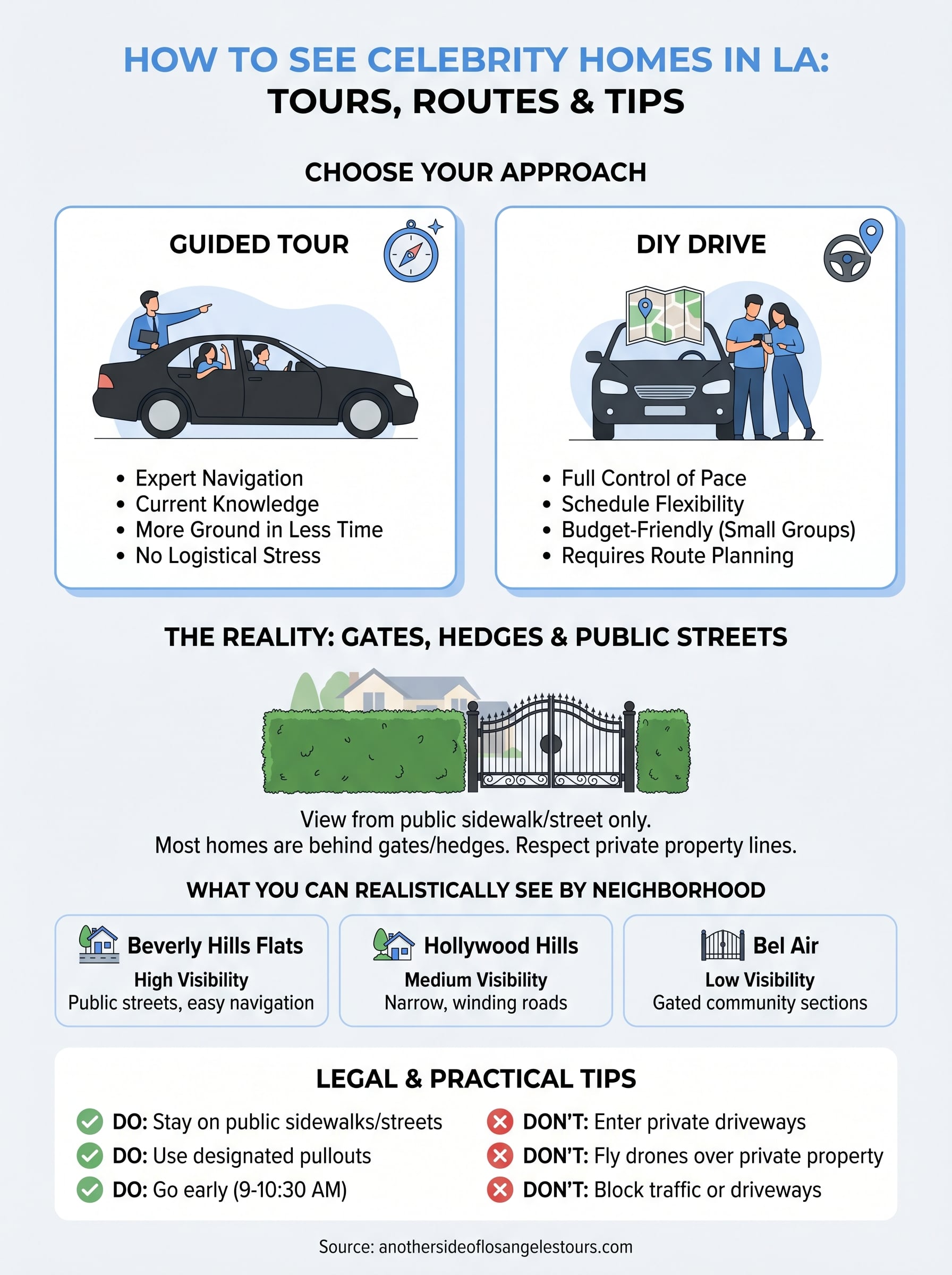
Most celebrity homes sit on private property behind gates, walls, or tall hedges. You will not walk up to a front door or step past a property line. What you will do is drive or walk along a public street or sidewalk and view exteriors, driveways, and architectural details from that vantage point. For many visitors, this is still genuinely exciting, especially when a knowledgeable guide explains the history behind a specific address or the celebrity currently living there.
The public street in front of any home is fair game, but everything behind the property line is private, and that boundary matters both legally and practically.
Some homes are clearly visible from the curb, with impressive facades or distinctive landscaping you can photograph without trouble. Others sit far back on large lots or are completely blocked by mature trees and fencing. You will not always know which situation applies until you arrive, which is one reason a local guide with current knowledge saves you from driving to a blank wall or a dead end with no view at all.
What you can realistically see
Your actual experience of visiting celebrity home neighborhoods depends on the area, the time of day, and how you get there. In parts of Beverly Hills, homes along streets like North Roxbury Drive or Elm Drive sit close enough to the road that you get a clear look at the architecture. In the Hollywood Hills, roads like Mulholland Drive offer wide views and glimpses of hillside estates, though many of those properties are tucked down private lanes with no street-level sightline.
Here is a quick breakdown of what to expect by neighborhood:
| Neighborhood | Typical visibility | Street access |
|---|---|---|
| Beverly Hills flats | High, homes close to street | Public streets, straightforward to navigate |
| Hollywood Hills | Medium, varies by property | Narrow, winding roads |
| Bel Air | Low, heavy gates and hedges | Gated community sections |
| Malibu Colony | Low from main road | Limited public beach access |
| Studio City / Sherman Oaks | Medium | Residential streets, easier parking |
Who actually lives there now
Celebrity residency changes constantly. Someone whose home appears on a popular map may have sold the property two years ago. This is one of the biggest disappointments people run into when they rely on outdated printed maps or crowd-sourced lists sold near the Walk of Fame. A guide who actively tracks LA real estate and entertainment can tell you which addresses are still accurate and which ones have already turned over to a new owner.
Real estate turnover in Beverly Hills and the Hollywood Hills moves fast, and stars relocate, downsize, or buy second homes without any public announcement. Treating the visit as a neighborhood exploration with celebrity context, rather than a guaranteed star-spotting event, puts you in the right mindset. You will come away with real stories and a feel for the neighborhoods that no satellite map can give you, regardless of whether a celebrity steps outside while you’re there.
Choose your approach: guided tour vs DIY route
When you’re figuring out how to see celebrity homes in LA, the first real decision is whether you book a guided tour or plan a self-directed driving route. Both options work, but they suit different travelers, different budgets, and different comfort levels with navigating unfamiliar streets. Understanding what each one actually delivers helps you make the right call before you spend any time or money.
What a guided tour gives you
A professional guided tour removes every layer of guesswork from the experience. Your guide handles navigation, knows which streets give you the best sightlines, and brings current knowledge about who lives where. Instead of splitting your attention between Google Maps and the windshield, you can focus entirely on what you’re seeing and hearing. Tours like the ones offered through Another Side Tours use private or semi-private vehicles, so you’re not crammed onto a bus with dozens of strangers listening to a pre-recorded script.
A guide who actively follows LA real estate gives you accurate current addresses, not a list of homes that sold three years ago and changed hands twice since.
Guided tours also cover more ground in less time because the route is already optimized. You skip the wrong turns, the dead ends on narrow hillside roads, and the frustrating search for parking on residential streets with strict permit restrictions.
What the DIY route gives you
A self-guided drive gives you full control over pace and schedule. You stop where you want, linger at addresses that interest you, and move on quickly from the ones that don’t. If you’re traveling with a small group or family, splitting a rental car and following a solid pre-planned route makes this a genuinely affordable option.
The trade-off is that you manage all the logistics yourself. That means:
- Verifying that your address list is current before you go
- Planning a route that avoids backtracking on winding hillside roads
- Knowing which streets have parking and which don’t
- Accepting that some spots will have no view from the public street
How to decide which option fits your trip
Match your situation to the right approach using this quick breakdown:
| Your situation | Best approach |
|---|---|
| First visit to LA with limited time | Guided tour |
| You want current, story-rich context | Guided tour |
| Solo or couple traveling on a tight budget | DIY drive |
| Full schedule flexibility matters most | DIY drive |
| Unfamiliar with LA’s road layout | Guided tour |
| Confident navigating new cities independently | DIY drive |
Choose a guided tour if you want an efficient, information-rich experience with no logistical stress. Choose the DIY route if flexibility and budget control matter more than having an expert on board.
Build a self-guided Beverly Hills drive
Beverly Hills is the most practical neighborhood to tackle on a self-guided drive because the streets are flat, well-signed, and laid out in a manageable grid. If you’re working out how to see celebrity homes in LA without booking a tour, Beverly Hills gives you clearer sightlines and easier navigation than any other celebrity neighborhood in the city. Start here before attempting the winding roads of the Hollywood Hills.
Plan your route before you leave the hotel
Walking out without a route plan wastes time and burns fuel on residential streets where U-turns are awkward. Before you leave, open Google Maps and drop pins on each address you want to visit, then use the multi-stop routing feature to build a logical sequence. Organize your stops moving south to north through the Beverly Hills flats to avoid doubling back across the same blocks.
Here is a reliable starting sequence to build your route around:
- North Roxbury Drive (between Sunset and Santa Monica): Homes sit close to the street, architecture is easy to photograph, and past residents include Lucille Ball and Jimmy Stewart
- Elm Drive: Quieter than Roxbury with similar sightlines
- North Maple Drive: Tree-lined and residential with a mix of classic and modern estates
- Linden Drive: Frank Sinatra once lived on this block
- Sunset Boulevard between Beverly Hills and Bel Air: Shows you the larger estates on the north side of the city
The south-to-north approach through the flats keeps your route tight and cuts driving time between stops by at least 20 minutes compared to zigzagging across the grid.
Streets that give you the best views
The Beverly Hills flats, the area south of Sunset Boulevard, consistently deliver better curb-to-facade sightlines than anywhere else in the city. Homes in this section were built closer to the street than properties in the hills, so you get actual architectural detail rather than a roofline glimpse above a hedge.
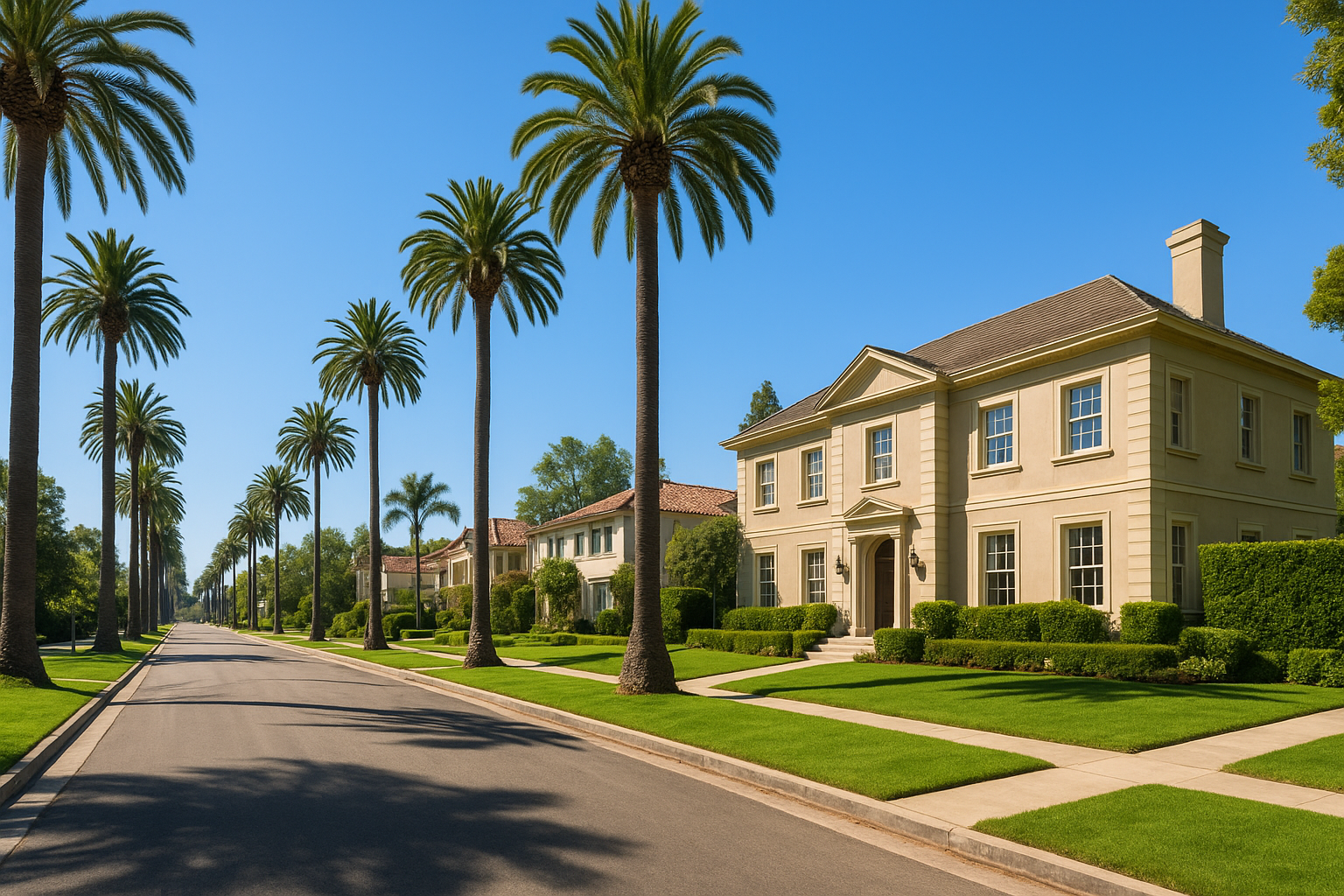
North Roxbury Drive is the single most rewarding street for this purpose. Several homes along this block have been owned by multiple generations of entertainment figures, and the properties are dense enough that you cover significant historical ground in under ten minutes of slow driving.
Practical details: parking, timing, and pace
Beverly Hills enforces residential permit parking on many blocks, so read signs carefully before you stop. Most areas allow non-permit vehicles for 30 to 60 minutes, which gives you enough time to step out, take photos, and move on without a ticket.
Starting your drive between 9:00 a.m. and 10:30 a.m. on a weekday works best. Traffic is lighter, morning light is better for photography, and residential streets feel noticeably less congested than they do during afternoon hours.
Drive the Hollywood Hills and Mulholland viewpoints
The Hollywood Hills offer a completely different experience from Beverly Hills, and if you’re researching how to see celebrity homes in LA, this area deserves its own dedicated plan. The roads here are narrow, winding, and often shared with cyclists and delivery trucks, so arriving without a clear route costs you time and patience. Done right, though, the Hollywood Hills give you some of the most dramatic scenery in the city along with glimpses of hillside estates that you simply cannot see from the flat streets below.
Know the roads before you go
The Hollywood Hills road network is not a grid. Streets like Laurel Canyon Boulevard and Coldwater Canyon Avenue cut north to south through the hills and serve as your main arteries. Smaller residential roads branch off these routes and often dead-end at private driveways or gated turnabouts. Before you leave, map your specific stops in sequence and confirm each one connects back to a main road without requiring a complicated reversal on a one-lane street.
Plan your Hollywood Hills route as a one-directional loop rather than a back-and-forth path, because three-point turns on steep narrow roads with blind corners are genuinely hazardous.
Mulholland Drive runs east to west along the crest of the Santa Monica Mountains and connects the Hollywood Hills to the west side of the city. Several pullouts along Mulholland give you wide valley views and glimpses of large hillside properties that are otherwise invisible from street level.
The best stops along Mulholland Drive
Use this sequence of stops to build a practical Mulholland route from east to west:
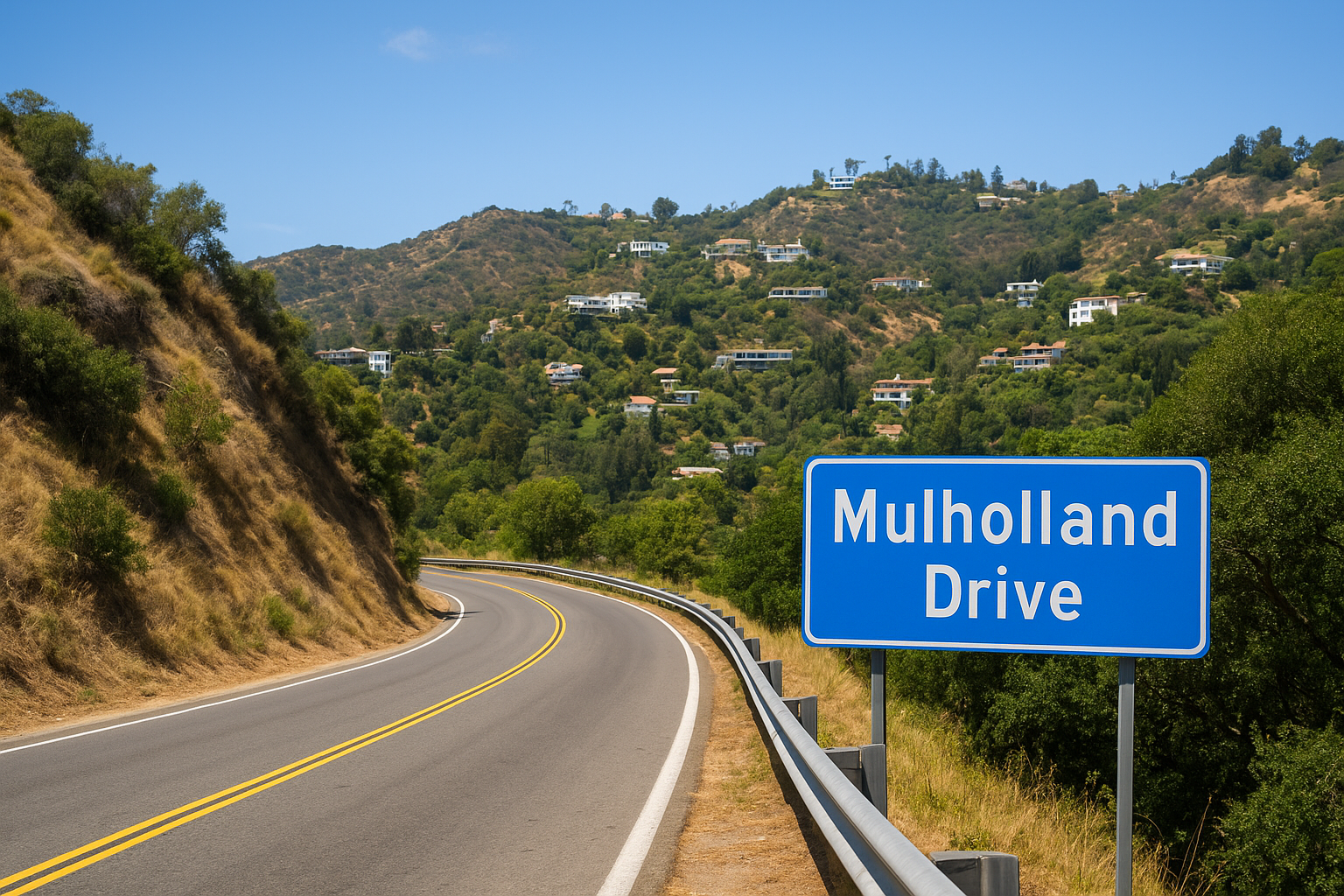
- Mulholland Drive at Cahuenga Pass: Entry point from Highway 101, easy to reach from Hollywood
- The Bowl Overlook: A small turnout near the Hollywood Bowl with views across the canyon
- Mulholland and Woodrow Wilson Drive intersection: This stretch has some of the most photographed hillside homes in the area
- Nancy Sinatra’s former stretch near the western section: Large properties set back from the road with visible rooflines and terraced grounds
- Mulholland Scenic Overlook at Laurel Canyon: One of the widest viewpoints on the entire drive
Tips for navigating narrow hillside streets
Pull completely off the road at any designated scenic overlook or turnout rather than stopping in the travel lane. Residential streets in the hills have no shoulders and limited sight distances, so even a brief stop in the road creates a hazard. Keep your phone mounted on a dash holder before you leave the flat streets, so you’re not holding it while managing steep grades and sharp curves.
Parking on hillside streets often requires curbing your wheels (turning tires toward the curb on downhill sections) or you risk a citation from the Los Angeles Department of Transportation, which enforces this actively in hillside neighborhoods.
Add places you can visit without crossing privacy lines
When you’re planning how to see celebrity homes in LA, it’s worth building your itinerary around destinations that deliver genuine access, not just a drive-by view from 50 feet away. Several publicly accessible locations sit within or directly adjacent to the most famous celebrity neighborhoods, and visiting them adds context, history, and photos that actually show you inside the experience rather than just outside a gate.
Public parks and viewpoints inside celebrity neighborhoods
Greystone Mansion and Park in Beverly Hills is one of the most overlooked stops on any celebrity home tour. The 18-acre estate grounds are open to the public daily and free to enter, and the 1928 Doheny family mansion itself has appeared in dozens of major films. You walk the formal gardens, view the exterior of the mansion, and photograph the estate from multiple angles without any restriction. The address is 905 Loma Vista Drive, Beverly Hills.
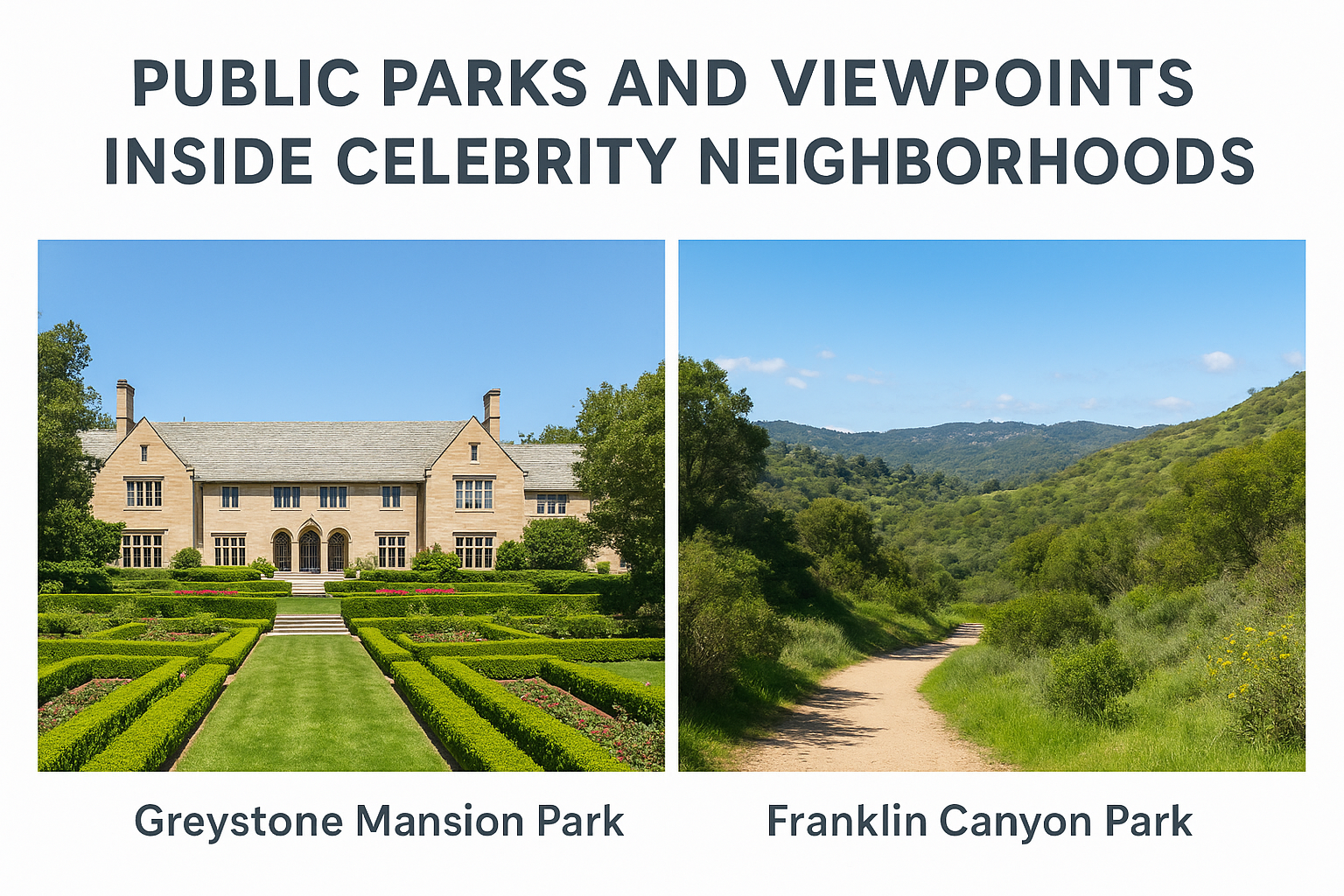
Franklin Canyon Park sits just above Beverly Hills and offers hiking trails with partial views across the hill estates below. The park is managed by the Santa Monica Mountains National Recreation Area and open every day. Arriving early in the morning gives you the best light and the quietest trails before the midday crowd arrives.
These parks sit inside the same zip codes as some of LA’s most expensive real estate, which means the scenery around you while you walk is the same scenery visible from those hillside homes.
Museums and landmark buildings with direct celebrity history
The Hollywood Museum at 1660 N. Highland Avenue sits inside the original Max Factor building and contains costumes, scripts, and personal items from over a century of entertainment history. This is a ticketed attraction with several floors of exhibits, and it puts you physically inside a building where major stars spent significant time during Hollywood’s golden era.
The Dolby Theatre, home of the Academy Awards, offers tours of the venue including the backstage areas, the Governor’s Ball ballroom, and the stage where celebrities stand during the ceremony. Tours run most days and last approximately 30 minutes, with advance tickets available directly through the venue.
Use this short checklist when adding public stops to your itinerary:
- Greystone Mansion Park: free, open daily, 905 Loma Vista Drive, Beverly Hills
- Franklin Canyon Park: free, open daily, hiking access above Beverly Hills
- Hollywood Museum: ticketed, 1660 N. Highland Avenue, Hollywood
- Dolby Theatre tour: ticketed, advance booking recommended, Hollywood Boulevard
- The Walk of Fame: free, open at all hours, Hollywood Boulevard
Each of these spots delivers real access rather than a curbside view, and combining them with your driving route builds a fuller day without crossing any property lines.
Follow etiquette, laws, and safety basics
Understanding the legal and behavioral boundaries is a core part of figuring out how to see celebrity homes in LA the right way. You are visiting active residential neighborhoods, not tourist attractions, and the people living there include families and private individuals alongside the celebrities you are looking for. Treating the area with basic respect keeps the experience legal, safe, and sustainable for every visitor who comes after you.
Know what the law actually allows
California law gives you the right to stand on any public sidewalk or street and view or photograph what is visible from that position. You cannot enter private property, peer through fences or gates, or use equipment to look over walls into a private yard. Drone photography over private property is a direct violation of California privacy law and can carry significant legal penalties, so leave any drone equipment at your hotel regardless of how tempting the aerial shot might look.
The moment you step off a public sidewalk onto a driveway or path that leads to a private residence, you have crossed from legal observation into trespass, regardless of whether a gate is open.
Here is a quick reference for what is and is not permitted on public streets:
| Action | Legal status |
|---|---|
| Photographing a home from a public sidewalk | Legal |
| Walking past a home on a public street | Legal |
| Entering a driveway or private path | Not legal |
| Flying a drone over a private home | Not legal |
| Peering through or over a fence | Not legal |
| Blocking a driveway with your vehicle | Not legal |
Behavior that gets you noticed for the wrong reasons
Several behaviors draw immediate attention from private security and local police in Beverly Hills and the Hollywood Hills, even when you are technically within the law. Parking directly in front of one home for an extended period, pointing cameras at windows, or following a vehicle in and out of a gated entrance all raise red flags. Beverly Hills PD actively patrols the residential streets and responds quickly to calls from residents reporting suspicious activity around their properties.
Keep your group small and quiet, move at a normal pace, and avoid gathering in one spot for more than a few minutes at a time. Loud commentary, extended photo sessions blocking the sidewalk, and approaching other visitors with unsolicited address information all make the neighborhood less welcoming for everyone.
Stay safe on residential streets
Narrow hillside streets in the Hollywood Hills present genuine physical hazards that have nothing to do with celebrity access. Poor sight lines, steep grades, and fast-moving local traffic make walking along the road without a sidewalk genuinely dangerous. Stick to designated pullouts and overlooks when you exit your vehicle, and never stand in a travel lane to take a photograph, regardless of how brief the stop seems.
Make the day smooth: timing, traffic, parking, photos
Planning when and how you move through LA makes a significant difference in how much you actually enjoy the day. If you’re figuring out how to see celebrity homes in LA, the logistics surrounding the actual sightseeing, including timing, traffic, parking, and photography, matter as much as the route itself. Getting these details right means less time frustrated behind the wheel and more time focused on what you came to see.
Time your departure to beat LA traffic
Leaving your hotel between 8:30 a.m. and 9:30 a.m. gives you the best window before midday congestion builds on Sunset Boulevard and the streets feeding into Beverly Hills. On weekends, that window extends slightly later, around 10:00 a.m., because residential streets see less early commuter traffic. Build your route to move from south to north, Beverly Hills flats first, then up into the Hollywood Hills, so you finish the hillside driving while afternoon light is still favorable for photography.
Reversing this order and starting in the hills means you arrive at the flats during peak afternoon traffic, when parking enforcement is also most active.
Park without the stress
Beverly Hills residential streets use a permit system that allows non-resident vehicles for 30 to 60 minutes on most blocks. Hollywood Hills streets are stricter; many have no legal parking at all outside of marked pullouts. Use this checklist before stepping out of your vehicle:
- Read every posted sign on the block, not just the nearest one
- Curb your wheels on any hillside street (tires turned toward the curb on downhill sections) to avoid a citation
- Set a phone timer for 25 minutes so you move before the time limit expires
- Keep a credit card accessible for metered spots near Sunset or Santa Monica Boulevard
Get photos that are actually worth keeping
The best natural light for exterior architecture photography falls in the two hours after sunrise and the hour before sunset. Morning light is more practical because it aligns with lower traffic. Position yourself on the opposite side of the street from the home you are photographing to capture the full facade rather than a compressed angle. Use the ultra-wide setting on your smartphone or a wide-angle lens to include more of the property without stepping back into the travel lane.
Shoot in both portrait and landscape orientations at each stop so you have options for sharing and printing later. Skip the flash entirely outdoors, it adds nothing in daylight and draws unnecessary attention on a quiet residential street.
Wrap it up and pick your best option
Now you have a complete picture of how to see celebrity homes in LA, from building your own Beverly Hills driving route to following Mulholland Drive west with a solid sequence of stops. The approach that fits your trip comes down to one question: do you want full control over your schedule, or do you want current knowledge, a planned route, and a guide who handles everything so you can focus on what you’re seeing?
If you prefer the guided option, the difference between a crowded bus tour and a private experience with a local expert is significant. You get accurate addresses, real stories behind the properties, and none of the logistical friction that comes with navigating unfamiliar hillside roads on your own. That is exactly what Another Side Tours delivers. Browse the private Los Angeles tour options and find the experience that matches your group size, schedule, and interests.